

This computer science problem involves algorithmic thinking and programming concepts. The solution below explains the approach, logic, and implementation step by step.
ScanSolve AI Answer
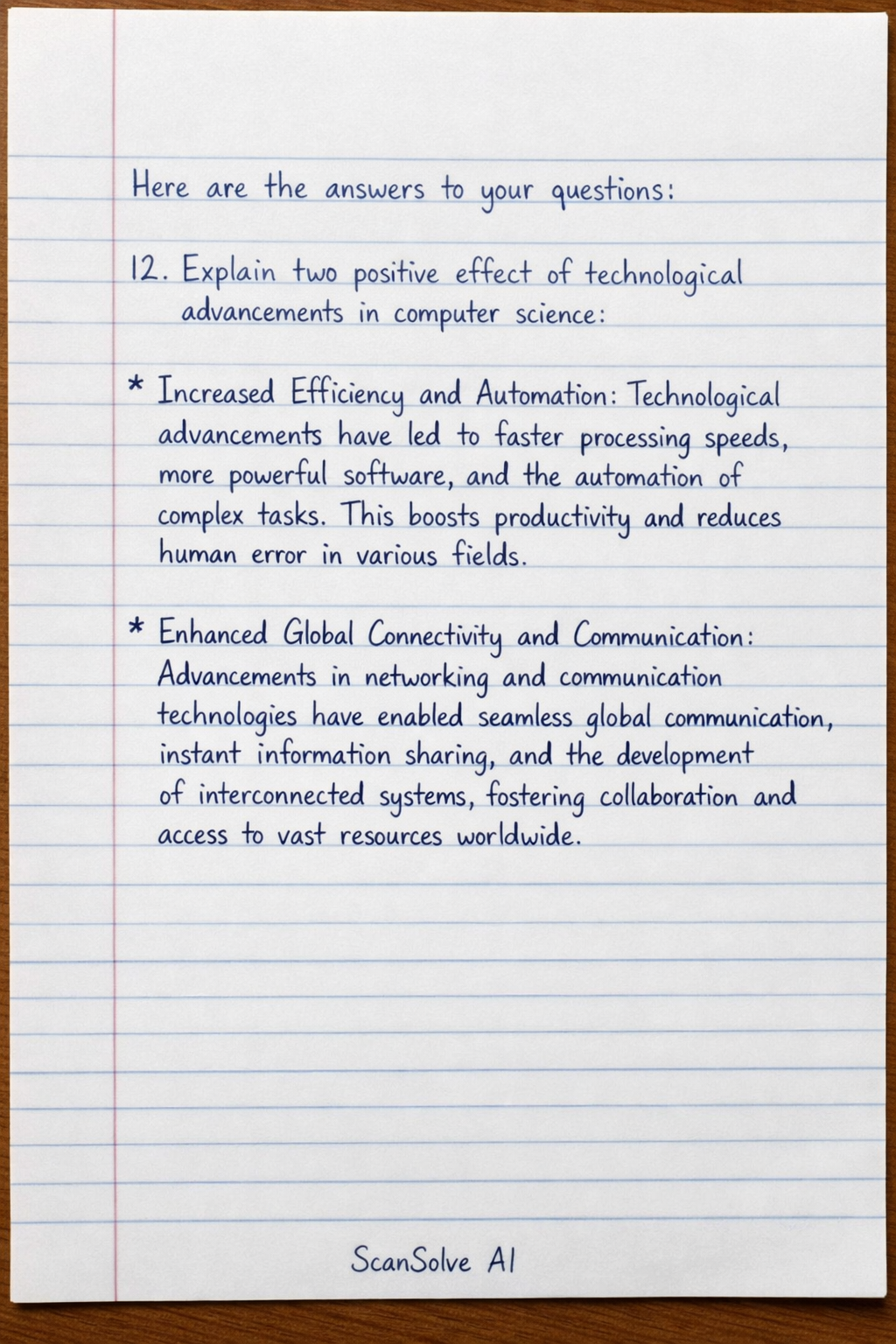
Here are the answers to your questions: 12. Explain two positive effect of technological advancements in computer science. Increased Efficiency and Automation*: Technological advancements have led to faster processing speeds, more powerful software, and the automation of complex tasks. This boosts productivity and reduces human error in various fields. Enhanced Global Connectivity and Communication*: Advancements in networking and communication technologies have enabled seamless global communication, instant information sharing, and the development of interconnected systems, fostering collaboration and access to vast resources worldwide. 13. Identify three computer buses and their functions. Data Bus*: Carries data between the processor, memory, and input/output devices. It is bidirectional. Address Bus*: Carries memory addresses from the processor to other components to specify the location of data to be read from or written to. It is unidirectional. Control Bus*: Carries control signals from the processor to other components to manage and synchronize operations, such as read/write signals, clock signals, and interrupt requests. It is bidirectional. 14. Define the following terms as used in computer. i) Resolution*: The number of distinct pixels (picture elements) that can be displayed on a screen or captured by a digital camera, typically expressed as width × height (e.g., 1920 × 1080). Higher resolution means a sharper and more detailed image. ii) Aspect ratio*: The proportional relationship between the width and height of an image or screen. It is commonly expressed as two numbers separated by a colon, such as 16:9 for widescreen displays or 4:3 for older standard displays. 15. State four factors to consider when buying a printer. Print Quality*: Consider the dots per inch (DPI) for text and image clarity. Print Speed*: Measured in pages per minute (PPM), important for high-volume printing. Cost of Consumables*: Evaluate the price and yield of ink cartridges or toner. Connectivity Options*: Check for USB, Wi-Fi, Ethernet, or mobile printing capabilities. Type of Printer*: Decide between inkjet (good for photos) or laser (good for text, faster). Duplex Printing*: Ability to print on both sides of the paper automatically. 16. Use of biometric devices are frequently used by most organisation. State two application areas where this device is used. Access Control and Security*: Biometric devices are used for secure entry into buildings, restricted areas, or computer systems, replacing traditional keys or passwords with fingerprint, facial, or iris recognition. Mobile Device Unlocking*: Smartphones and tablets commonly use fingerprint scanners or facial recognition to unlock devices and authorize payments, providing a convenient and secure method of authentication.