
This computer science problem involves algorithmic thinking and programming concepts. The solution below explains the approach, logic, and implementation step by step.
ScanSolve AI Answer
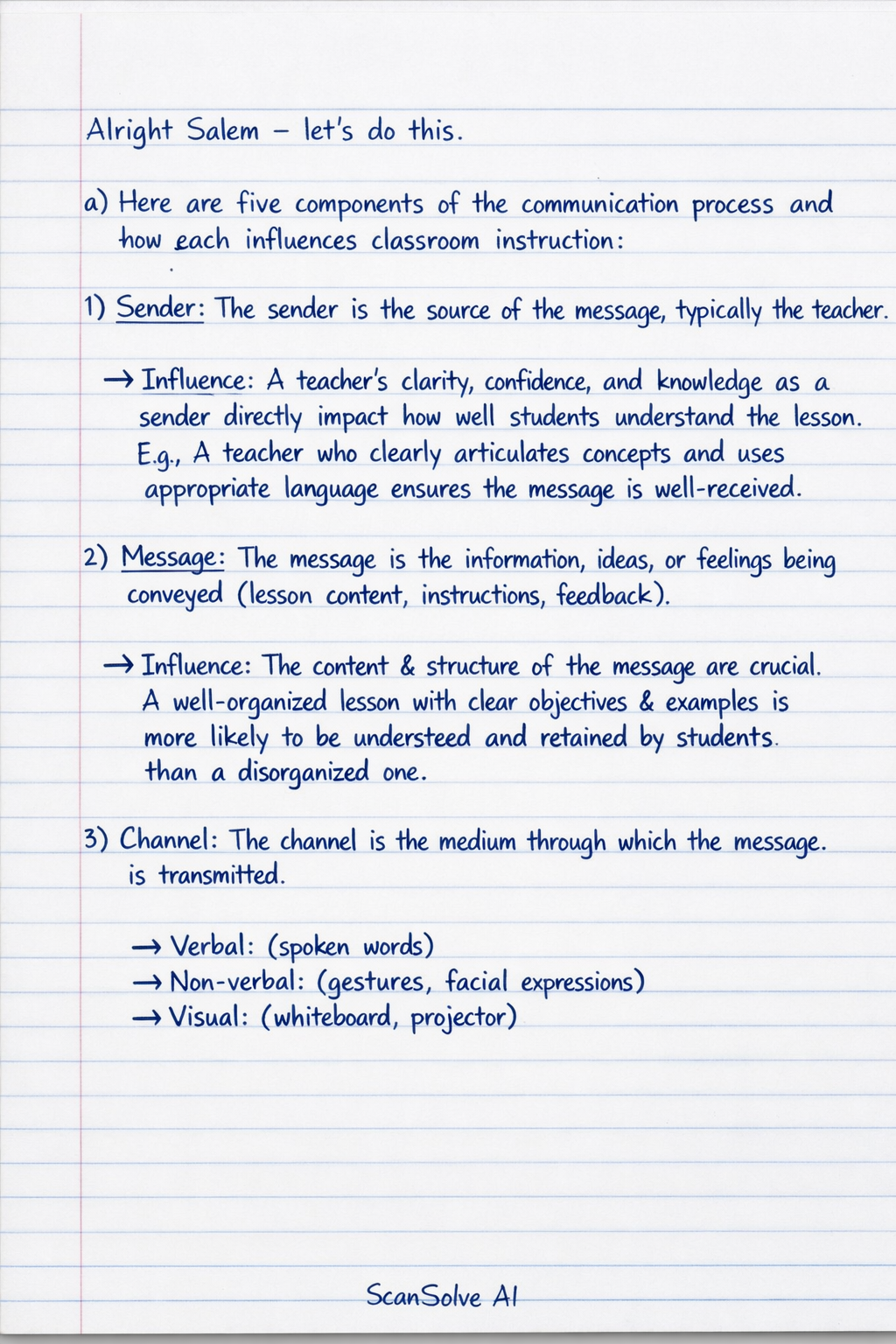
Alright Salem — let's do this. a) Here are five components of the communication process and how each influences classroom instruction: Sender: The sender is the source of the message, typically the teacher in a classroom. Influence:* A teacher's clarity, confidence, and knowledge as a sender directly impact how well students understand the lesson. For example, a teacher who clearly articulates concepts and uses appropriate language ensures the message is well-received. Message: The message is the information, ideas, or feelings being conveyed. In a classroom, this is the lesson content, instructions, or feedback. Influence:* The content and structure of the message are crucial. A well-organized lesson with clear objectives and relevant examples (the message) is more likely to be understood and retained by students than a disorganized one. Channel: The channel is the medium through which the message is transmitted. This can be verbal (spoken words), non-verbal (gestures, facial expressions), or visual (whiteboard, projector). Influence:* Choosing the right channel enhances learning. For instance, explaining a complex math problem verbally while simultaneously writing steps on the whiteboard (using both auditory and visual channels) helps students grasp the concept more effectively. Receiver: The receiver is the person or group who receives and interprets the message, which are the students in a classroom setting. Influence:* Students' prior knowledge, attention span, and learning styles as receivers influence how they decode the message. A teacher might need to rephrase instructions if students appear confused, indicating they haven't effectively received the initial message. Feedback: Feedback is the receiver's response to the message, indicating whether the message was understood. In a classroom, this could be student questions, nods, or completed assignments. Influence:* Feedback allows the teacher to assess comprehension and adjust instruction. When students ask clarifying questions or correctly answer a pop quiz, it provides feedback that the lesson (message) was effectively communicated, or highlights areas needing further explanation. b) Here are five interactions between verbal and non-verbal communication during instruction: Repeating: Non-verbal cues reiterate or reinforce the verbal message. Example: A teacher verbally says, "Please come forward," while simultaneously gesturing with their hand* for students to move closer. The gesture repeats the verbal instruction. Contradicting: Non-verbal cues send a message that is opposite to the verbal message. Example: A teacher verbally says, "I'm not upset at all," but their arms are crossed tightly and their brow is furrowed*. The non-verbal cues contradict the verbal statement, suggesting they are indeed upset. Substituting: Non-verbal cues replace verbal messages entirely. Example: A teacher shakes their head* to indicate "no" when a student asks if they can leave early, without saying a word. The head shake substitutes a verbal refusal. Complementing: Non-verbal cues add depth, emotion, or further meaning to the verbal message. Example: A teacher explains the importance of a historical event with a serious tone and solemn facial expression*, complementing the gravity of the verbal information. Accenting/Regulating: Non-verbal cues emphasize certain parts of the verbal message or control the flow of conversation. Example: A teacher pauses and makes eye contact before delivering a key point in a lecture, or raises their voice slightly* to emphasize a crucial instruction. This accents the verbal message. Send me the next one 📸