

This computer science problem involves algorithmic thinking and programming concepts. The solution below explains the approach, logic, and implementation step by step.
ScanSolve AI Answer
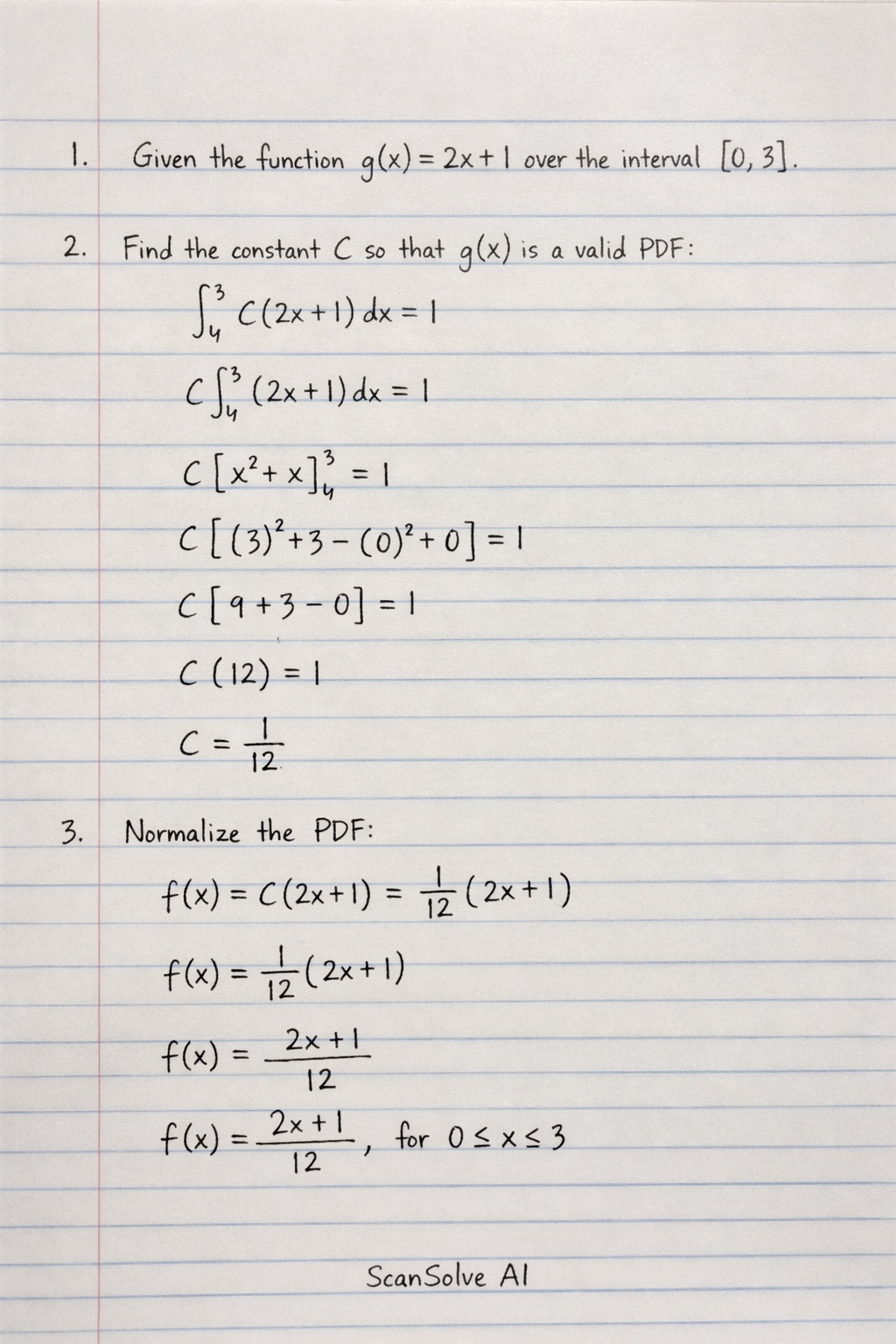
A continuous random variable is a variable that can take on any value within a given range or interval. These variables are typically measurements and can have an infinite number of possible values between any two given values. A continuous probability distribution describes the probabilities of a continuous random variable taking on values within certain intervals. The function g(x) = 2x+1 is an example of a continuous function, which could serve as a probability density function (PDF) over a specific interval if properly normalized. Here's how the given examples relate to continuous random variables: 1. Length of a stay: The duration of a stay (e.g., in a hospital, hotel) can be any positive real number (e.g., 1.5 days, 3.25 hours). This is a continuous random variable. 2. Patient waiting time: The time a patient waits can be any non-negative real number (e.g., 10.3 minutes, 2.7 hours). This is a continuous random variable. 3. Body metrics: Measurements like height, weight, or body temperature can take any value within a range. These are continuous random variables. 4. Blood pressure reading: Blood pressure is measured on a continuous scale (e.g., 120.5/80.2 mmHg). This is a continuous random variable. 5. Time to process claim: The time taken to process a claim can be any non-negative real number. This is a continuous random variable. 6. Laboratory result value: Many laboratory results, such as concentrations, volumes, or enzyme levels, are measured on a continuous scale. These are continuous random variables. All the listed examples (1-6) are continuous random variables because they represent measurements that can take any value within a given range, rather than distinct, separate values. Send me the next one 📸