

This computer science problem involves algorithmic thinking and programming concepts. The solution below explains the approach, logic, and implementation step by step.
ScanSolve AI Answer
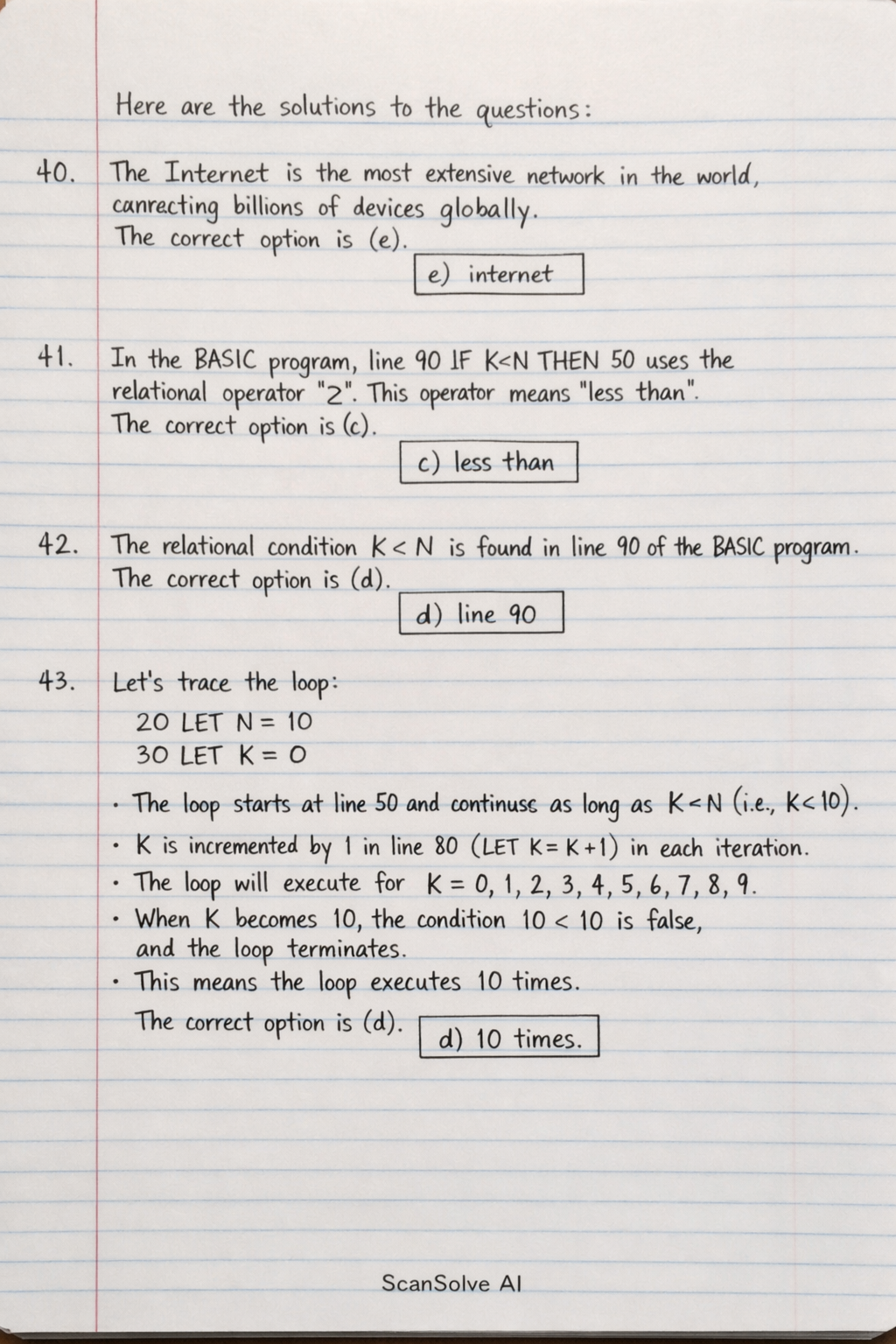
Here are the solutions to the questions: 40. The Internet is the most extensive network in the world, connecting billions of devices globally. The correct option is (e). e) internet 41. In the BASIC program, line 90 IF K<N THEN 50 uses the relational operator <. This operator means "less than". The correct option is (c). c) less than 42. The relational condition K<N is found in line 90 of the BASIC program. The correct option is (d). d) line 90 43. Let's trace the loop: 20 LET N = 10 30 LET K = 0 The loop starts at line 50 and continues as long as K < N (i.e., K < 10). K is incremented by 1 in line 80 (LET K=K+1) in each iteration. The loop will execute for K = 0, 1, 2, 3, 4, 5, 6, 7, 8, 9. When K becomes 10, the condition 10 < 10 is false, and the loop terminates. This means the loop executes 10 times. The correct option is (d). d) 10 times 44. In line 90 IF K<N THEN 50, the "THEN 50" statement means that if the condition K<N is true, the program control branches (jumps) to line 50 to continue execution from that point. The correct option is (a). a) branch to continue execution 45. The statement 60 LET A = LB means that the expression LB (L times B) is evaluated, and the resulting product is assigned to the variable A. The correct option is (a). a) evaluate the expression L times B and assign the product to the variable A 46. The statement 10 REM program computes the area of a rectangle uses the keyword REM. REM stands for REMark and indicates that the text following it on that line is a comment, which is ignored by the program interpreter/compiler. The correct option is (a). a) treat the text after the keyword REM as a comment 47. The END statement in BASIC, as seen in line 100 END, marks both the physical end of the program code and the logical termination point of the program's execution. The correct option is (a). a) physical and logical end of the program 48. The statement 50 INPUT L, B is used to prompt the user to enter numerical values for the variables L and B from the keyboard during the program's execution. The correct option is (a). a) enter a numerical value for variable L and variable B respectively from the keyboard during program execution 49. The statement 80 LET K=K+1 performs the following actions: It evaluates the expression K+1 (adds 1 to the current value of K). It then assigns this new sum back to the variable K. This effectively increases the numerical value of K by 1 and stores the updated value in K. All options (a), (b), and (c) are correct descriptions of aspects of this statement. The correct option is (e). e) a, b, and c 50. The statement 70 PRINT "AREA = "A will display the literal string "AREA = " on the screen, followed by the current numerical value stored in the variable A. The correct option is (a). a) display on the screen the string "AREA =" without the quotes and followed by the content of the numerical variable A