
We read your photo as:
A) Define a 4 X 4 Multiplexer b) Design a 4 X 4 multiplexer using MSI component
ScanSolve AI Answer
This answer stops before the end.
It was cut off when it was first written. Ask ScanSolve this question again for the full working.
Here is the solution for question 1:
Question 1:
a) Defined a 4 X 4 Multiplexer
b) Design a 4 X 4 multiplexer using MSI component
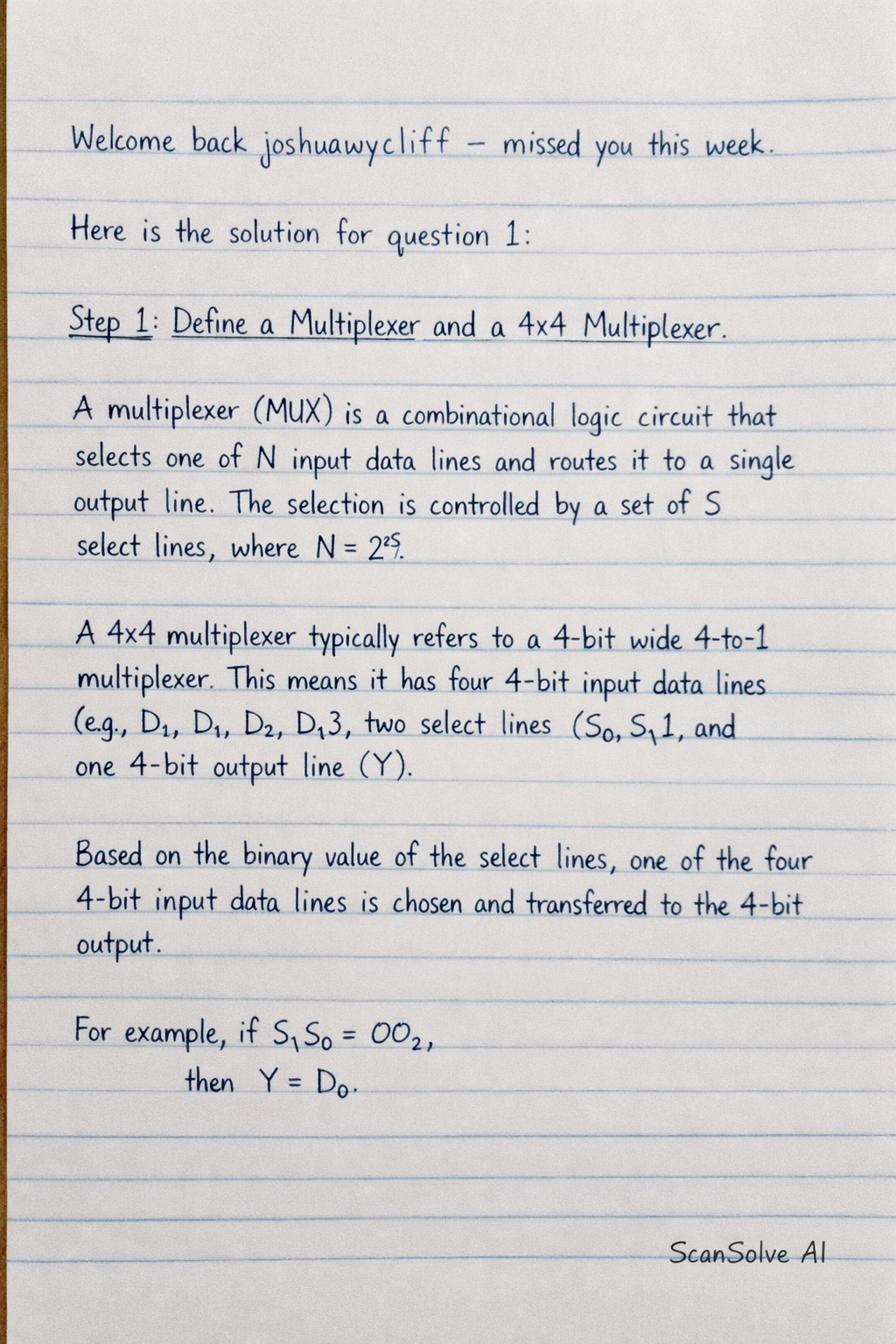
Step 1: Define a Multiplexer and a 4x4 Multiplexer.
A multiplexer (MUX) is a combinational logic circuit that selects one of input data lines and routes it to a single output line. The selection is controlled by a set of select lines, where .
A 4x4 multiplexer typically refers to a 4-bit wide 4-to-1 multiplexer. This means it has four 4-bit input data lines (e.g., ), two select lines (), and one 4-bit output line (). Based on the binary value of the select lines, one of the four 4-bit input data lines is chosen and transferred to the 4-bit output. For example, if , then .
Step 2: Design a 4x4 multiplexer using MSI components.
To design a 4-bit wide 4-to-1 multiplexer using MSI components, we can use two 74LS153 dual 4-to-1 multiplexer chips. Each 74LS153 chip contains two independent 4-to-1 multiplexers that share common select lines. We will use one 74LS153 for the lower two bits of the 4-bit data and another 74LS153 for the upper two bits.
The inputs are four 4-bit data lines: .
The select lines are .
The output is a single 4-bit data line: .
-
Chip 1 (74LS153_1): This chip handles the least significant bits (LSBs) of the 4-bit data.
- MUX A (1Y output) will select and output . Its inputs will be .
- MUX B (2Y output) will select and output . Its inputs will be .
- The select lines and are connected to the common select inputs (A and B) of this chip.
- Both enable pins (1G and 2G) are connected to ground (active low enable).
-
Chip 2 (74LS153_2): This chip handles the most significant bits (MSBs) of the 4-bit data.
- MUX A (1Y output) will select and output . Its inputs will be .
- MUX B (2Y output) will select and output . Its inputs will be .
- The select lines and are connected to the common select inputs (A and B) of this chip, in parallel with Chip 1.
- Both enable pins (1G and 2G) are connected to ground (active low enable).
The block diagram below illustrates this design:
\begin{array}{c}
Input Data Lines \\
\begin{array}{|c|}
\hline
D_0[3:0] \\
D_1[3:0] \\
D_2[3:0] \\
D_3[3:0] \\
\hline
\end{array}
\end{array}
\quad \xrightarrow{\quad} \quad
\begin{array}{|c|c|c|}
\hline
\multicolumn{3}{|c|}{4x4 Multiplexer Design} \\
\hline
Chip 1 (74LS153) & Chip 2 (74LS153) \\
\hline
\begin{array}{l}
MUX A (1Y): \\
\quad Inputs:  D_0[0], D_1[0], D_2[0], D_3[0] \\
\quad Output:  Y[0] \\
MUX B (2Y): \\
\quad Inputs:  D_0[1], D_1[1], D_2[1], D_3[1] \\
\quad Output:  Y[1] \\
Select:  S_0, S_1 \\
Enable: GND
\end{array} &
\begin{array}{l}
MUX A (1Y): \\
\quad Inputs: D_0[2], D_1Still stuck on this one?
Ask a follow-up, and the answer starts from this question.
More Computer Science Questions
Handwritten Step-by-Step Solution
Get this as a handwritten image on WhatsApp — like a tutor wrote it for you.
Try on WhatsApp