
We read your photo as:
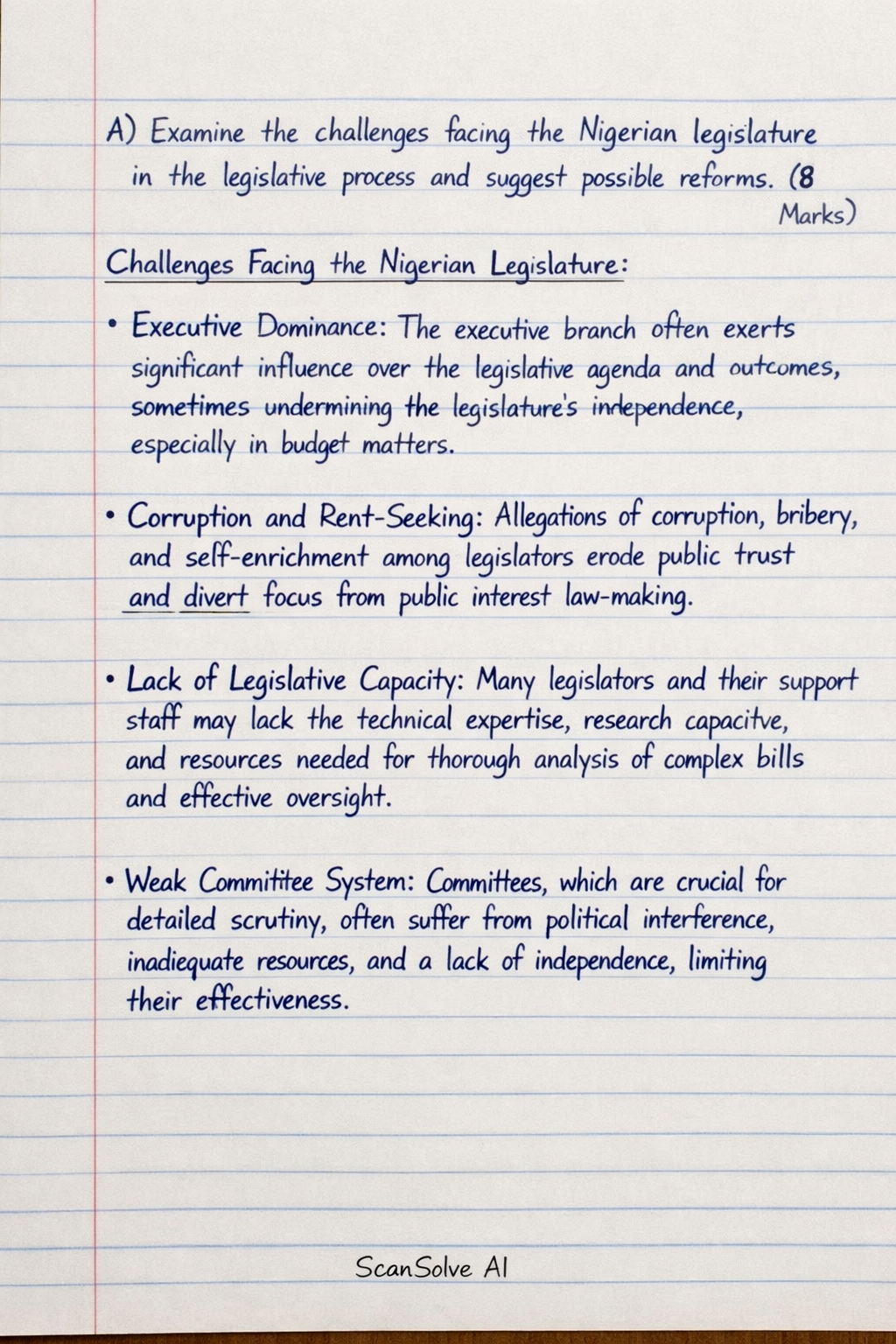
A) Examine the challenges facing the Nigerian legislature in the legislative process and suggest possible reforms. (8 Marks)
Computer Science
ScanSolve AI Answer
A) Examine the challenges facing the Nigerian legislature in the legislative process and suggest possible reforms. (8 Marks)
Challenges Facing the Nigerian Legislature:
- Executive Dominance: The executive branch often exerts significant influence over the legislative agenda and outcomes, sometimes undermining the legislature's independence, especially in budget matters.
- Corruption and Rent-Seeking: Allegations of corruption, bribery, and self-enrichment among legislators erode public trust and divert focus from public interest law-making.
- Lack of Legislative Capacity: Many legislators and their support staff may lack the technical expertise, research capacity, and resources needed for thorough analysis of complex bills and effective oversight.
- Weak Committee System: Committees, which are crucial for detailed scrutiny, often suffer from political interference, inadequate resources, and a lack of independence, limiting their effectiveness.
- Party Indiscipline: While party discipline is important, excessive adherence to party lines can stifle independent thought and debate, leading to rubber-stamping of executive proposals.
- Public Perception and Legitimacy: The legislature often faces negative public perception due to perceived inefficiency, high cost of governance, and lack of responsiveness to citizens' needs.
- Slow Legislative Process: The process of law-making can be protracted, leading to delays in addressing urgent national issues.
- Inadequate Public Participation: Limited avenues for public engagement in the legislative process mean that laws may not fully reflect the diverse needs and opinions of the populace.
Possible Reforms:
- Strengthening Legislative Capacity: Invest in training programs for legislators and staff, and enhance research and analytical support services to improve the quality of legislative output.
- Enhancing Committee Effectiveness: Grant committees greater autonomy, provide adequate funding and expert staff, and ensure their recommendations are given serious consideration.
- Promoting Transparency and Accountability: Implement stricter anti-corruption measures, ensure public access to legislative proceedings and records, and enforce asset declaration rules for legislators.
- Reducing Executive Influence: Strengthen the legislature's financial autonomy and its capacity to initiate and amend bills independently, fostering a more balanced separation of powers.
- Improving Public Engagement: Establish more robust mechanisms for public hearings, citizen petitions, and online platforms to gather public input on proposed legislation.
- Reviewing Legislative Rules: Streamline legislative procedures to enhance efficiency without compromising thoroughness, potentially by setting clear timelines for bill progression.
- Ethical Conduct and Oversight: Establish and enforce a strong code of conduct for legislators, with clear penalties for breaches, to restore public confidence.
B) Analyze the role of political parties in shaping legislative behavior and decision-making. (7 Marks)
Political parties play a fundamental and pervasive role in shaping legislative behavior and decision-making within the Nigerian National Assembly.
- Party Discipline and Cohesion: Parties enforce discipline among their members, often through a whip system, to ensure they vote along party lines on key legislation. This creates predictable voting blocs and helps the majority party pass its agenda.
- Policy Formulation and Agenda Setting: Political parties develop manifestos and policy platforms during elections. Once in power, the ruling party's agenda largely dictates which bills are introduced, prioritized, and debated in the legislature, guiding the overall legislative direction.
- Leadership Selection: Parties determine who holds critical leadership positions within the legislature, such as the Senate President, Speaker of the House, and committee chairs. These leaders significantly influence the legislative agenda, committee assignments, and the flow of legislative business.
- Resource Allocation: Parties can influence the allocation of resources, committee assignments, and even constituency projects to their loyal members, which can shape individual legislators' behavior and priorities.
- Opposition Role: Opposition parties scrutinize government policies, propose alternative solutions, and hold the ruling party accountable. Their collective voice and organized dissent can significantly influence debates, force amendments, or even block legislation.
- Consensus Building and Conflict Resolution: While parties can be a source of partisan division, they also serve as platforms for building consensus among members with diverse views, especially within the majority party, to ensure the passage of legislation.
- Recruitment and Socialization: Parties recruit candidates for legislative office and socialize them into party norms, values, and policy positions, which then influence their behavior and decision-making once elected.
Was this helpful?
Still stuck on this one?
Ask a follow-up, and the answer starts from this question.
Got a different question?Ask your own question
More Computer Science Questions
QGive out 10 challenges facing East African Legislative Assembly, suggest the possible solutions to…QDiscuss the structure and composition of the Nigerian National Assembly, highlighting the functions…QA) Discuss the oversight function of the legislature and explain how it promotes accountability in…Q50 GOVERNMENT JAMB PAST QUESTIONS AND ANSWERS 📚📝🧠💯 https://whatsapp.com/channel/0029VarOc8iCHDyu…Q2026 LEVEL 100 Exam QUESTIONS POL 102: Introduction to Political Science What do you understand by…
Handwritten Step-by-Step Solution
Get this as a handwritten image on WhatsApp — like a tutor wrote it for you.
Try on WhatsApp