
We read your photo as:
Add the two binary numbers 11102 and 1112.
ScanSolve AI Answer
Answer
Step-by-step solution
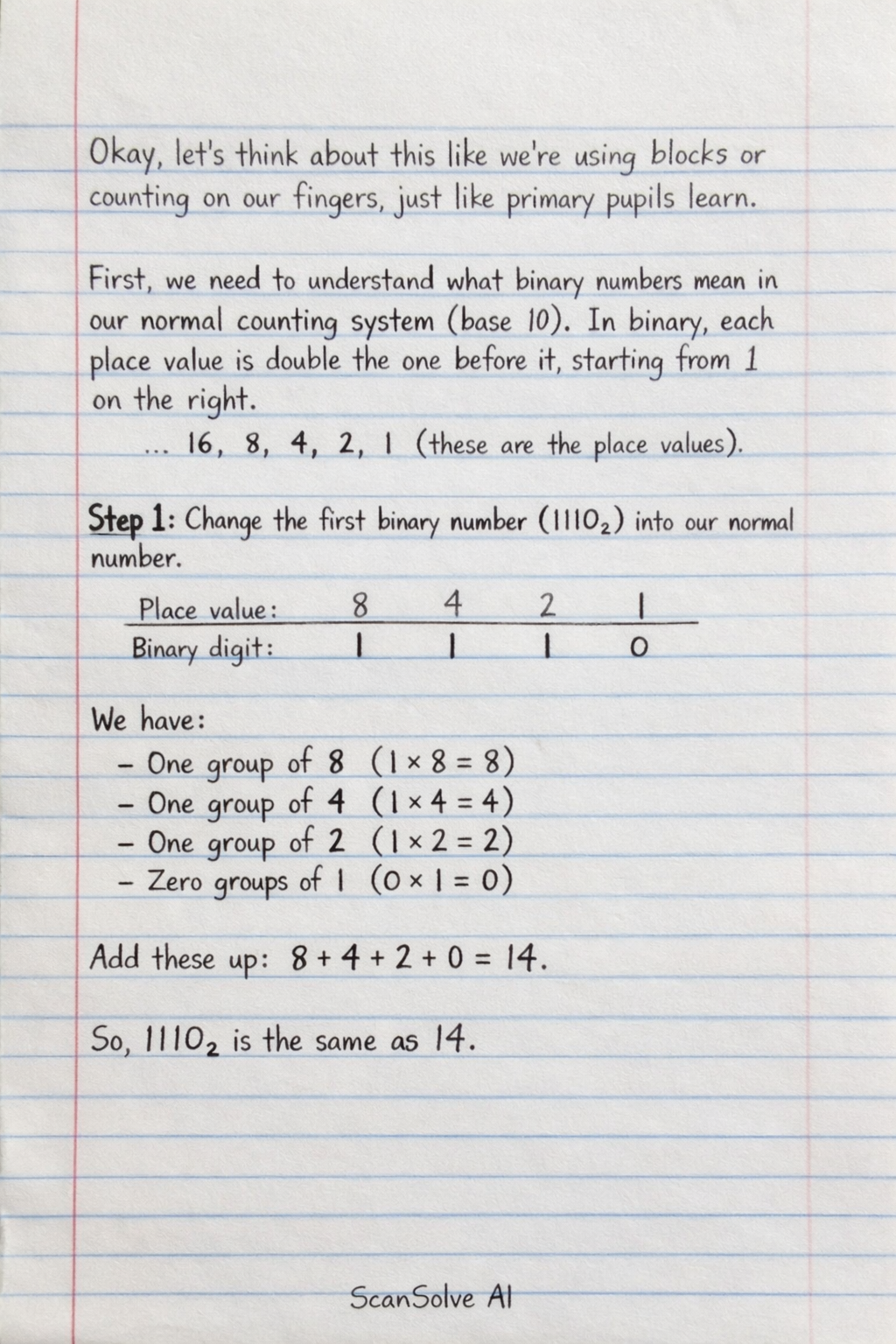
4 stepsOkay, let's think about this like we're using blocks or counting on our fingers, just like primary pupils learn.
First, we need to understand what binary numbers mean in our normal counting system (base 10). In binary, each place value is double the one before it, starting from 1 on the right.
- ... 16, 8, 4, 2, 1 (these are the place values)
Change the first binary number () into our normal number.
We have:
- One group of 8 ()
- One group of 4 ()
- One group of 2 ()
- Zero groups of 1 ()
Add these up: .
So, is the same as 14.Change the second binary number () into our normal number.
We have:
- One group of 4 ()
- One group of 2 ()
- One group of 1 ()
Add these up: .
So, is the same as 7.Add the two normal numbers together.
Now we just add .
.Change our answer (21) back into a binary number.
We need to find which binary place values add up to 21. We'll use the place values: .
-
Does 16 fit into 21? Yes. So we use one 16. left over. Binary: 1 (for the s place)
-
Does 8 fit into 5? No. So we don't use an 8. Binary: 0 (for the s place)
-
Does 4 fit into 5? Yes. So we use one 4. left over. Binary: 1 (for the s place)
-
Does 2 fit into 1? No. So we don't use a 2. Binary: 0 (for the s place)
-
Does 1 fit into 1? Yes. So we use one 1. left over. Binary: 1 (for the s place)
Putting the binary digits together from left to right (from the s place down to the s place), we get .
-
Try one yourself
A new problem that tests the same skill.
Still stuck on this one?
Ask a follow-up, and the answer starts from this question.
More Computer Science Questions
Handwritten Step-by-Step Solution
Get this as a handwritten image on WhatsApp — like a tutor wrote it for you.
Try on WhatsApp