
We read your photo as:
Can you explain the advantages of oblique projection, the challenges in creating 3D models from it and how to overcome them, and how to convert cavalier to cabinet oblique drawings?
ScanSolve AI Answer
Step-by-step solution
4 stepsHere are the answers to the questions:
43) Advantages of oblique projection compared to perspective drawing: * a. Oblique projection is simpler to draw and does not require vanishing points, making it easier for quick sketches. * b. It allows one face (usually the front) to be drawn in its true shape and size, making it easier to read dimensions directly from that face.
44) A learner is designing a 3D model from an oblique drawing: * a) Challenges faced: * i. Oblique drawings can sometimes appear distorted, especially for complex shapes, making it difficult to accurately visualize the true form of the object. * ii. It can be challenging to accurately interpret depths and angles from a single oblique view, potentially leading to errors in the 3D model. * b) How to overcome these challenges: * i. Use multiple orthographic views (front, top, side) in conjunction with the oblique drawing to gain a comprehensive understanding of the object's dimensions and features. * ii. Utilize Computer-Aided Design (CAD) software which allows for easy manipulation, rotation, and accurate dimensioning of 3D models, reducing interpretation errors.
45) Convert the given cavalier oblique drawing into a cabinet oblique drawing.
To convert a cavalier oblique drawing into a cabinet oblique drawing, the primary change is in the length of the receding lines (depth).
- In a cavalier oblique drawing, the receding lines are drawn to their true length.
- In a cabinet oblique drawing, the receding lines are drawn to half their true length (foreshortened).
Conversion Process:
Identify the front face
The front face of the object (the "L" shape with the step) remains unchanged. All dimensions on this face (width and height) are drawn to their true scale.
- The overall width is units.
- The overall height is units.
- The top step adds 10 units to the height of that section.
Identify receding lines
The depth of the object is given as 20 units. These are the lines that extend backwards from the front face, typically at an angle (e.g., ).
Foreshorten receding lines
For a cabinet oblique drawing, these receding lines must be drawn at half their true length.
- The original depth is 20 units.
- The new depth for the cabinet oblique drawing will be units.
Redraw the object
- Draw the front face exactly as it appears in the given drawing.
- From each corner of the front face that recedes into the page, draw a line at the chosen oblique angle (e.g., ).
- Measure and mark a distance of 10 units along each of these receding lines.
- Connect the ends of these foreshortened receding lines to complete the back faces of the object. Hidden lines may be omitted or shown as dashed lines.
The resulting drawing will appear less deep and less distorted than the cavalier oblique drawing, providing a more realistic visual representation of the object's depth.
Still stuck on this one?
Ask a follow-up, and the answer starts from this question.
More Computer Science Questions
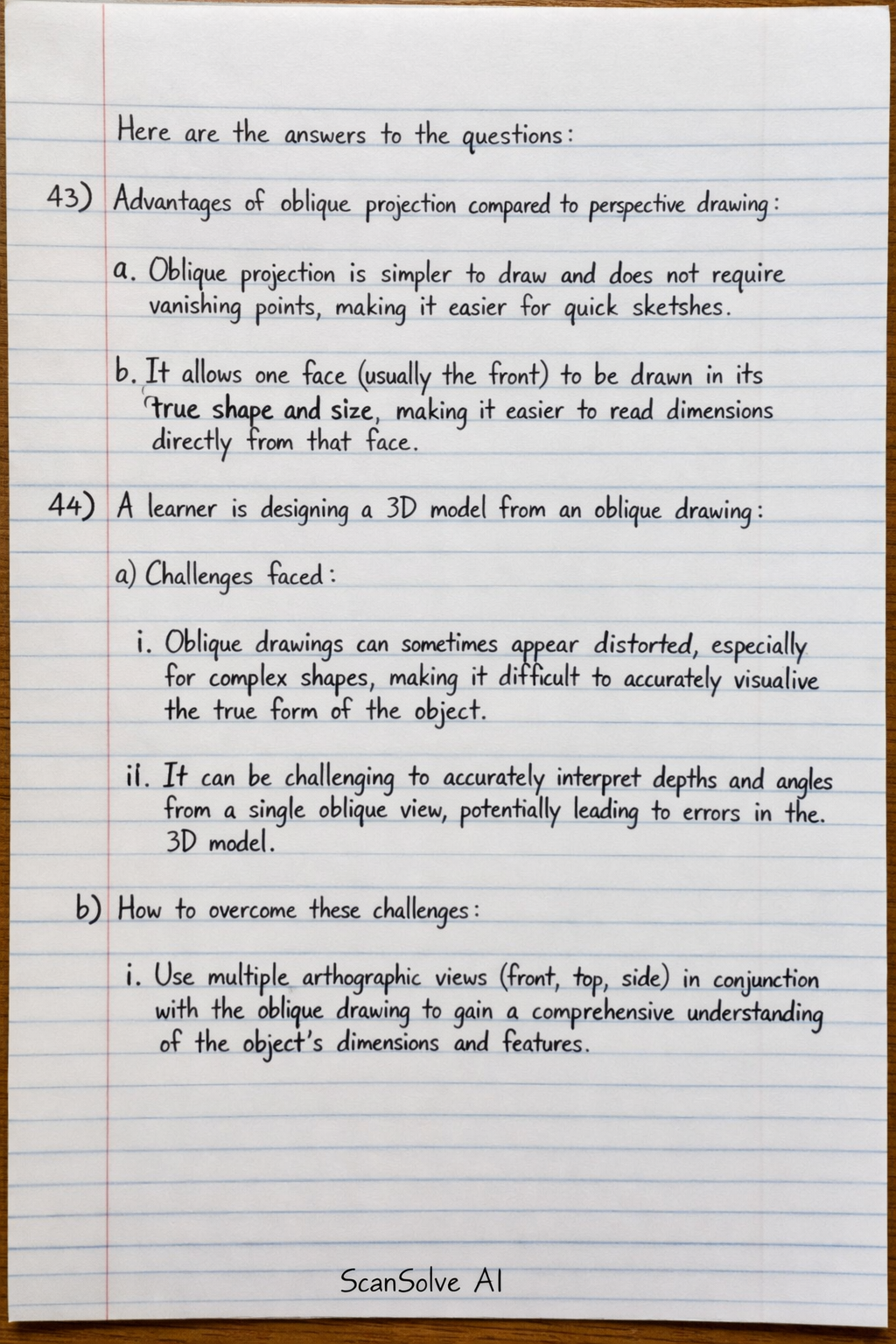
Handwritten Step-by-Step Solution
Get this as a handwritten image on WhatsApp — like a tutor wrote it for you.
Try on WhatsApp