

This computer science problem involves algorithmic thinking and programming concepts. The solution below explains the approach, logic, and implementation step by step.
ScanSolve AI Answer
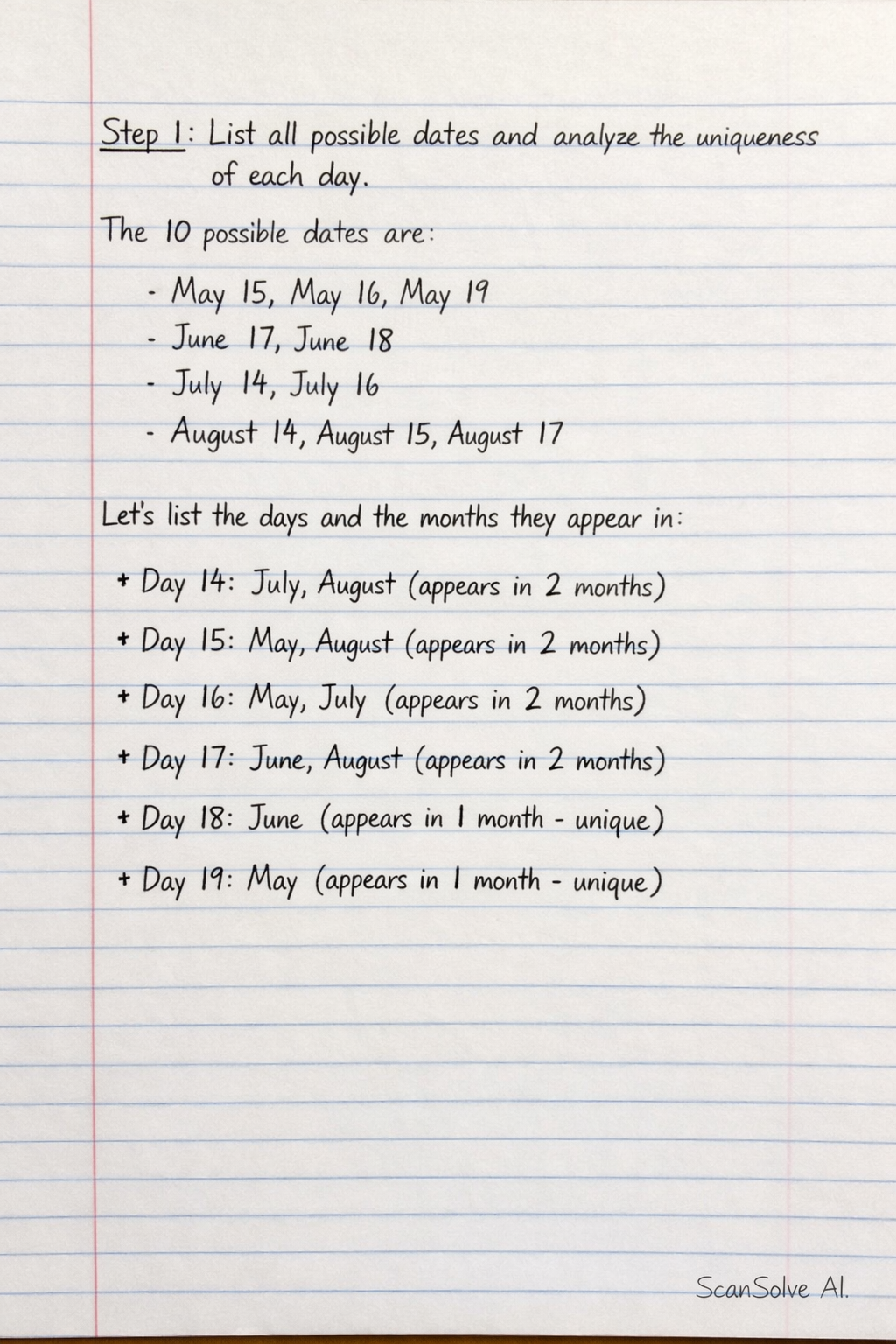
Step 1: List all possible dates and analyze the uniqueness of each day. The 10 possible dates are: May 15, May 16, May 19 June 17, June 18 July 14, July 16 August 14, August 15, August 17 Let's list the days and the months they appear in: Day 14: July, August (appears in 2 months) Day 15: May, August (appears in 2 months) Day 16: May, July (appears in 2 months) Day 17: June, August (appears in 2 months) Day 18: June (appears in 1 month - unique) Day 19: May (appears in 1 month - unique) Step 2: Analyze Albert's first statement. Albert: "I don't know when Cheryl's birthday is, but I know that Bernard doesn't know either." "I don't know when Cheryl's birthday is": This means the month Albert knows has multiple possible days, which is true for all months (May has 3, June has 2, July has 2, August has 3). "I know that Bernard doesn't know either": This is the key. If Bernard knew the birthday, it would mean the day Bernard was told is unique in the original list. For Albert to know Bernard doesn't know, it means that the actual month (which Albert knows) cannot contain any day that is unique in the original list. If it did, and that unique day was the birthday, Bernard would* know, contradicting Albert's statement. Let's check each month: May (15, 16, 19): Day 19 is unique. If the birthday was May 19, Bernard (knowing "19") would know. So, Albert cannot have May. (Eliminate May) June (17, 18): Day 18 is unique. If the birthday was June 18, Bernard (knowing "18") would know. So, Albert cannot have June. (Eliminate June) July (14, 16): Neither day 14 nor day 16 is unique (14 appears in July/August, 16 appears in May/July). If Albert has July, he can truthfully say Bernard doesn't know. (Keep July) August (14, 15, 17): None of these days (14, 15, 17) are unique. If Albert has August, he can truthfully say Bernard doesn't know. (Keep August) After Albert's first statement, the possible dates are reduced to: July 14, July 16 August 14, August 15, August 17 Step 3: Analyze Bernard's statement. Bernard: "At first I didn't know when Cheryl's birthday was, but now I know." "At first I didn't know": This is consistent, as all remaining days (14, 15, 16, 17) appeared in multiple months in the original list. "but now I know": Bernard now knows the birthday. This means that the day Bernard was told must uniquely identify the birthday from the remaining* list of dates. Let's check the days in the remaining list: If Bernard's day is 14: It could be July 14 or August 14. Bernard still wouldn't know. So, the birthday cannot be on the 14th. (Eliminate July 14, August 14) If Bernard's day is 15: The only remaining date with day 15 is August 15. Bernard would know. (Keep August 15) If Bernard's day is 16: The only remaining date with day 16 is July 16. Bernard would know. (Keep July 16) If Bernard's day is 17: The only remaining date with day 17 is August 17. Bernard would know. (Keep August 17) After Bernard's statement, the possible dates are reduced to: July 16 August 15 August 17 Step 4: Analyze Albert's second statement. Albert: "Then I know it too." Albert knows the month. He now knows the birthday from the current* list of possible dates. Let's check the months in the current list: If Albert's month is July: The only remaining date in July is July 16. Albert would know. If Albert's month is August: The remaining dates in August are August 15 and August 17. Albert would not* know. Since Albert says "Then I know it too", his month must be July. This uniquely identifies the birthday as July 16. Cheryl's birthday is July 16.