
We read your photo as:
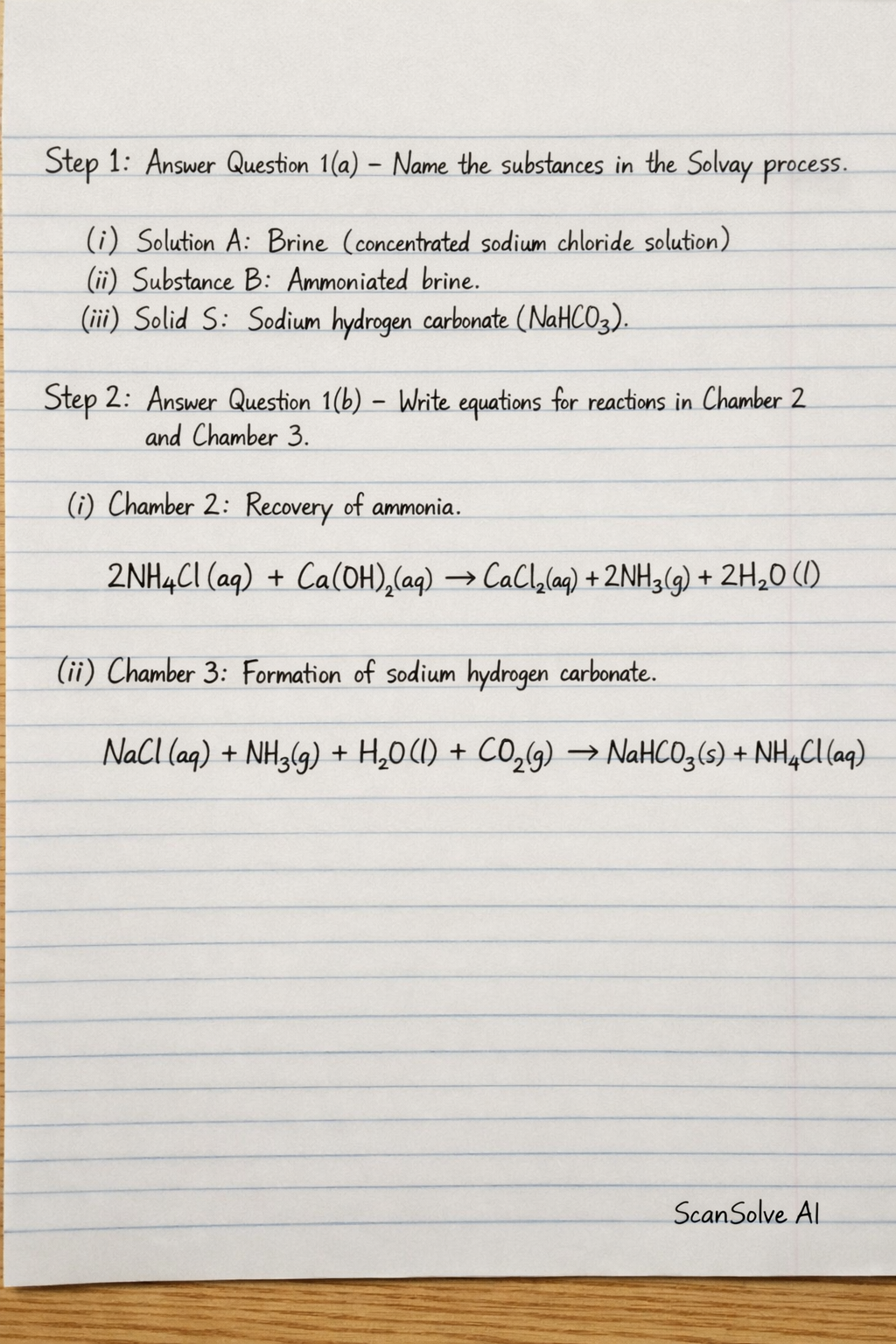
Answer Question 1(a) - Name the substances in the Solvay process.
Computer Science
ScanSolve AI Answer
Step-by-step solution
12 stepsAnswer Question 1(a) - Name the substances in the Solvay process.
- a)
- (i) Solution A: Brine (concentrated sodium chloride solution)
- (ii) Substance B: Ammoniated brine
- (iii) Solid S: Sodium hydrogen carbonate ()
- a)
Answer Question 1(b) - Write equations for reactions in Chamber 2 and Chamber 3.
- b)
- (i) Chamber 2: Recovery of ammonia.
- (ii) Chamber 3: Formation of sodium hydrogen carbonate.
- b)
Answer Question 1(c) - Identify processes (i) and (ii).
- c)
- (i) Process (I): Carbonation or Precipitation (formation of sodium hydrogen carbonate)
- (ii) Process (II): Thermal decomposition or Calcination (conversion of sodium hydrogen carbonate to sodium carbonate)
- c)
Answer Question 1(d) - Explain how carbon(IV) oxide is obtained.
- d) Carbon(IV) oxide () is obtained by the thermal decomposition of limestone () in a lime kiln: It can also be obtained by burning coke (carbon):
Answer Question 1(e) - Give two reasons for the efficiency of the Solvay process.
- e)
- Most of the raw materials, such as ammonia and carbon dioxide, are recycled within the process.
- The process produces sodium carbonate, a valuable chemical, with calcium chloride as the only major by-product, which has some industrial uses.
- e)
Answer Question 1(f) - Give two uses of sodium carbonate.
- f)
- Used in the manufacture of glass.
- Used for softening hard water.
- Used in the manufacture of detergents and soaps.
- Used in the paper industry.
- f)
Answer Question 2(a) - What happens to the brightness of the bulb during electrolysis?
- a) The brightness of the bulb decreases. As electrolysis proceeds, the concentration of mobile ions ( and ) in the molten copper(II) chloride decreases as they are discharged at the electrodes. Fewer ions mean lower electrical conductivity, causing the bulb to dim.
Answer Question 2(b) - Name suitable electrodes.
- b) A suitable pair of electrodes is graphite or platinum.
Answer Question 2(c) - Identify the anode and cathode.
- c)
- Anode: The electrode connected to the positive terminal of the battery (left electrode in the diagram).
- Cathode: The electrode connected to the negative terminal of the battery (right electrode in the diagram).
- c)
Answer Question 2(d) - Write the half equation for the reaction at the anode.
- d) At the anode, chloride ions are oxidized to chlorine gas.
Answer Question 2(e) - State and explain one precaution.
- e)
- Wear safety goggles: Molten salts are very hot and corrosive; goggles protect eyes from splashes.
- Carry out in a fume cupboard: Chlorine gas is produced at the anode, which is toxic and should not be inhaled.
- e)
Answer Question 3 - Explain the reactions of carbon(IV) oxide with sodium hydroxide and calcium hydroxide.
- When carbon(IV) oxide () is bubbled through sodium hydroxide (), it reacts to form sodium carbonate () and water. Both products are soluble in water, so no visible change is observed.
- When is bubbled through calcium hydroxide (, limewater), it reacts to form calcium carbonate () and water. Calcium carbonate is insoluble in water, which causes a white precipitate to form, making the solution cloudy.
Was this helpful?
Still stuck on this one?
Ask a follow-up, and the answer starts from this question.
Got a different question?Ask your own question
More Computer Science Questions
QDescribe the Solvay process using a text-based diagram, showing the inputs, outputs, and key stages.QQ1. Consider flow chart below. On solvay processQDescribe the Solvay process and related chemical reactions, including calculations for the reaction…QThe flow chart diagram below shows some of the processes involved in the manufacture of sodium…QIdentify the substances labeled M, F, X, and L in the Solvay process. Describe the reaction in…
Handwritten Step-by-Step Solution
Get this as a handwritten image on WhatsApp — like a tutor wrote it for you.
Try on WhatsApp