Arrange this well for me Part 1: Mutation Case Study 1. Difference between Kwame and Kojo mutations ✅ Your answer is correct. Kwame – Somatic mutation Occurs in body cells. Not present in gametes (sperm or egg). Not inherited by offspring. Affects only the individual. Kojo – Germline mutation Occurs in reproductive cells (germ cells). Present in gametes. Heritable and passed to offspring. Can appear in future generations. ✔ This distinction is exactly what lecturers expect. 2. Type of inheritance in Kojo's family ⚠ Your AI answer says: Y-linked inheritance. This might not be the safest exam answer. Why? The question only states: Father affected Two sons affected Daughter not affected This suggests Y-linked inheritance but does not prove it completely, because: Sample size is small. It could also be autosomal inheritance with chance distribution. Safer exam answer Possible Y-linked inheritance (Holandric inheritance). Reason: Mutation passed from father to sons. Daughter did not inherit it. Y chromosome is transmitted only from father to son. ✔ If the lecturer wants interpretation, this explanation is acceptable. 3. Mutation subject to natural selection ✅ Correct answer: Kojo's germline mutation Reason Natural selection acts on heritable genetic variation. Germline mutations → inherited → affect population genetics Somatic mutations → die with the individual Therefore: Kwame’s mutation → not subject to natural selection Kojo’s mutation → subject to natural selection Part 2: Fruit Fly Experiment 1. Physical relationship of the genes ✅ Correct answer: Linked genes Explanation Traits appear together more often than expected. This means genes are located close together on the same chromosome. They tend to be inherited together. 2. Mechanism producing new combinations ✅ Correct answer: Genetic recombination through crossing over during meiosis Explanation: Occurs during Prophase I of meiosis. Homologous chromosomes exchange DNA segments. This produces recombinant chromosomes. Leads to new trait combinations. Final Full-Marks Summary (Short Version for Exam) a) Kwame developed a somatic mutation, which occurred in body cells and is not inherited. Kojo developed a germline mutation in reproductive cells, which can be inherited by offspring. b) The inheritance pattern suggests Y-linked (holandric) inheritance, because the mutation was transmitted from the father to both sons but not to the daughter. c) Kojo’s mutation is subject to natural selection because germline mutations are heritable and can affect the genetic composition of future generations. Fruit fly experiment The genes controlling eye colour and wing shape are linked genes located on the same chromosome. The occasional new combinations arise due to genetic recombination through crossing over during meiosis (Prophase I).
This computer science problem involves algorithmic thinking and programming concepts. The solution below explains the approach, logic, and implementation step by step.
ScanSolve AI Answer
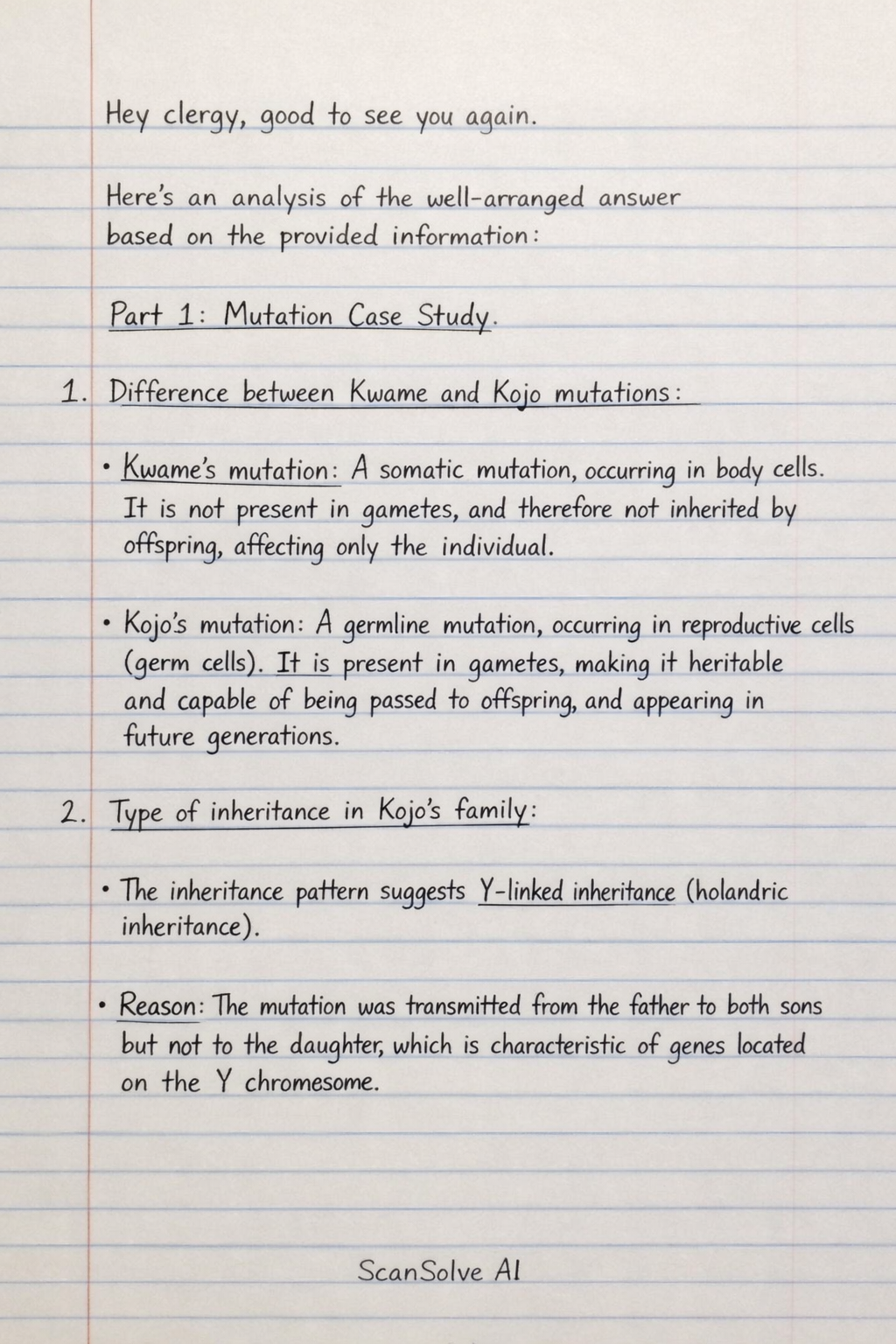
Hey clergy, good to see you again.
Here is the well-arranged answer based on the provided information:
Part 1: Mutation Case Study
1. Difference between Kwame and Kojo mutations
Kwame's mutation: A somatic mutation*, occurring in body cells. It is not present in gametes and therefore not inherited by offspring, affecting only the individual.
Kojo's mutation: A germline mutation*, occurring in reproductive cells (germ cells). It is present in gametes, making it heritable and capable of being passed to offspring and appearing in future generations.
2. Type of inheritance in Kojo's family
The inheritance pattern suggests Y-linked inheritance* (holandric inheritance).
Reason: The mutation was transmitted from the father to both sons but not to the daughter, which is characteristic of genes located on the Y chromosome.
3. Mutation subject to natural selection
Kojo's germline mutation* is subject to natural selection.
Reason: Natural selection acts on heritable genetic variation. Germline mutations are inherited, affecting the genetic composition of future generations and thus influencing population genetics. Somatic mutations, like Kwame's, die with the individual and are not passed on.
Part 2: Fruit Fly Experiment
1. Physical relationship of the genes
The genes controlling eye color and wing shape are linked genes*.
Explanation: They are located close together on the same chromosome and tend to be inherited together, causing traits to appear together more often than expected.
2. Mechanism producing new combinations
The mechanism producing new combinations is genetic recombination through crossing over*.
Explanation: This process occurs during Prophase I of meiosis, where homologous chromosomes exchange segments of DNA, leading to the formation of recombinant chromosomes and new combinations of traits.
Send me the next one 📸
