
We read your photo as:
Explain how communication occurs using a mobile voice network, including the roles of base stations and the Mobile Switching Center.
Computer Science
ScanSolve AI Answer
Here's how communication takes place using a mobile voice network:
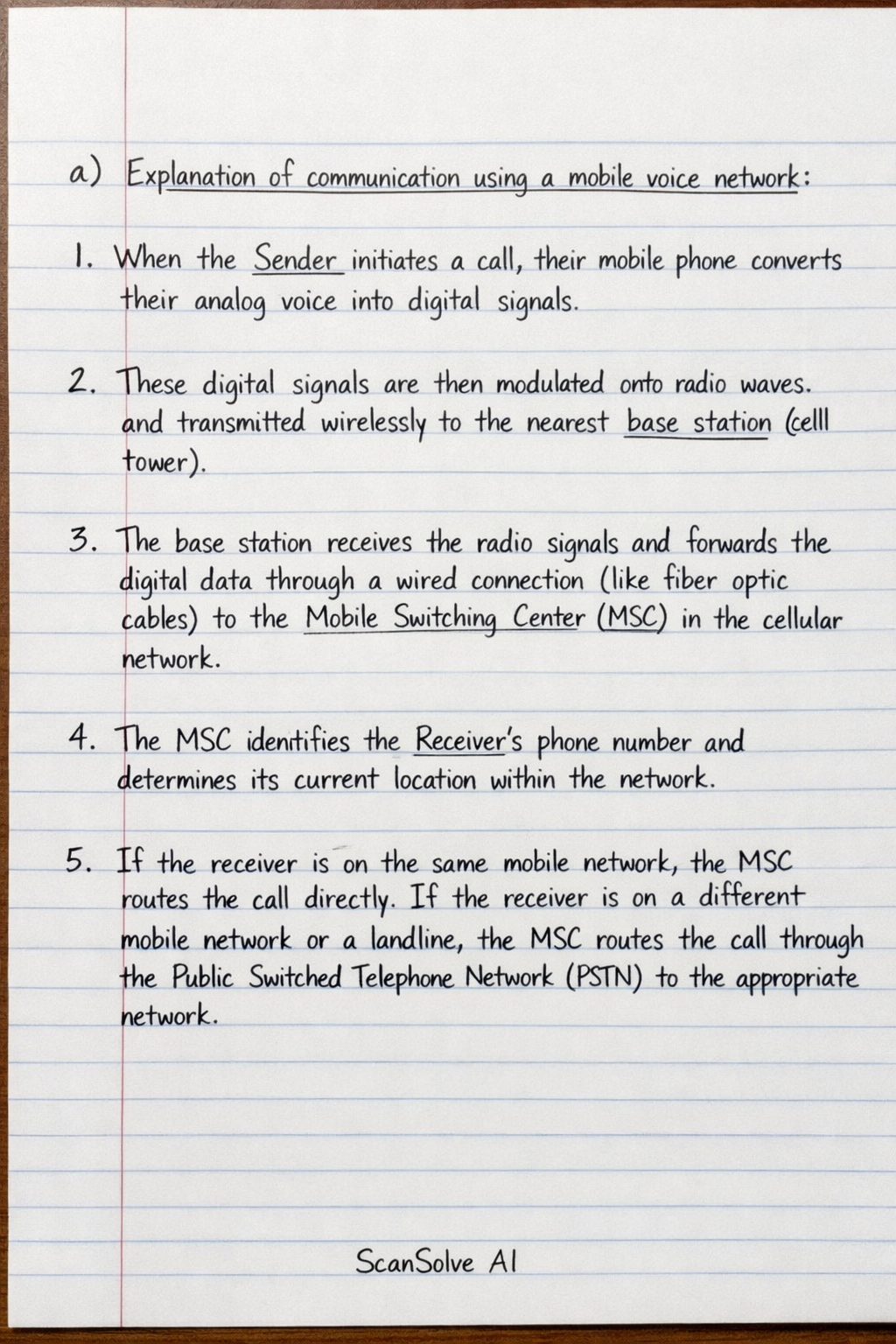
a) Explanation of communication using a mobile voice network:
- When the Sender initiates a call, their mobile phone converts their analog voice into digital signals.
- These digital signals are then modulated onto radio waves and transmitted wirelessly to the nearest base station (cell tower).
- The base station receives the radio signals and forwards the digital data through a wired connection (like fiber optic cables) to the Mobile Switching Center (MSC) in the cellular network.
- The MSC identifies the Receiver's phone number and determines its current location within the network.
- If the receiver is on the same mobile network, the MSC routes the call directly. If the receiver is on a different mobile network or a landline, the MSC routes the call through the Public Switched Telephone Network (PSTN) to the appropriate network.
- The call eventually reaches the MSC serving the receiver's location. This MSC then sends a signal to the base station nearest to the receiver's phone.
- The base station transmits radio waves to the receiver's mobile phone, causing it to ring.
- Once the receiver answers, their phone converts the incoming digital signals back into analog voice, allowing the conversation to take place. The process is reversed for the receiver's voice to reach the sender.
b) Identified components:
- Sender: The person initiating the mobile phone call.
- Receiver: The person receiving the mobile phone call.
- Transmission medium:
- Wireless (radio waves) between the mobile phones and the base stations.
- Wired (fiber optic cables, copper lines) between base stations, Mobile Switching Centers (MSCs), and the Public Switched Telephone Network (PSTN).
- Type of network used: A cellular network (mobile voice network) which integrates with the Public Switched Telephone Network (PSTN).
Was this helpful?
Still stuck on this one?
Ask a follow-up, and the answer starts from this question.
Got a different question?Ask your own question
More Computer Science Questions
QExplain step-by-step how mobile voice communication works, including sender, receiver, transmission…QDescribe the steps involved in making a phone call from a mobile phone to another mobile phone in a…QThe technology platform from which mobile technology runs is known as code-division multiple access.QWhat is mobile service providersQExplain the concept of a modern telecommunication system. Illustrate your answer with a block…
Handwritten Step-by-Step Solution
Get this as a handwritten image on WhatsApp — like a tutor wrote it for you.
Try on WhatsApp