
We read your photo as:
Computer Fundamentals: Define processed data, list languages, identify input devices, and define AI. Discuss pros/cons of computers, types of software, and language levels.
ScanSolve AI Answer
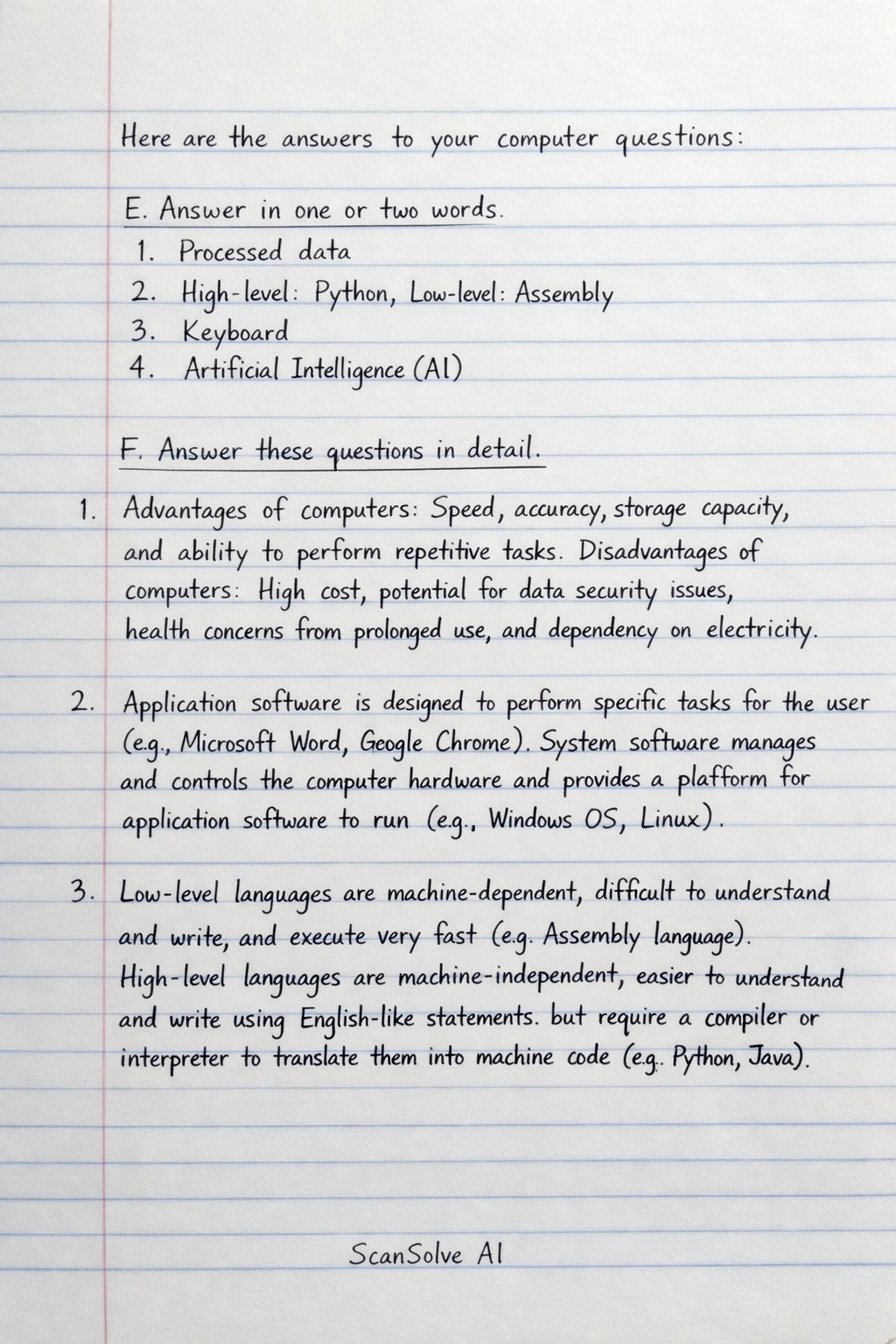
Here are the answers to your computer questions:
E. Answer in one or two words.
- Processed data
- High-level: Python, Low-level: Assembly
- Keyboard
- Artificial Intelligence (AI)
F. Answer these questions in detail.
-
Advantages of computers: Speed, accuracy, storage capacity, and ability to perform repetitive tasks. Disadvantages of computers: High cost, potential for data security issues, health concerns from prolonged use, and dependency on electricity.
-
Application software is designed to perform specific tasks for the user (e.g., Microsoft Word, Google Chrome). System software manages and controls the computer hardware and provides a platform for application software to run (e.g., Windows OS, Linux).
-
Low-level languages are machine-dependent, difficult to understand and write, and execute very fast (e.g., Assembly language). High-level languages are machine-independent, easier to understand and write using English-like statements, but require a compiler or interpreter to translate them into machine code (e.g., Python, Java).
-
Output devices are hardware components that display or present processed data from the computer to the user.
- Monitor: Displays visual output like text, images, and videos.
- Printer: Produces hard copies of digital documents on paper.
-
Hardware refers to the physical components of a computer system that you can touch and see (e.g., CPU, keyboard, monitor). Software is a set of instructions or programs that tell the hardware what to do and how to perform tasks (e.g., operating systems, applications).
-
PROM (Programmable Read-Only Memory): A type of ROM that can be programmed once by the user. Once programmed, its contents cannot be erased or modified.
- EPROM (Erasable Programmable Read-Only Memory): A type of ROM that can be programmed by the user and erased by exposing it to strong ultraviolet light. After erasure, it can be reprogrammed.
- EEPROM (Electrically Erasable Programmable Read-Only Memory): A type of ROM that can be programmed and erased electrically. It allows individual bytes of data to be erased and reprogrammed without removing the chip from the circuit board.
Still stuck on this one?
Ask a follow-up, and the answer starts from this question.
More Computer Science Questions
Handwritten Step-by-Step Solution
Get this as a handwritten image on WhatsApp — like a tutor wrote it for you.
Try on WhatsApp