
We read your photo as:
• Computer System Organization:
ScanSolve AI Answer
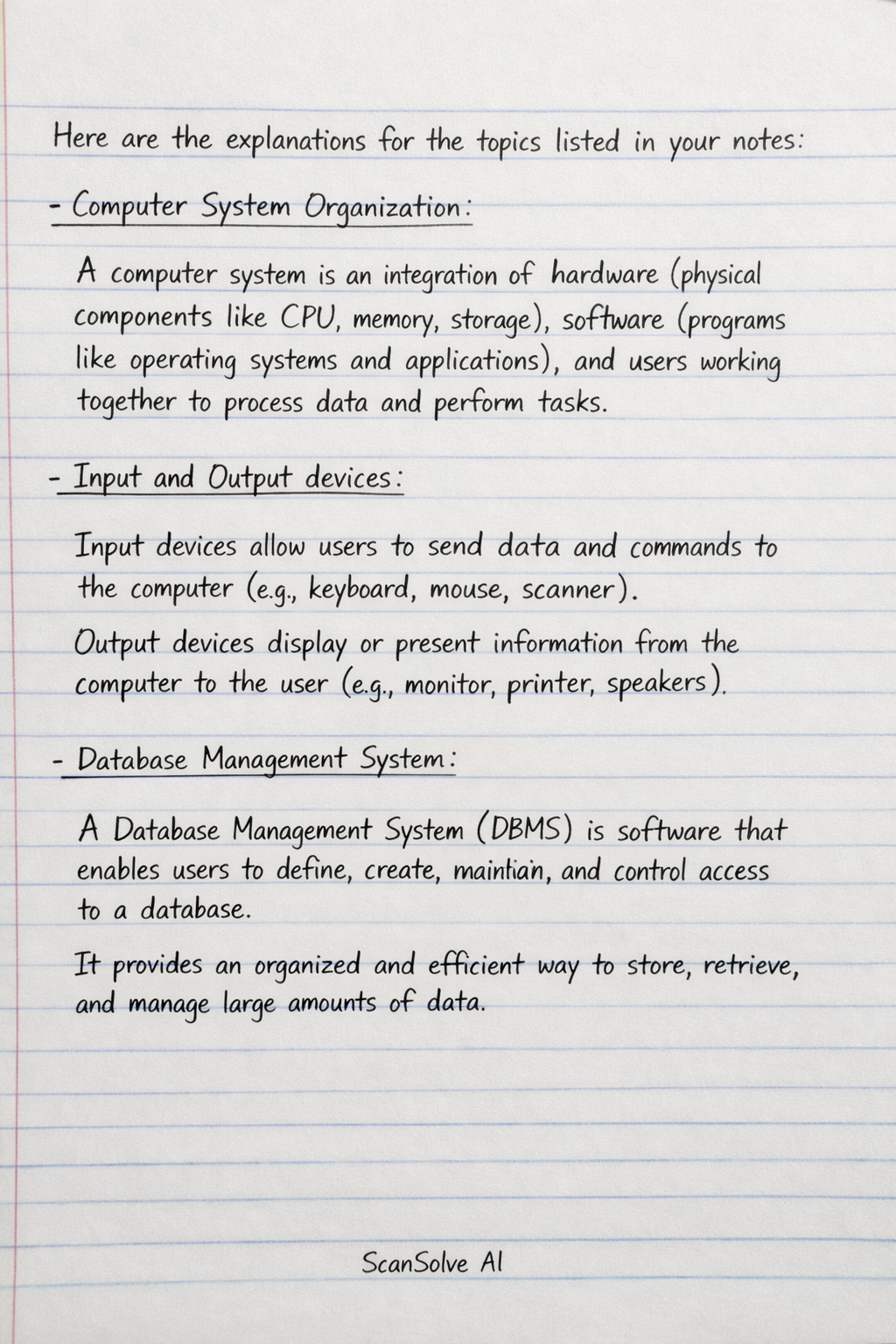
Here are the explanations for the topics listed in your notes:
-
Computer System Organization: A computer system is an integration of hardware (physical components like CPU, memory, storage), software (programs like operating systems and applications), and users working together to process data and perform tasks.
-
Input and Output devices: Input devices allow users to send data and commands to the computer (e.g., keyboard, mouse, scanner). Output devices display or present information from the computer to the user (e.g., monitor, printer, speakers).
-
Database Management System: A Database Management System (DBMS) is software that enables users to define, create, maintain, and control access to a database. It provides an organized and efficient way to store, retrieve, and manage large amounts of data.
-
HTML and its Basic Tags: HTML (HyperText Markup Language) is the standard markup language for creating web pages. It uses tags to structure content. Basic tags include
<html>(document root),<head>(meta-information),<body>(visible content),<p>(paragraph),<h1>to<h6>(headings),<a>(hyperlink), and<img>(image). -
Data Types in Programming: Data types classify the kind of values a variable can hold, determining how they are stored in memory and what operations can be performed on them. Common examples include Integer (
intfor whole numbers), Floating-point (float/doublefor decimals), Character (charfor single letters), Boolean (boolfor true/false), and String (for sequences of characters). -
C++ Program to Check Prime: A prime number is a natural number greater than 1 that has no positive divisors other than 1 and itself. To check if a number is prime, you can iterate from up to . If is divisible by any in this range, it is not prime; otherwise, it is prime.
-
Program to find Factorial: The factorial of a non-negative integer , denoted by , is the product of all positive integers less than or equal to . For example, , and . The logic involves initializing a variable (e.g.,
factorial) to 1 and then multiplying it by each integer from 1 up to . -
Program to find largest among three numbers: To find the largest among three numbers (let's say ), you can use conditional statements. A common approach is to assume the first number () is the largest, then compare it with the second number () and update if is larger. Finally, compare the current largest with the third number () and update if is larger. The final value held is the largest.
Still stuck on this one?
Ask a follow-up, and the answer starts from this question.
More Computer Science Questions
Handwritten Step-by-Step Solution
Get this as a handwritten image on WhatsApp — like a tutor wrote it for you.
Try on WhatsApp