

This computer science problem involves algorithmic thinking and programming concepts. The solution below explains the approach, logic, and implementation step by step.
ScanSolve AI Answer
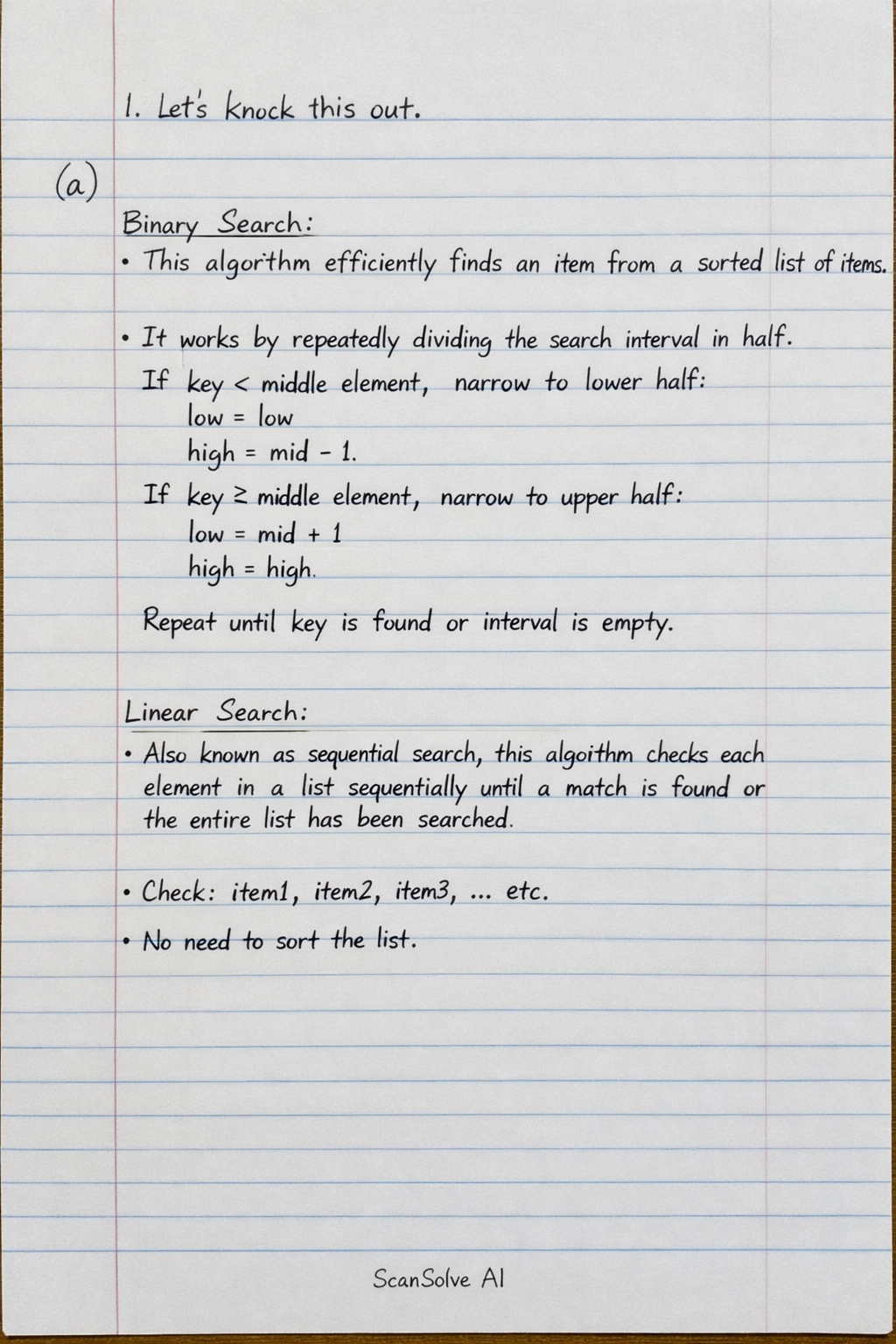
IT, let's knock this out. a) • Binary Search: This algorithm efficiently finds an item from a sorted list of items. It works by repeatedly dividing the search interval in half. If the value of the search key is less than the item in the middle of the interval, it narrows the interval to the lower half. Otherwise, it narrows it to the upper half. This process continues until the value is found or the interval is empty. • Linear Search: Also known as sequential search, this algorithm checks each element in a list sequentially until a match is found or the entire list has been searched. It does not require the list to be sorted. b) • Big-O Notation: In algorithm analysis, Big-O notation is used to describe the upper bound or the worst-case scenario of an algorithm's running time or space complexity. It characterizes how the running time or space requirements grow as the input size (n) increases, ignoring constant factors and lower-order terms. For example, O(n^2) means the time grows quadratically with input size. • Computational Complexity: This term refers to the amount of resources (typically time and space/memory) required by an algorithm to solve a given problem. It quantifies the efficiency of an algorithm, indicating how its performance scales with the size of the input data. c) i) • Worst Case Analysis: This evaluates the maximum amount of resources (time or space) an algorithm might require. It considers the input that causes the algorithm to perform the largest number of operations or consume the most memory. • Average Case Analysis: This evaluates the expected amount of resources an algorithm might require, considering all possible inputs and their probabilities. It provides a more realistic measure of performance for typical inputs. • Best Case Analysis: This evaluates the minimum amount of resources an algorithm might require. It considers the input that allows the algorithm to perform the smallest number of operations or consume the least memory. ii) • Infix Notation: This is the most common way to write arithmetic expressions, where the operator is placed between its operands. Example: A + B • Prefix Notation (Polish Notation): In this notation, the operator is placed before its operands. Example: + A B (equivalent to A + B) • Postfix Notation (Reverse Polish Notation - RPN): In this notation, the operator is placed after its operands. Example: A B + (equivalent to A + B) Send me the next one 📸