
We read your photo as:
Critically evaluate the TPACK framework as a strategic tool for bridging the 'digital divide' and fostering 'new epistemologies' in South African classrooms during the Fourth Industrial Revolution (4IR).
ScanSolve AI Answer
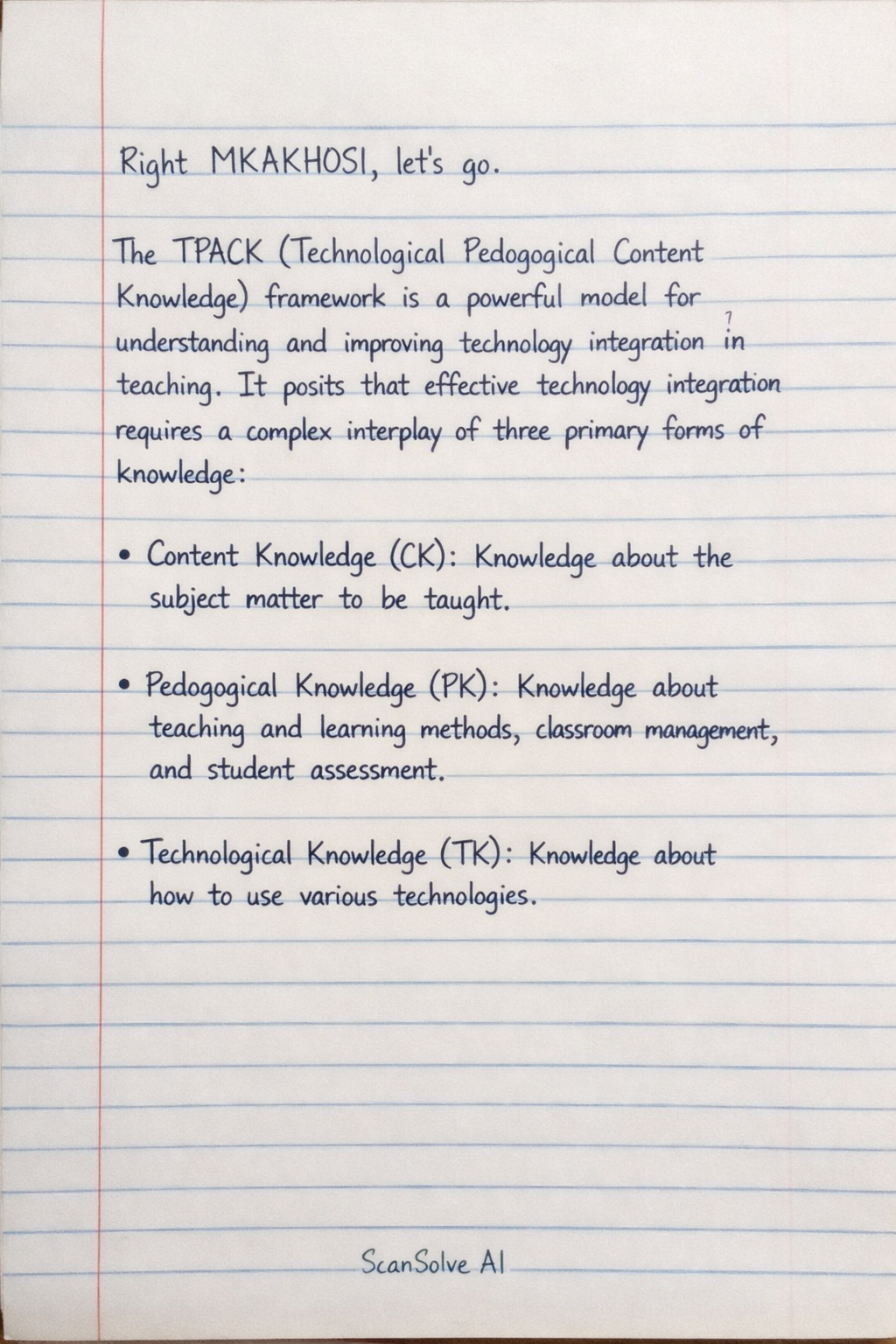
The TPACK (Technological Pedagogical Content Knowledge) framework is a powerful model for understanding and improving technology integration in teaching. It posits that effective technology integration requires a complex interplay of three primary forms of knowledge:
- Content Knowledge (CK): Knowledge about the subject matter to be taught.
- Pedagogical Knowledge (PK): Knowledge about teaching and learning methods, classroom management, and student assessment.
- Technological Knowledge (TK): Knowledge about how to use various technologies.
The intersections of these three forms of knowledge create new, integrated forms of knowledge:
- Pedagogical Content Knowledge (PCK): How to teach specific content.
- Technological Content Knowledge (TCK): How technology can represent and facilitate specific content.
- Technological Pedagogical Knowledge (TPK): How technology can be used in teaching and learning processes.
- Technological Pedagogical Content Knowledge (TPACK): The holistic understanding of how to teach specific content using appropriate technologies in a pedagogically sound way.
Here's a critical evaluation of the TPACK framework in the South African context:
-
TPACK as a Strategic Tool for Bridging the Digital Divide: The TPACK framework is crucial for bridging the digital divide because it moves beyond simply providing technology. In South Africa, many previously disadvantaged schools may receive devices, but without the integrated knowledge of TPACK, these devices often remain underutilized or are used ineffectively. TPACK empowers teachers to:
- Design relevant learning experiences: Teachers with strong TPACK can select and adapt technology (TK) to teach specific curriculum content (CK) in ways that are pedagogically appropriate and engaging (PK), even with limited resources. This ensures that technology use is meaningful and directly supports learning outcomes, rather than being a superficial add-on.
- Foster digital literacy: By integrating technology purposefully into lessons, teachers naturally develop students' digital skills, critical thinking, and problem-solving abilities, which are essential for navigating the digital world and reducing the gap between digitally rich and poor students.
-
Fostering 'New Epistemologies' in 4IR Classrooms: The Fourth Industrial Revolution (4IR) demands 'new epistemologies' – new ways of knowing, learning, and creating knowledge, focusing on skills like critical thinking, creativity, collaboration, and computational thinking. TPACK enables teachers to foster these by:
- Shifting from transmission to construction: Instead of just delivering content, TPACK-informed teachers can design activities where students actively construct knowledge using digital tools. For example, using simulations (TK) to explore scientific concepts (CK) through inquiry-based learning (PK).
- Promoting higher-order thinking: Teachers can leverage technology to facilitate complex tasks, data analysis, and project-based learning, moving students beyond rote memorization to deeper understanding and application of knowledge.
-
Moving Teachers from 'Users' to 'Creative Creators': The specific purpose of TPACK in this regard is to transform teachers from passive consumers of technology into active designers of learning experiences.
- A teacher who is merely a 'user' might use a PowerPoint presentation because it's available. A 'creative creator' with TPACK, however, understands why a specific interactive simulation (TK) is better for explaining a complex physics concept (CK) to their particular class (PK), and can adapt or even develop resources to suit their context.
- This deep understanding allows teachers to innovate solutions for resource constraints, differentiate instruction for diverse learners, and create engaging, relevant digital learning environments that directly address the needs of their students and the demands of the 4IR. This creative capacity is vital for redressing the digital divide, as it enables teachers to make the most of whatever technology is available and tailor it to their unique classroom challenges.
-
Critical Considerations in the South African Context: While powerful, TPACK implementation faces challenges in South Africa:
- Teacher Training and Development: Many teachers may lack foundational TK, PK, or CK, making the integration into TPACK complex. Sustained, context-specific professional development is crucial.
- Infrastructure Deficiencies: Even with TPACK knowledge, poor internet connectivity, lack of devices, and unreliable electricity in many schools remain significant barriers to effective technology integration.
- Curriculum Alignment: The existing curriculum may not always be flexible enough to fully support the innovative, technology-rich pedagogical approaches that TPACK encourages.
The TPACK framework provides a robust conceptual lens for understanding and developing the complex knowledge teachers need to effectively integrate technology, bridge the digital divide, and prepare South African students for the demands of the 4IR. However, its successful implementation requires addressing systemic issues related to infrastructure, teacher training, and curriculum flexibility.
Still stuck on this one?
Ask a follow-up, and the answer starts from this question.
More Computer Science Questions
Handwritten Step-by-Step Solution
Get this as a handwritten image on WhatsApp — like a tutor wrote it for you.
Try on WhatsApp