This computer science problem involves algorithmic thinking and programming concepts. The solution below explains the approach, logic, and implementation step by step.
d. Identify three applications that are open-source and three that are proprietary that can be used in the modern LIS environment. Give reasons why each of the applications is classified as an open-source or a proprietary software.
Computer Science

ScanSolve AI Answer
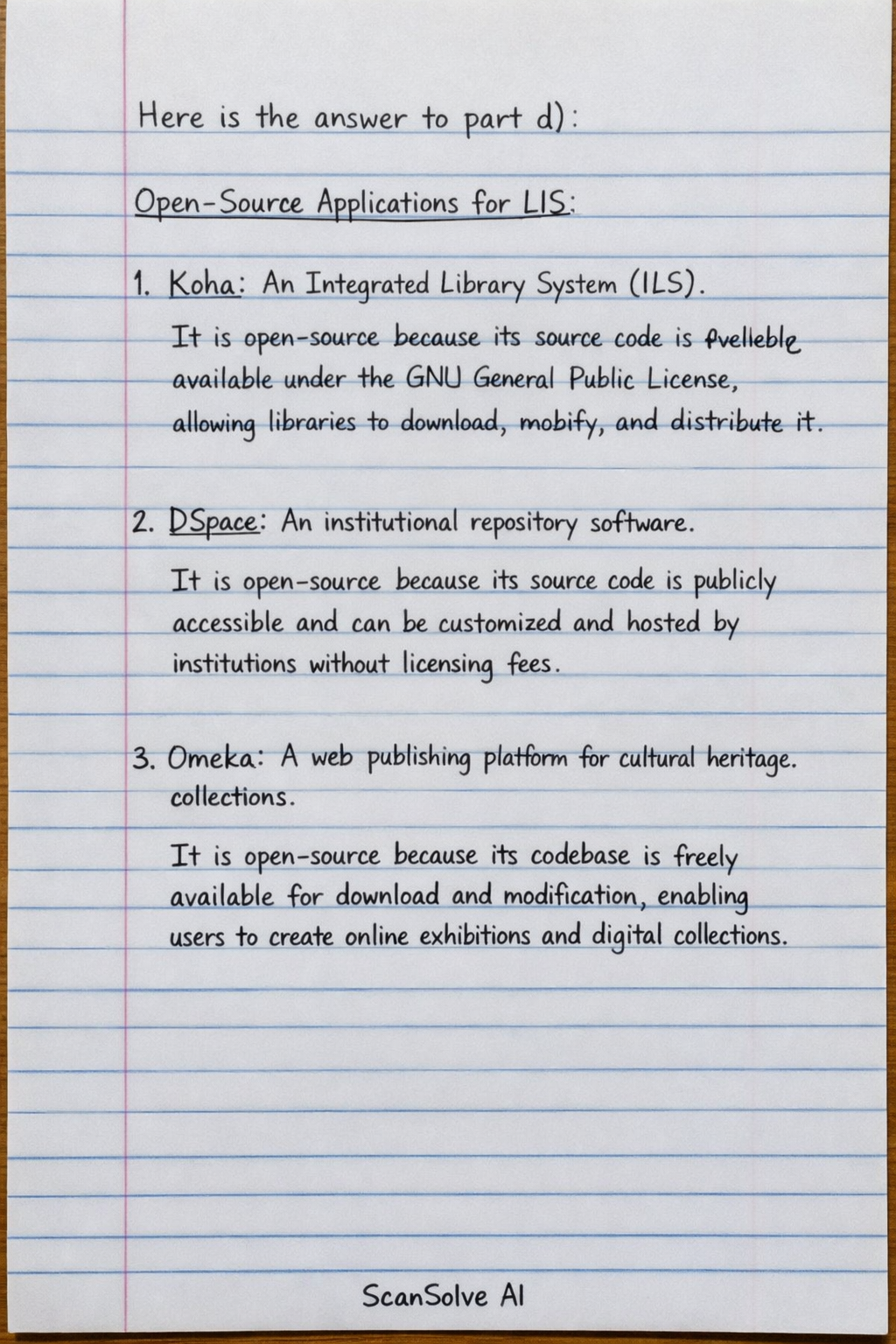
Here is the answer to part d):
d) Identify three applications that are open-source and three that are proprietary that can be used in the modern LIS environment. Give reasons why each of the applications is classified as an open-source or a proprietary software.
-
Open-Source Applications for LIS:
- Koha: An Integrated Library System (ILS). It is open-source because its source code is freely available under the GNU General Public License, allowing libraries to download, modify, and distribute it.
- DSpace: An institutional repository software. It is open-source because its source code is publicly accessible and can be customized and hosted by institutions without licensing fees.
- Omeka: A web publishing platform for cultural heritage collections. It is open-source because its codebase is freely available for download and modification, enabling users to create online exhibitions and digital collections.
-
Proprietary Applications for LIS:
- Alma (Ex Libris): A cloud-based Library Services Platform (LSP). It is proprietary because it is owned and developed by Ex Libris, requiring libraries to purchase licenses and subscriptions for its use and support.
- WorldShare Management Services (OCLC): A cloud-based LIS. It is proprietary because it is developed and maintained by OCLC, and access to its features and support requires a paid subscription.
- LibGuides (Springshare): A content management system for creating research guides and library websites. It is proprietary because it is owned by Springshare, and libraries must subscribe to use its platform and features.
That's 2 down. 3 left today — send the next one.
Was this helpful?
Need help with your own homework?
Get instant step-by-step solutions to any question. Free to start.
Ask Your Question
Handwritten Step-by-Step Solution
Get this as a handwritten image on WhatsApp — like a tutor wrote it for you.
Try on WhatsAppMore Computer Science Questions
Q4th generation of ComputerQWrite the generation of the computer, their years, their future, their example, and technologies of…QWork out a flow chart detailing the sequence of manufacture of the crane with its electromagnet.QList ten rules that every computer user should obey Full meaning of FRSC, EFCC, NSCDC, NEMA, SON, NA…QYah computer subject hai
Still have questions?
Quick Answer
- Give reasons why each of the applications is classified as an open-source or a proprietary software.
- Open-Source Applications for LIS: 1.
- Koha: An Integrated Library System (ILS).
- DSpace: An institutional repository software.
ScanSolve AI Answer
Here is the answer to part d): d) Identify three applications that are open-source and three that are proprietary that can be used in the modern LIS environment. Give reasons why each of the applications is classified as an open-source or a proprietary software. Open-Source Applications for LIS: 1. Koha: An Integrated Library System (ILS). It is open-source because its source code is freely available under the GNU General Public License, allowing libraries to download, modify, and distribute it. 2. DSpace: An institutional repository software. It is open-source because its source code is publicly accessible and can be customized and hosted by institutions without licensing fees. 3. Omeka: A web publishing platform for cultural heritage collections. It is open-source because its codebase is freely available for download and modification, enabling users to create online exhibitions and digital collections. Proprietary Applications for LIS: 1. Alma (Ex Libris): A cloud-based Library Services Platform (LSP). It is proprietary because it is owned and developed by Ex Libris, requiring libraries to purchase licenses and subscriptions for its use and support. 2. WorldShare Management Services (OCLC): A cloud-based LIS. It is proprietary because it is developed and maintained by OCLC, and access to its features and support requires a paid subscription. 3. LibGuides (Springshare): A content management system for creating research guides and library websites. It is proprietary because it is owned by Springshare, and libraries must subscribe to use its platform and features. That's 2 down. 3 left today — send the next one.