
DAYSPRING TUTORS – MTH 102 Differentiability Practice Questions Determine whether the function f(x) = |x - 2| is differentiable at x = 2. Test the differentiability of f(x) = |2x + 1| at x = -1/2 by checking the left-hand and right-hand derivatives. Determine whether the function f(x) = |x² - 4| is differentiable at x = 2 and x = -2. Investigate the differentiability of f(x) = |x| + x at x = 0. Determine whether f(x) = |x - 3|/(x - 3) is differentiable at x = 3. Examine whether the function f(x) = x + 2, x < 1 |x - 1| + 2, x ≥ 1 is differentiable at x = 1. Test whether f(x) = |x² - 9| is differentiable at x = 3. Determine the values of x where the function f(x) = |x³ - x| fails
ScanSolve AI Answer
Step-by-step solution
4 stepsPour déterminer si la fonction est dérivable en , nous devons vérifier si la dérivée à gauche et la dérivée à droite sont égales en ce point.
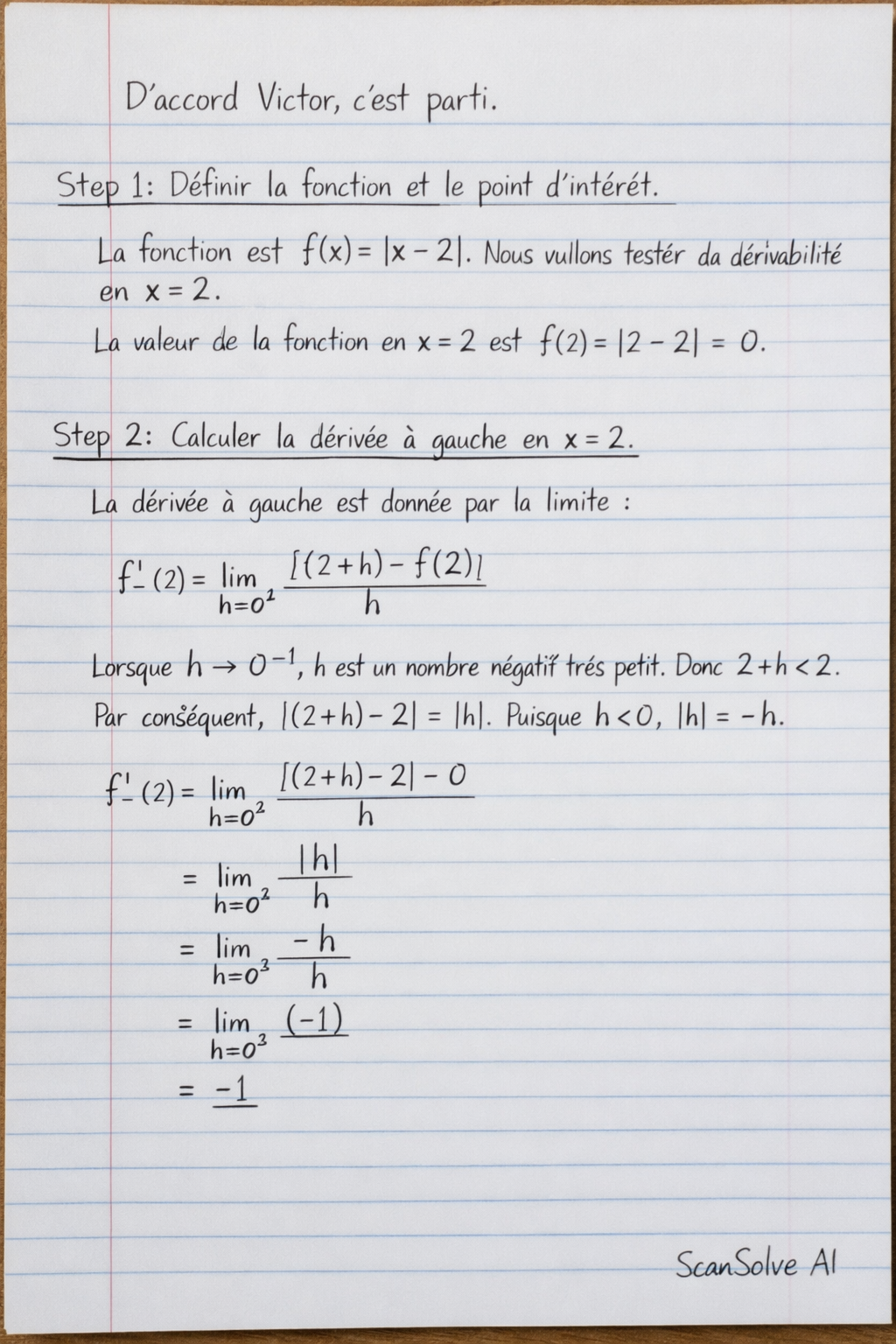
Définir la fonction et le point d'intérêt.
La fonction est . Nous voulons tester la dérivabilité en .
La valeur de la fonction en est .Calculer la dérivée à gauche en .
La dérivée à gauche est donnée par la limite :
Lorsque , est un nombre négatif très petit. Donc .
Par conséquent, . Puisque , .Calculer la dérivée à droite en .
La dérivée à droite est donnée par la limite :
Lorsque , est un nombre positif très petit. Donc .
Par conséquent, . Puisque , .Comparer les dérivées à gauche et à droite.
Nous avons trouvé que et .
Puisque , la fonction n'est pas dérivable en .La fonction n'est pas dérivable en .
Still stuck on this one?
Ask a follow-up, and the answer starts from this question.
More Computer Science Questions
Handwritten Step-by-Step Solution
Get this as a handwritten image on WhatsApp — like a tutor wrote it for you.
Try on WhatsApp