
We read your photo as:
Explain the difference between the following concepts as applied in AI and ML: Train Dataset vs Test Dataset, Overfitting vs Underfitting, Clean Data vs Dirty Data, Strong AI vs Weak AI.
ScanSolve AI Answer
here are the answers to Questions 1 and 2 from the exam paper:
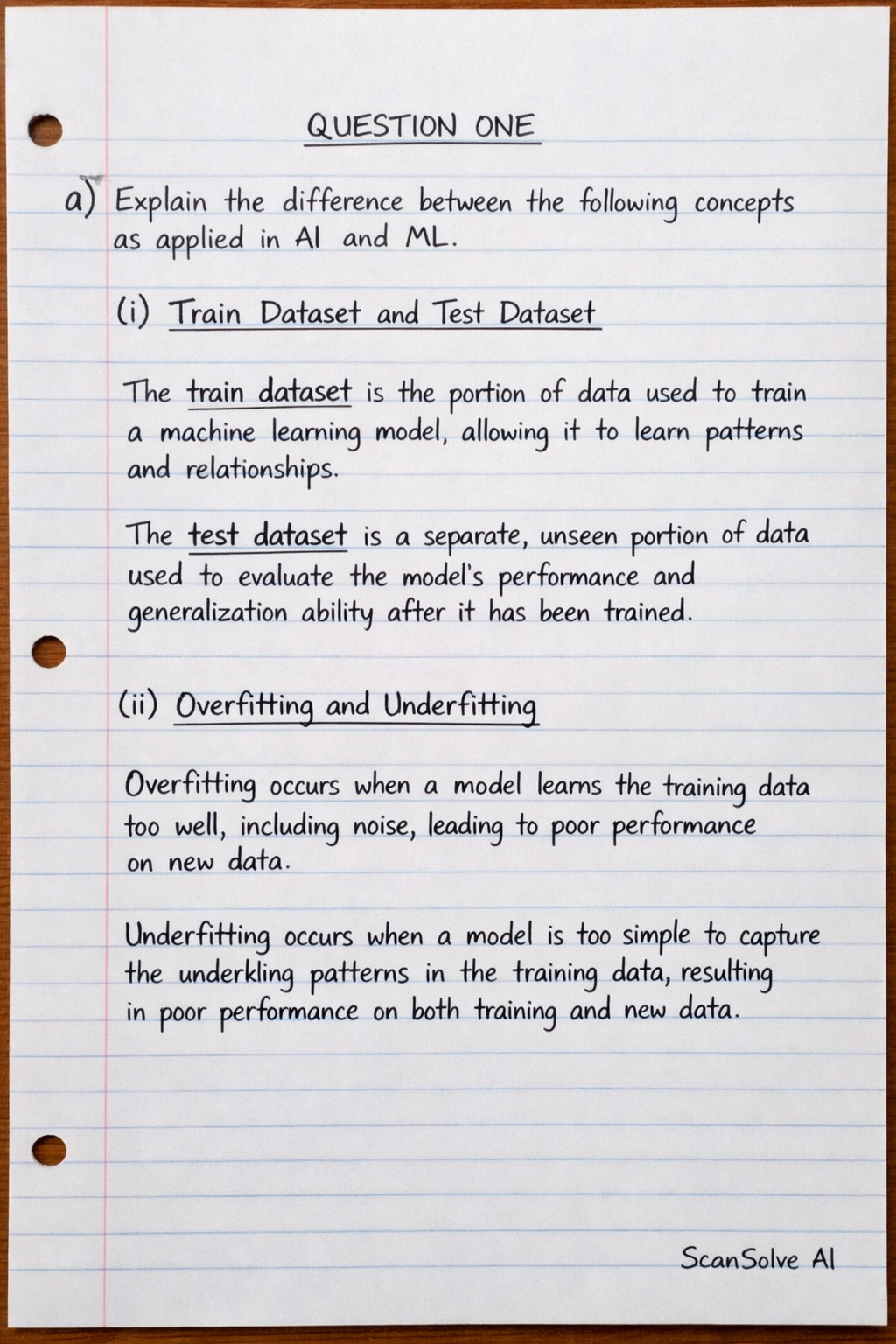
QUESTION ONE
a) Explain the difference between the following concepts as applied in AI and ML.
-
(i) Train Dataset and Test Dataset The train dataset is the portion of data used to train a machine learning model, allowing it to learn patterns and relationships. The test dataset is a separate, unseen portion of data used to evaluate the model's performance and generalization ability after it has been trained.
-
(ii) Overfitting and Underfitting Overfitting occurs when a model learns the training data too well, including noise, leading to poor performance on new data. Underfitting occurs when a model is too simple to capture the underlying patterns in the training data, resulting in poor performance on both training and new data.
-
(iii) Clean Data and Dirty Data Clean data is data that is accurate, consistent, complete, and free from errors, duplicates, or irrelevant information. Dirty data contains errors, inconsistencies, missing values, or irrelevant entries, which can negatively impact the performance and reliability of AI/ML models.
-
(iv) Strong AI and Weak AI Strong AI (or Artificial General Intelligence - AGI) refers to AI systems that possess human-like cognitive abilities, including consciousness, self-awareness, and the ability to understand, learn, and apply intelligence to any intellectual task. Weak AI (or Narrow AI) refers to AI systems designed and trained for a specific task, such as facial recognition or playing chess, without possessing general human-like intelligence.
-
(v) Fully Observable and Partially Observable Environments In a fully observable environment, an agent has access to all necessary information about the current state of the environment to make an optimal decision. In a partially observable environment, the agent's sensors provide only incomplete or noisy information about the environment's state, requiring the agent to maintain an internal model or make inferences.
b) Describe the relevance of Artificial Intelligence in the following real-life domains;
-
(i) Agriculture AI is relevant in agriculture for precision farming, optimizing crop yields through data analysis (soil, weather), automating tasks with robots (planting, harvesting), and detecting diseases or pests early using image recognition.
-
(ii) Hospitals In hospitals, AI assists with disease diagnosis (analyzing medical images), personalized treatment plans, drug discovery, managing patient records, and automating administrative tasks, improving efficiency and patient care.
-
(iii) Universities AI in universities supports personalized learning experiences, automated grading, research data analysis, administrative automation, and intelligent tutoring systems, enhancing education and operational efficiency.
-
(iv) Transport Sector AI is crucial for developing self-driving vehicles, optimizing traffic flow, predictive maintenance of transport infrastructure, logistics and route optimization, and enhancing safety through real-time monitoring.
-
(v) Manufacturing Industries AI in manufacturing enables predictive maintenance of machinery, quality control through computer vision, robotic automation of production lines, supply chain optimization, and demand forecasting, leading to increased efficiency and reduced costs.
c) As an AI student, what is your view about AI and the future regards employment? Do you think AI will take over people's jobs, is it necessary then?
As an AI student, my view is that AI will significantly transform, rather than completely take over, most jobs. While AI will automate repetitive and data-intensive tasks, it will also create new jobs requiring human skills like creativity, critical thinking, emotional intelligence, and AI development/management. It is necessary to embrace AI because it enhances productivity, solves complex problems, and drives innovation, ultimately leading to societal progress. The focus should be on upskilling and reskilling the workforce to collaborate with AI, rather than fearing job displacement.
QUESTION TWO
a) With examples, explain the concept of Intelligent Agents.
An Intelligent Agent is an autonomous entity that perceives its environment through sensors and acts upon that environment through actuators to achieve goals. It is rational, meaning it strives to achieve the best possible outcome or, when there is uncertainty, the best expected outcome.
- Example 1 (Robotic Vacuum Cleaner): This agent perceives its environment using sensors (e.g., for dirt, obstacles) and acts using actuators (wheels, vacuum brush). Its goal is to clean the floor efficiently.
- Example 2 (Self-Driving Car): This agent perceives its environment via cameras, radar, lidar, etc., and acts through steering, acceleration, and braking. Its goal is to safely transport passengers to a destination.
b) Discuss five categories of Intelligent agents.
- Simple Reflex Agents: These agents select actions based only on the current percept, ignoring the rest of the percept history. They work well only if the environment is fully observable.
- Example: A thermostat that turns on the heater when the temperature drops below a set point.
- Model-Based Reflex Agents: These agents maintain an internal state (a model) of the world, which is updated based on percepts and how the agent's actions affect the world. They use this model to handle partially observable environments.
- Example: A self-driving car that uses a map and its current location to understand its position even if a sensor temporarily fails.
- Goal-Based Agents: These agents use their current state and a set of goals to decide which actions to take. They consider the future consequences of actions to find a path to the goal.
- Example: A chess-playing AI that evaluates possible moves to achieve a checkmate.
- Utility-Based Agents: These agents are similar to goal-based agents but also consider the "utility" or desirability of different states. They choose actions that maximize their expected utility, especially in situations with multiple goals or uncertainty.
- Example: A financial trading agent that aims to maximize profit while minimizing risk.
- Learning Agents: These agents have a learning element that allows them to improve their performance over time. They observe their actions and their outcomes, using this experience to refine their knowledge and decision-making processes.
- Example: A spam filter that learns to identify new types of spam based on user feedback.
c) Explain the following Machine Learning Algorithms and where each can be applied.
-
(i) K-Means K-Means is an unsupervised learning algorithm used for clustering. It partitions observations into clusters, where each observation belongs to the cluster with the nearest mean (centroid). The algorithm iteratively assigns data points to clusters and updates cluster centroids until convergence.
- Application: Customer segmentation (grouping customers with similar buying habits), image compression, document clustering.
-
(ii) Naive Bayes Naive Bayes is a supervised learning algorithm based on Bayes' theorem with the "naive" assumption of conditional independence between features. It's a probabilistic classifier that calculates the probability of a given input belonging to a certain class.
- Application: Spam detection (classifying emails as spam or not), sentiment analysis (determining positive/negative sentiment in text), document classification.
-
(iii) Support Vector Machine (SVM) Support Vector Machine (SVM) is a supervised learning algorithm used for classification and regression tasks. It works by finding an optimal hyperplane that best separates data points of different classes in a high-dimensional space, maximizing the margin between the classes.
- Application: Image classification (e.g., recognizing handwritten digits), text categorization, bioinformatics (e.g., protein classification).
Still stuck on this one?
Ask a follow-up, and the answer starts from this question.
More Computer Science Questions
Handwritten Step-by-Step Solution
Get this as a handwritten image on WhatsApp — like a tutor wrote it for you.
Try on WhatsApp