
We read your photo as:
Differentiate between half-duplex and full-duplex transmission modes. List and explain 3 things to consider when choosing a network topology. Explain the FIVE basic components in a communication syste
ScanSolve AI Answer
QUESTION 8
(i) Communication Systems
A. Differentiate between half-duplex and full-duplex transmission modes.
- Half-duplex transmission allows data to flow in both directions, but not simultaneously. Data can be transmitted from A to B, or from B to A, but only one direction at a time.
- Full-duplex transmission allows data to flow in both directions simultaneously. Both sender and receiver can transmit and receive data at the same time.
B. List and explain 3 things to consider when choosing a network topology.
- Cost: This includes the cost of cabling, network devices (e.g., switches, routers), and installation. Some topologies, like mesh, require extensive cabling and more devices, leading to higher costs.
- Reliability and Fault Tolerance: How resilient the network is to failures. A topology like mesh offers high reliability because multiple paths exist between devices, while a bus topology is highly vulnerable to a single cable break.
- Scalability: The ease with which the network can be expanded to include more devices or cover a larger area. Star topology is generally easy to scale by adding more devices to the central hub/switch, whereas a ring topology can be more complex to expand without disrupting the network.
C. Explain the FIVE basic components in a communication system.
- Sender (Source): The device or entity that originates the message or data to be transmitted.
- Receiver (Destination): The device or entity that is intended to receive the message or data.
- Message: The actual information, data, or signal that is being sent from the sender to the receiver.
- Medium (Transmission Medium): The physical path or channel through which the message travels from the sender to the receiver (e.g., copper wire, fiber optic cable, airwaves).
- Protocol: A set of rules and standards that govern how data is formatted, transmitted, received, and interpreted by devices in a communication system, ensuring successful and orderly exchange of information.
(ii) Data Representation
A. What do you understand as a "data type" used in data representation?
A data type is a classification that specifies which type of value a variable can hold (e.g., integer, floating-point number, character, boolean) and what operations can be performed on it. It determines how data is stored in memory and how it can be manipulated.
B. What is an array?
An array is a data structure that stores a collection of elements of the same data type in contiguous memory locations. Each element can be accessed using an index or a subscript.
C. List TWO operations that can be performed on a queue.
- Enqueue: Adding an element to the rear (end) of the queue.
- Dequeue: Removing an element from the front (beginning) of the queue.
D. Differentiate between a Queue and a Stack.
- A Queue is a linear data structure that follows the First-In, First-Out (FIFO) principle, meaning the first element added is the first one to be removed.
- A Stack is a linear data structure that follows the Last-In, First-Out (LIFO) principle, meaning the last element added is the first one to be removed.
(iii) Network Diagram Analysis
To determine the completion time, critical activities, and non-critical activities, we will calculate the earliest start (ES), earliest finish (EF), latest start (LS), and latest finish (LF) times for each node.
Forward Pass (Earliest Times):
- Node 1: ES = 0, EF = 0
- Node 2: ES = EF(1) = 0. EF = ES(2) + A = 0 + 8 = 8
- Node 3: ES = EF(1) = 0. EF = ES(3) + B = 0 + 10 = 10
- Node 4: ES = EF(1) = 0. EF = ES(4) + C = 0 + 7 = 7
- Node 5: ES = EF(2) + D = 8 + 20 = 28. EF = 28
- Node 6: ES = EF(3) + E = 10 + 16 = 26. EF = 26
- Node 7: ES = EF(4) + F = 7 + 25 = 32. EF = 32
- Node 8: ES = max(EF(5) + G, EF(6) + H) = max(28 + 8, 26 + 11) = max(36, 37) = 37. EF = 37
- Node 9: ES = max(EF(6) + I, EF(7) + J) = max(26 + 14, 32 + 10) = max(40,
Still stuck on this one?
Ask a follow-up, and the answer starts from this question.
More Computer Science Questions
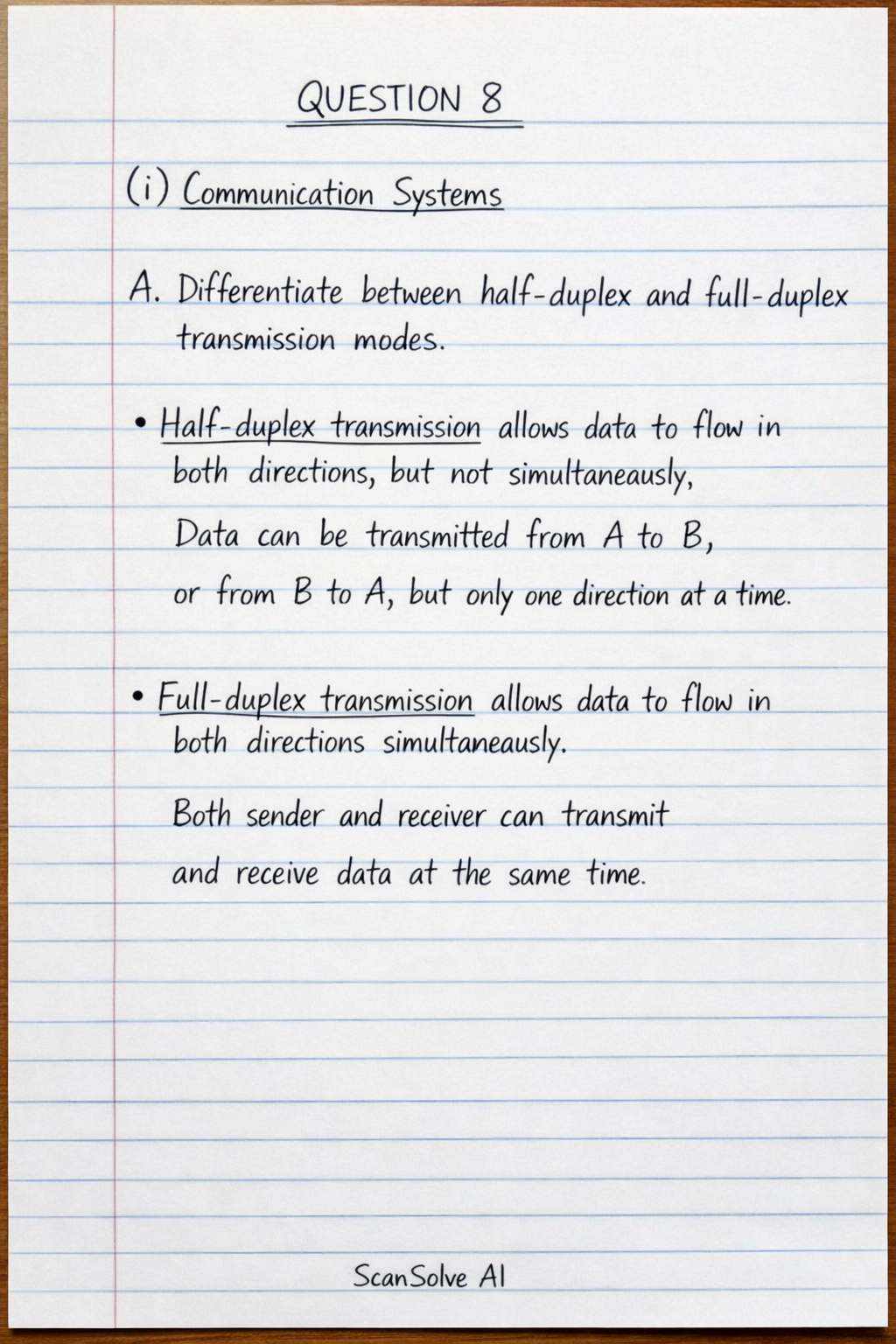
Handwritten Step-by-Step Solution
Get this as a handwritten image on WhatsApp — like a tutor wrote it for you.
Try on WhatsApp