
We read your photo as:
Discuss data collection: meaning of types of data, collection, general procedures/methods, and its use in research.
Computer Science
ScanSolve AI Answer
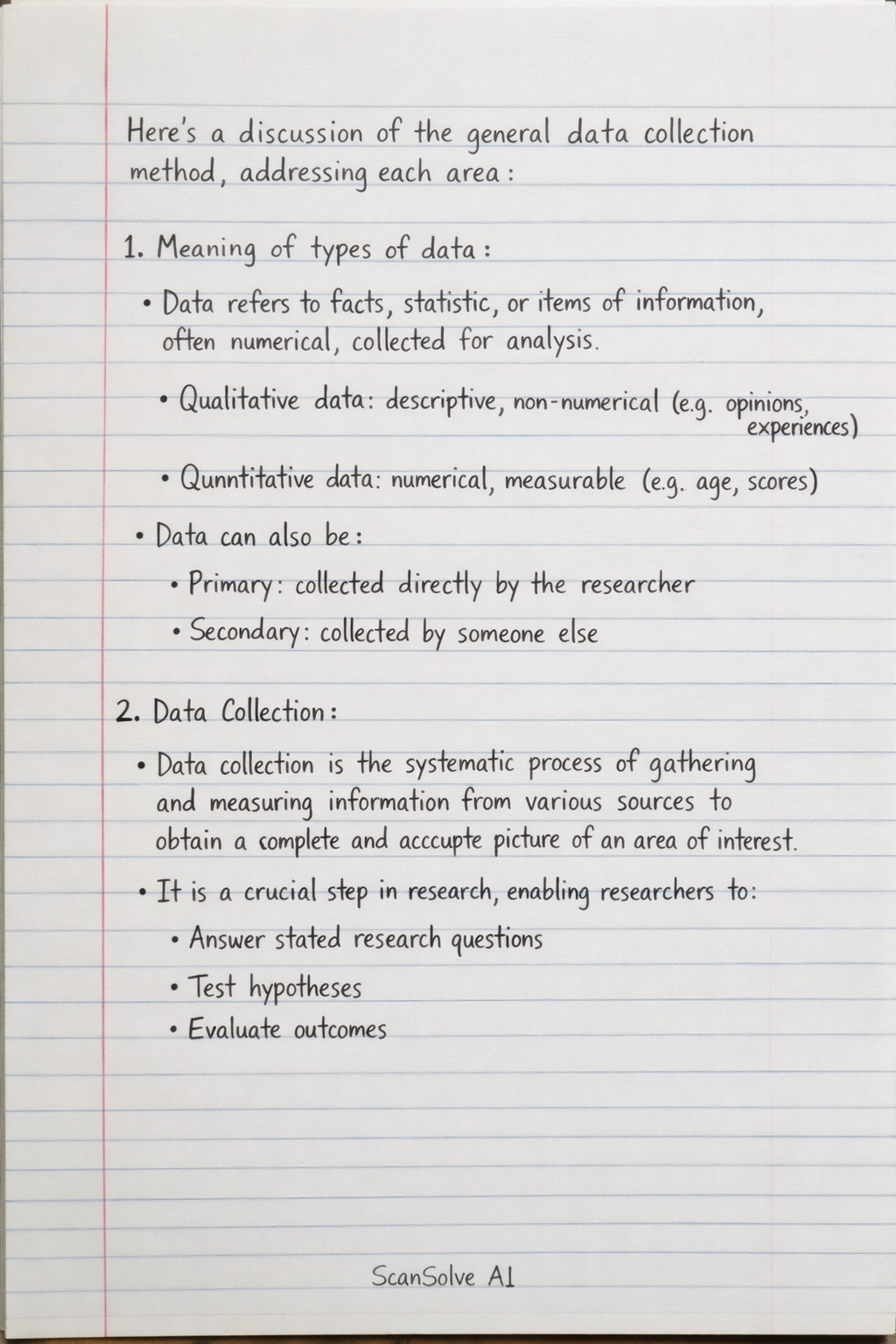
Here's a discussion of the general data collection method, addressing each area:
-
Meaning of types of data:
- Data refers to facts, statistics, or items of information, often numerical, collected for analysis. The main types include qualitative data (descriptive, non-numerical, e.g., opinions, experiences) and quantitative data (numerical, measurable, e.g., age, scores). Data can also be primary (collected directly by the researcher) or secondary (collected by someone else).
-
Data Collection:
- Data collection is the systematic process of gathering and measuring information from various sources to obtain a complete and accurate picture of an area of interest. It is a crucial step in research, enabling researchers to answer stated research questions, test hypotheses, and evaluate outcomes.
-
General data collection procedures and methods:
- General procedures involve defining research questions, selecting a sample, choosing appropriate methods, collecting data, and organizing it for analysis. Common methods include surveys (questionnaires), interviews (structured, semi-structured, unstructured), observations (participant, non-participant), experiments, and focus groups.
-
How is data collection in action (research)?
- In research, data collection is the practical implementation of the chosen methodology. For example, a researcher studying consumer behavior might conduct surveys to gather quantitative data on purchasing habits and then follow up with interviews to understand the qualitative reasons behind those habits, directly addressing their research objectives.
-
Triangulation and how the various types are distinguished?
- Triangulation is a research strategy that involves using multiple methods, data sources, theories, or investigators to cross-check and validate findings. The main types are data triangulation (using different data sources), investigator triangulation (multiple researchers), theory triangulation (multiple theoretical perspectives), and methodological triangulation (multiple research methods).
-
Paper and pencil methods of data collection:
- These are traditional methods where data is recorded manually on physical forms. Examples include self-administered questionnaires distributed in print, paper-based surveys completed by respondents, and standardized tests or scales where answers are marked on paper.
-
Live method of data collection:
- Live methods involve real-time interaction or direct observation. This includes face-to-face interviews, focus group discussions where participants interact directly, and direct observation of behaviors or events as they occur in their natural setting.
-
Ostensive method:
- In the context of data collection, an ostensive method refers to collecting data by observing or documenting direct demonstrations or examples rather than relying solely on verbal descriptions. It involves pointing to or showing instances of a phenomenon to gather information, often used in fields like linguistics or anthropology to understand concepts through direct examples.
Was this helpful?
Still stuck on this one?
Ask a follow-up, and the answer starts from this question.
Got a different question?Ask your own question
More Computer Science Questions
QFrom the image, the question is: Discuss the general data collection method taking into…QWhat are the two categories of data collection methods shown in the image, and what are examples of…QWhat are some common data collection methods used in qualitative research? 4a. What is the…Q1....... is the process of sorting and categorizing data into various forms,or any distinct class…QWhat are the primary and secondary sources of data collection with examples?
Handwritten Step-by-Step Solution
Get this as a handwritten image on WhatsApp — like a tutor wrote it for you.
Try on WhatsApp