
We read your photo as:
Draw and name Three (3) flowchart symbols. Hence explain each. Write a Pseudocode to compute student result and print "Pass" when score >=10, otherwise print "Fail". Draw a flowchart for the pseudocode in (b) above.
ScanSolve AI Answer
Step-by-step solution
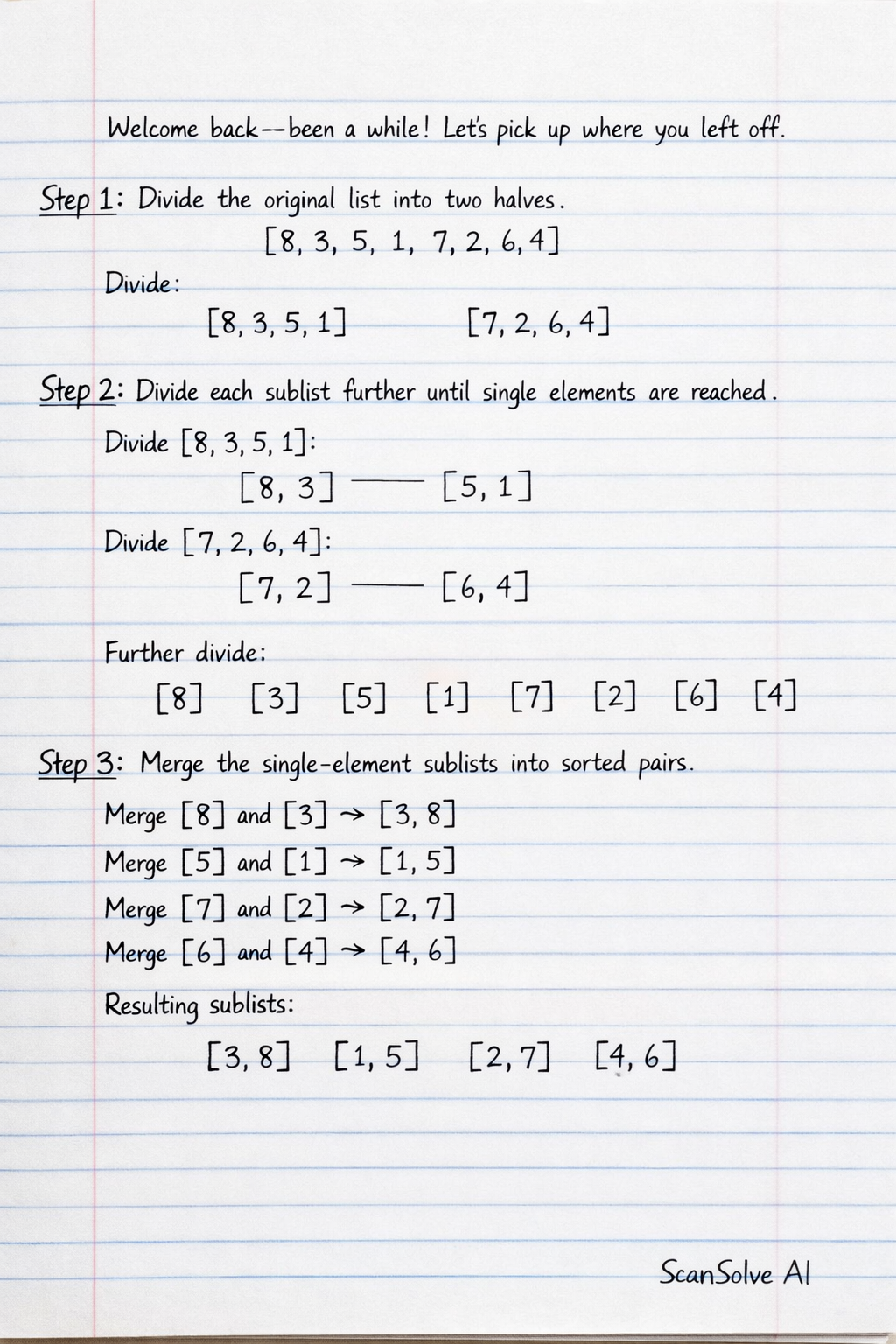
5 stepsTo sort the list [8, 3, 5, 1, 7, 2, 6, 4] using the merge sort process, we repeatedly divide the list into halves until each sublist contains only one element, then merge these sublists in sorted order.
Divide the original list into two halves.
Divide:
Continue dividing each sublist until individual elements are reached.
Divide
[8, 3, 5, 1]:Divide
[7, 2, 6, 4]:Further divide:
Merge the single-element sublists into sorted pairs.
Merge
[8]and[3][3, 8]
Merge[5]and[1][1, 5]
Merge[7]and[2][2, 7]
Merge[6]and[4][4, 6]
Resulting sublists:Merge the sorted pairs into larger sorted sublists.
Merge
[3, 8]and[1, 5][1, 3, 5, 8]
Merge[2, 7]and[4, 6][2, 4, 6, 7]
Resulting sublists:Merge the two final sorted sublists to get the complete sorted list.
Merge
[1, 3, 5, 8]and[2, 4, 6, 7][1, 2, 3, 4, 5, 6, 7, 8]The sorted list is:
Still stuck on this one?
Ask a follow-up, and the answer starts from this question.
More Computer Science Questions
Handwritten Step-by-Step Solution
Get this as a handwritten image on WhatsApp — like a tutor wrote it for you.
Try on WhatsApp