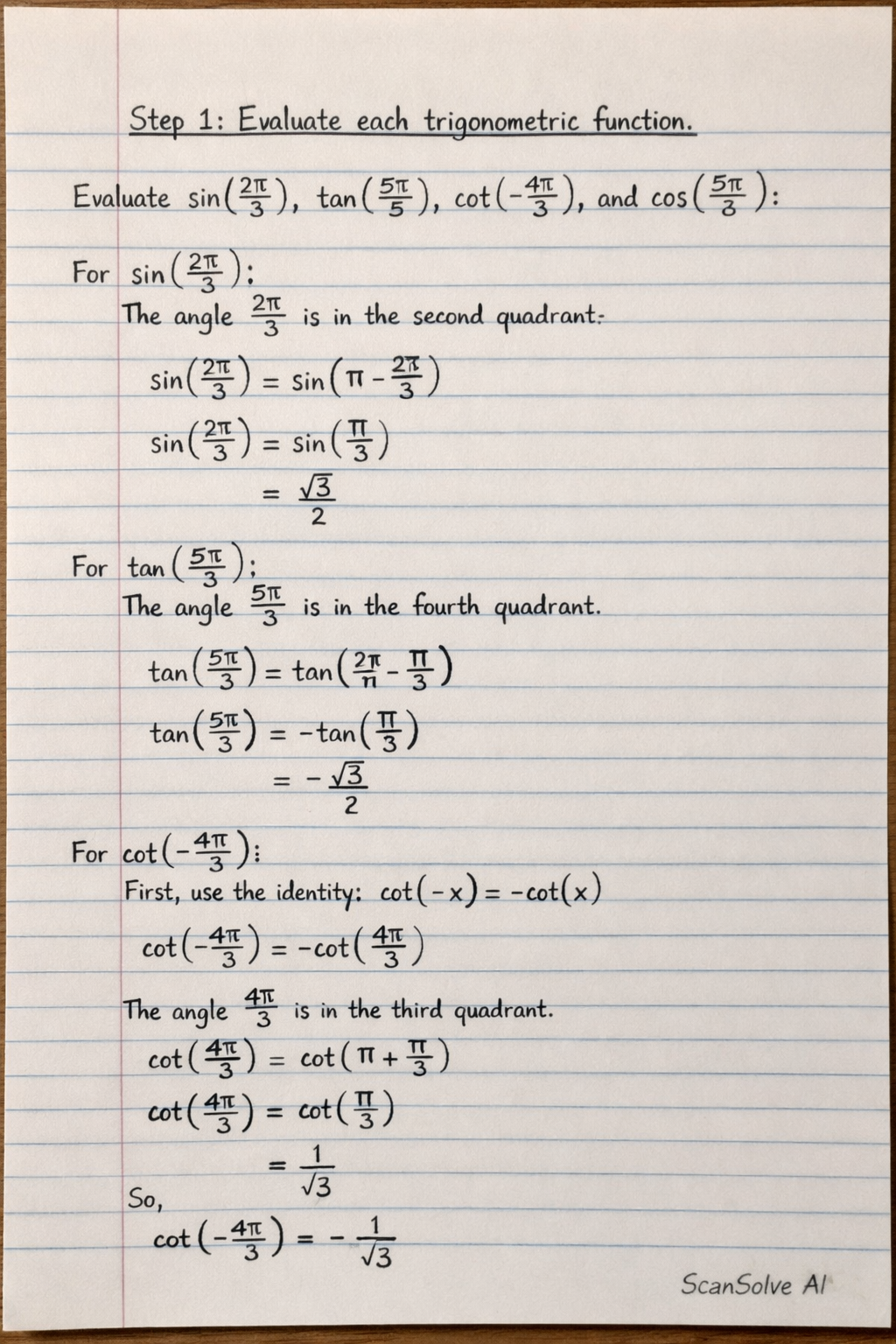
Step 1: Evaluate each trigonometric function.
We need to find the values of sin(32π), tan(35π), cot(3−4π), and cos(65π).
For sin(32π):
The angle 32π is in the second quadrant.
sin(32π)=sin(π−3π)=sin(3π)=23
For tan(35π):
The angle 35π is in the fourth quadrant.
tan(35π)=tan(2π−3π)=−tan(3π)=−3
For cot(3−4π):
First, use the identity cot(−x)=−cot(x):
cot(3−4π)=−cot(34π)
The angle 34π is in the third quadrant.
cot(34π)=cot(π+3π)=cot(3π)=31
So,
cot(3−4π)=−31
For cos(65π):
The angle 65π is in the second quadrant.
cos(65π)=cos(π−6π)=−cos(6π)=−23
Step 2: Substitute the values into the expression for A.
A=sin(32π)tan(35π)cot(3−4π)cos(65π)A=(23)⋅(−3)⋅(−31)⋅(−23)
Step 3: Multiply the terms to simplify.
A=23⋅(−13)⋅(−31)⋅(−23)
Multiply the numerators:
3⋅(−3)⋅(−1)⋅(−3)=(−3)⋅(−1)⋅(−3)=3⋅(−3)=−33
Multiply the denominators:
2⋅1⋅3⋅2=43
Combine the numerator and denominator:
A=43−33
Cancel out 3 from the numerator and denominator:
A=−43
The simplified value is:
−43
That's 2 down. 3 left today — send the next one.
Was this helpful?
Need help with your own homework?
Get instant step-by-step solutions to any question. Free to start.
This computer science problem involves algorithmic thinking and programming concepts. The solution below explains the approach, logic, and implementation step by step.
ScanSolve AI Answer
Step 1: Evaluate each trigonometric function. We need to find the values of ((2)/(3)), ((5)/(3)), ((-4)/(3)), and ((5)/(6)). For ((2)/(3)): The angle (2)/(3) is in the second quadrant. ((2)/(3)) = ( - ()/(3)) = (()/(3)) = sqrt(3)2 For ((5)/(3)): The angle (5)/(3) is in the fourth quadrant. ((5)/(3)) = (2 - ()/(3)) = -(()/(3)) = -sqrt(3) For ((-4)/(3)): First, use the identity (-x) = -(x): ((-4)/(3)) = -((4)/(3)) The angle (4)/(3) is in the third quadrant. ((4)/(3)) = ( + ()/(3)) = (()/(3)) = (1)/(sqrt(3)) So, ((-4)/(3)) = -(1)/(sqrt(3)) For ((5)/(6)): The angle (5)/(6) is in the second quadrant. ((5)/(6)) = ( - ()/(6)) = -(()/(6)) = -sqrt(3)2 Step 2: Substitute the values into the expression for A. A = ((2)/(3)) ((5)/(3)) ((-4)/(3)) ((5)/(6)) A = (sqrt(3)2) · (-sqrt(3)) · (-(1)/(sqrt(3))) · (-sqrt(3)2) Step 3: Multiply the terms to simplify. A = sqrt(3)2 · (-sqrt(3)1) · (-(1)/(sqrt(3))) · (-sqrt(3)2) Multiply the numerators: sqrt(3) · (-sqrt(3)) · (-1) · (-sqrt(3)) = (-3) · (-1) · (-sqrt(3)) = 3 · (-sqrt(3)) = -3sqrt(3) Multiply the denominators: 2 · 1 · sqrt(3) · 2 = 4sqrt(3) Combine the numerator and denominator: A = -3sqrt(3)4sqrt(3) Cancel out sqrt(3) from the numerator and denominator: A = -(3)/(4) The simplified value is: -(3)/(4) That's 2 down. 3 left today — send the next one.