
We read your photo as:
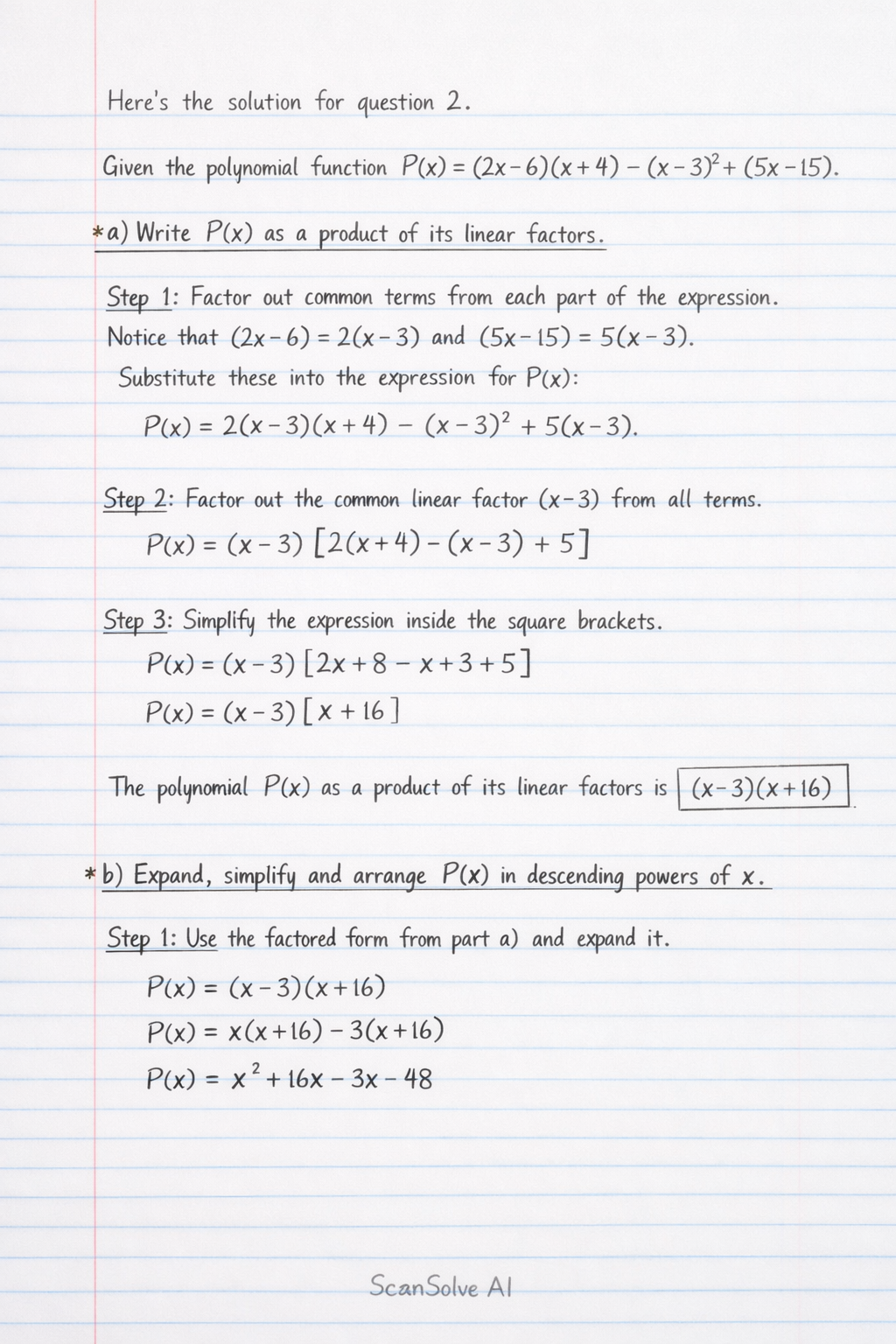
Given the polynomial function P(x) = (2x - 6)(x + 4) - (x - 3)2 + (5x - 15).
ScanSolve AI Answer
Answers
6 partsUse the left and right arrow keys to trace the curve, up and down to jump between key points, and plus and minus to zoom.
| Point | x | y |
|---|---|---|
| Minimum | −6.5 | −90.25 |
| y-intercept | 0 | −48 |
| x-intercept | 3 | 0 |
Step-by-step solution
9 stepsHere's the solution for question 2.
Given the polynomial function .
Part a· 3 steps
Write as a product of its linear factors.
Factor out common terms from each part of the expression.
Notice that and .
Substitute these into the expression for :Factor out the common linear factor from all terms.
Simplify the expression inside the square brackets.
The polynomial as a product of its linear factors is .
Part b
Expand, simplify and arrange in descending powers of .
Use the factored form from part a) and expand it.
Combine like terms.
The polynomial in descending powers of is .
Part c2
State the degree of .
The degree of a polynomial is the highest power of the variable in the polynomial. From part b), . The highest power of is 2.
The degree of is .
Part d
State the domain of definition of .
is a polynomial function. Polynomial functions are defined for all real numbers.
The domain of is or .
Part e
Solve in the equation .
Set each linear factor equal to zero.
Solve for in each equation.
The solutions are .
Part f
Determine the range of values of for which .
Identify the roots of the quadratic expression.
The roots are and , as found in part e).
Analyze the sign of the quadratic expression.
The expression is a parabola opening upwards (since the coefficient of is positive when expanded). This means the parabola is above or on the x-axis when is less than or equal to the smaller root, or greater than or equal to the larger root.
So, we need or .The range of values for is .
In interval notation, this is .
Try one yourself
A new problem that tests the same skill.
Still stuck on this one?
Ask a follow-up, and the answer starts from this question.
More Computer Science Questions
Handwritten Step-by-Step Solution
Get this as a handwritten image on WhatsApp — like a tutor wrote it for you.
Try on WhatsApp