
We read your photo as:
Define entity, attribute, and data model. Explain Second (2NF) and Third Normal Forms (3NF) in database design.
ScanSolve AI Answer
i)
- Entity: A real-world object or concept that is distinguishable from other objects and about which data can be stored. Examples include a student, a book, or a course.
- Attribute: A property or characteristic that describes an entity. For a 'student' entity, attributes might include 'student ID', 'name', or 'date of birth'.
- Data Model: An abstract model that organizes elements of data and standardizes how they relate to one another and to the properties of real-world entities. It defines the structure of a database.
ii)
-
Second Normal Form (2NF) addresses partial dependencies. A partial dependency occurs when a non-key attribute is functionally dependent on only a part of a composite primary key, rather than on the entire primary key. To achieve 2NF, these partial dependencies are removed by breaking down the table into smaller tables where non-key attributes are fully dependent on the primary key.
-
Third Normal Form (3NF) addresses transitive dependencies. A transitive dependency exists when a non-key attribute is functionally dependent on another non-key attribute, which in turn is dependent on the primary key. In other words, an attribute is indirectly dependent on the primary key through another non-key attribute. To achieve 3NF, these transitive dependencies are removed by placing the transitively dependent attributes into a new table.
Still stuck on this one?
Ask a follow-up, and the answer starts from this question.
More Computer Science Questions
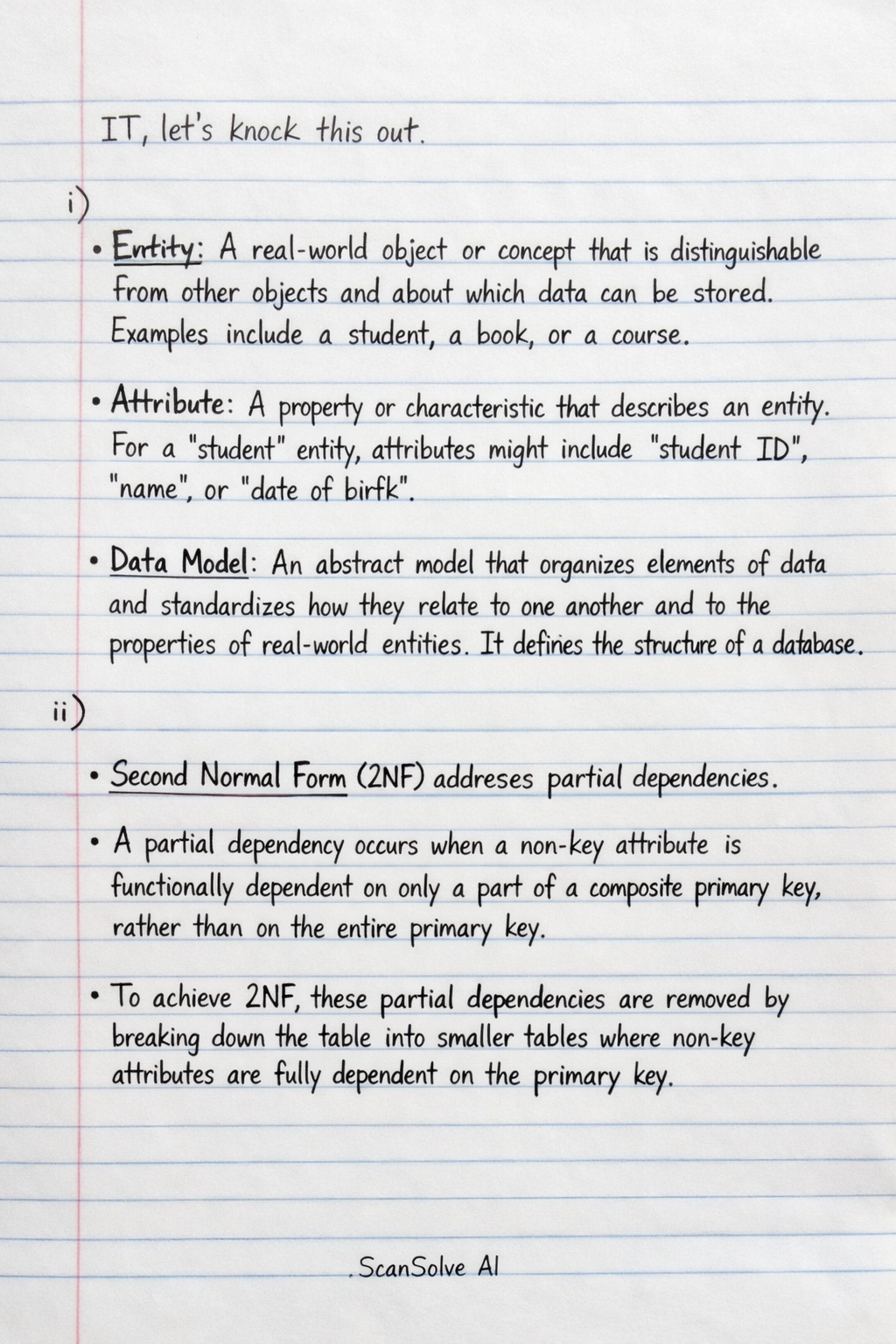
Handwritten Step-by-Step Solution
Get this as a handwritten image on WhatsApp — like a tutor wrote it for you.
Try on WhatsApp