
We read your photo as:
Describe the essential ICT facilities for a university library serving 2,000 students and 600 staff, including their nature, number, and importance.
ScanSolve AI Answer
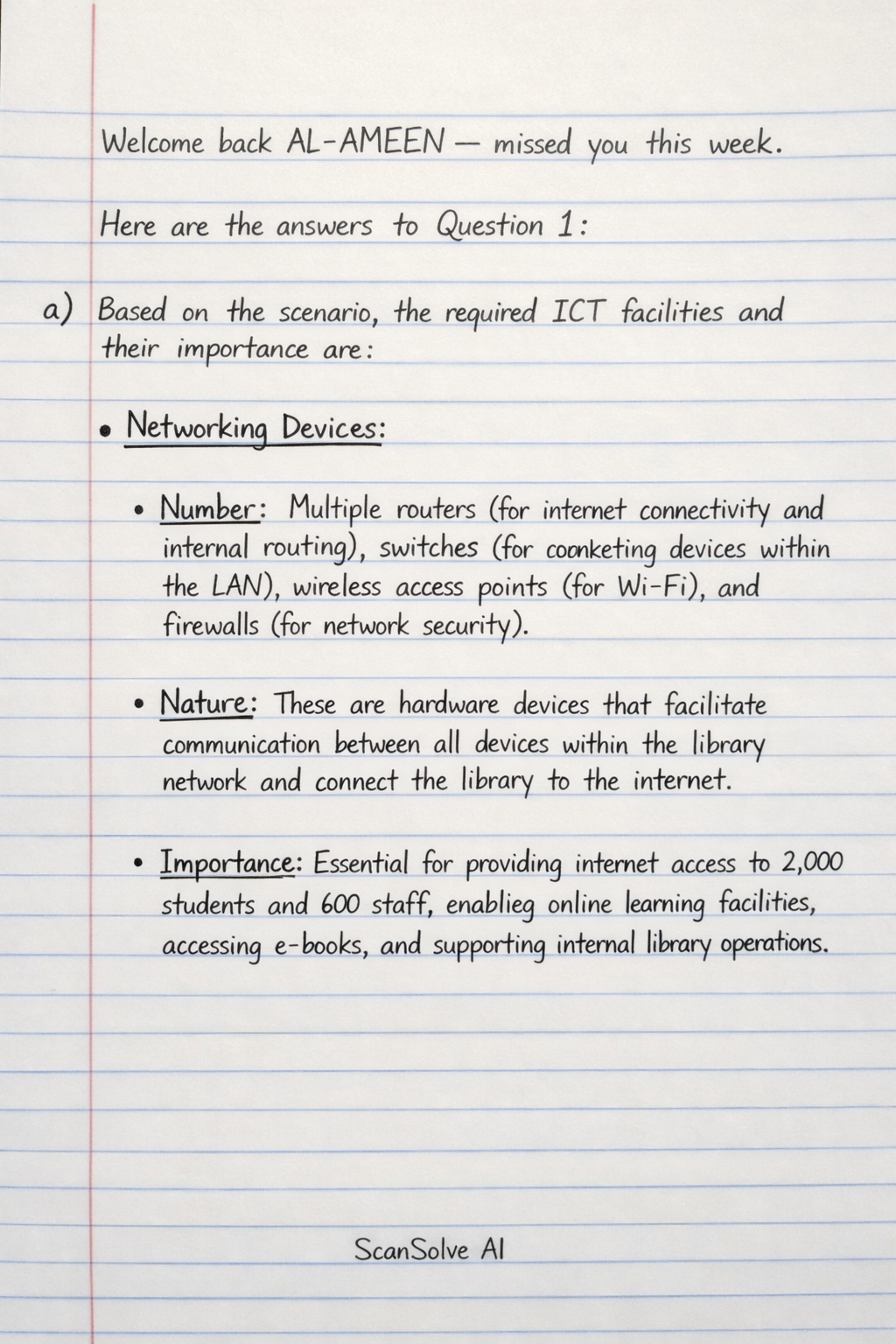
Here are the answers to Question 1:
a) Based on the scenario, the required ICT facilities and their importance are:
-
Networking Devices:
- Number: Multiple routers (for internet connectivity and internal routing), switches (for connecting devices within the LAN), wireless access points (for Wi-Fi), and firewalls (for network security).
- Nature: These are hardware devices that facilitate communication between all devices within the library network and connect the library to the internet.
- Importance: Essential for providing internet access to 2,000 students and 600 staff, enabling online learning facilities, accessing e-books, and supporting internal library operations.
-
Internetworking Devices:
- Number: Routers and potentially VPN concentrators if remote access is allowed.
- Nature: Devices that connect different networks (e.g., the library's internal network to the wider internet).
- Importance: Crucial for external access to e-books, online learning platforms, and general internet browsing.
-
Servers:
- Number: Multiple servers for different functions.
- Nature:
- Database Servers: To store information about 5,000 hardcopies, 10,000 e-books, student and staff records, and user authentication data.
- Web Servers: To host the online learning platform, library portal, and e-book access interfaces.
- Authentication Servers: To manage user identification and authentication for students and staff.
- File Servers: To store shared documents and digital resources.
- Backup Servers: For data redundancy and disaster recovery.
- Importance: Central to managing all digital resources, user access, and online services, ensuring data availability and integrity.
-
Other ICT Facilities:
- Number: Numerous workstations/PCs (for staff and students), printers, scanners, security cameras, and potentially biometric scanners.
- Nature: End-user devices and peripheral equipment.
- Importance: Provide direct access points for users to utilize library resources, facilitate administrative tasks, and enhance physical security.
b) The software, web application (or website) applications, and other programs required to run the business include:
- Library Management System (LMS): Software to manage hardcopy books, e-books, cataloging, circulation, acquisitions, and patron records.
- E-book Reader Software/Platforms: Applications or web-based platforms for accessing and reading the 10,000 e-books.
- Online Learning Platform/Learning Management System (LMS): A web application to deliver online courses and educational content.
- Operating Systems: Such as Windows, Linux, or macOS for servers, workstations, and other devices.
- Database Management Systems (DBMS): Software like MySQL, PostgreSQL, or Oracle to manage the underlying databases for the LMS and e-book platforms.
- Antivirus/Anti-malware Software: Essential for protecting all devices from malicious threats.
- Network Monitoring Tools: Software to monitor network traffic, device performance, and security events.
- User Authentication and Access Control Systems: Software to manage user logins, permissions, and enforce access policies.
- Office Productivity Suites: Such as Microsoft Office or LibreOffice for administrative tasks.
- Firewall and Intrusion Detection/Prevention Systems (IDS/IPS) Software: To protect the network from unauthorized access and attacks.
- Backup and Recovery Software: For regular data backups and system restoration.
c) With respect to CIA, security mechanisms and measures for devices, application software, and the entire facility against physical and logical attacks are:
-
Confidentiality:
- Devices: Implement strong access controls (e.g., multi-factor authentication for servers, role-based access), encrypt data at rest (e.g., full disk encryption) and in transit (e.g., SSL/TLS for network communication). Secure configurations for all devices.
- Application Software: Enforce role-based access control (RBAC) within applications, encrypt sensitive data stored or processed by applications, and ensure secure session management.
- Entire Facility: Implement strict physical access controls (e.g., access cards, biometric scanners for server rooms), ensure data privacy policies are in place, and conduct regular security awareness training for staff.
-
Integrity:
- Devices: Implement file integrity monitoring, use digital signatures for software updates, enforce strict change management processes, and regularly patch and update operating systems and firmware.
- Application Software: Implement input validation to prevent data corruption, use hashing and digital signatures for data verification, ensure proper error handling, and maintain audit trails/logs.
- Entire Facility: Implement data backup and recovery procedures, ensure data consistency across systems, and establish clear data governance policies.
-
Availability:
- Devices: Implement redundancy for critical hardware (e.g., RAID for storage, redundant power supplies), use uninterruptible power supplies (UPS), and ensure regular maintenance and monitoring.
- Application Software: Design applications for high availability (e.g., load balancing, clustering), implement robust backup and recovery mechanisms for application data, and ensure sufficient server resources.
- Entire Facility: Implement a robust network infrastructure with redundant links, ensure environmental controls (HVAC, fire suppression) for server rooms, and have a comprehensive disaster recovery plan.
-
Physical Attacks:
- Measures: Secure server rooms with locked doors, access control systems (key cards, biometrics), CCTV surveillance, environmental monitoring (temperature, humidity), fire suppression systems, and security guards. Implement asset tagging and inventory management.
-
Logical Attacks:
- Measures: Deploy firewalls and intrusion detection/prevention systems (IDS/IPS), implement strong password policies and multi-factor authentication, conduct regular vulnerability assessments and penetration testing, use up-to-date antivirus/anti-malware software, implement network segmentation, and provide ongoing cybersecurity training for all users.
d) A Disaster Recovery (DR) and Business Continuity (BC) plan in case of any disaster:
-
Disaster Recovery (DR) Plan:
- Data Backup and Recovery: Implement a comprehensive backup strategy (e.g., daily incremental, weekly full backups) for all critical data (e-books, user databases, system configurations). Store backups offsite in a secure location. Regularly test data restoration procedures to ensure recoverability.
- System Recovery: Maintain detailed documentation for restoring all critical systems (servers, network devices, applications). Utilize virtualization for easier system replication and recovery. Have agreements with vendors for quick replacement of critical hardware.
- Communication Plan: Establish clear communication protocols to inform staff, students, and stakeholders about the disaster, its impact, and recovery progress.
-
Business Continuity (BC) Plan:
- Business Impact Analysis (BIA): Identify critical library functions (e.g., e-book access, online learning, user authentication) and determine their Recovery Time Objectives (RTOs) and Recovery Point Objectives (RPOs).
- Alternative Facilities: Identify and prepare alternative locations or remote work capabilities for essential staff if the main library building becomes inaccessible.
- Emergency Procedures: Develop and regularly practice emergency evacuation plans, fire safety procedures, and protocols for various disaster scenarios (e.g., power outage, cyberattack).
- Vendor and Supplier Management: Establish agreements with critical vendors (e.g., internet service providers, e-book platform providers) to ensure continuity of services during a disaster.
- Regular Testing and Review: Periodically test the entire DR/BC plan through drills and simulations to identify gaps and ensure its effectiveness. Update the plan regularly to reflect changes in the library's infrastructure or operations.
Still stuck on this one?
Ask a follow-up, and the answer starts from this question.
More Computer Science Questions
Handwritten Step-by-Step Solution
Get this as a handwritten image on WhatsApp — like a tutor wrote it for you.
Try on WhatsApp