
We read your photo as:
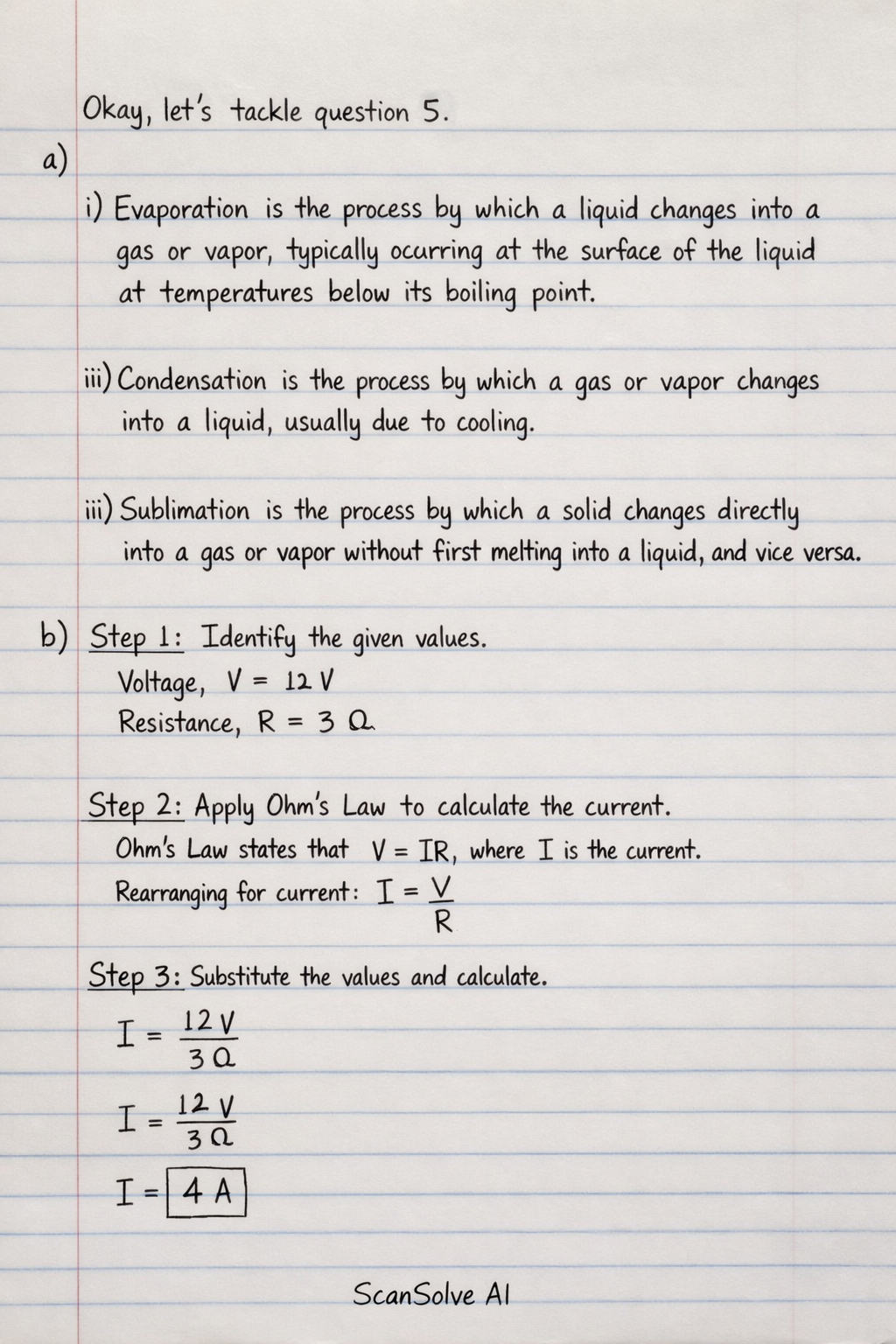
Evaporation is the process by which a liquid changes into a gas or vapor, typically occurring at the surface of the liquid at temperatures below its boiling point.
ScanSolve AI Answer
Answer
Step-by-step solution
3 stepsOkay, let's tackle question 5.
Part a(i)
Evaporation is the process by which a liquid changes into a gas or vapor, typically occurring at the surface of the liquid at temperatures below its boiling point.
Part a(ii)
Condensation is the process by which a gas or vapor changes into a liquid, usually due to cooling.
Part a(iii)
Sublimation is the process by which a solid changes directly into a gas or vapor without first melting into a liquid, and vice versa.
Part b
Identify the given values.
Voltage,
Resistance,Apply Ohm's Law to calculate the current.
Ohm's Law states that , where is the current.
Rearranging for current:Substitute the values and calculate.
Part c(i)
Here are three differences between a porcupine and a hedgehog:
-
- Size: Porcupines are generally much larger than hedgehogs.
-
- Quills: Porcupine quills are typically longer, sharper, and can detach easily, while hedgehog spines are shorter, less sharp, and generally remain attached.
-
- Defense mechanism: Porcupines may release their quills as a defense, whereas hedgehogs primarily roll into a tight ball to protect themselves with their spines.
Part c(ii)
The difference between a Vertebrate and an Invertebrate is the presence or absence of a backbone (vertebral column). Vertebrates are animals that possess a backbone, while invertebrates are animals that do not have a backbone.
Part d(i)
According to the Brønsted-Lowry definition, an Acid is a proton (H) donor.
Part d(ii)
According to the Brønsted-Lowry definition, a Base is a proton (H) acceptor.
Try one yourself
A new problem that tests the same skill.
Still stuck on this one?
Ask a follow-up, and the answer starts from this question.
More Computer Science Questions
Handwritten Step-by-Step Solution
Get this as a handwritten image on WhatsApp — like a tutor wrote it for you.
Try on WhatsApp