
We read your photo as:
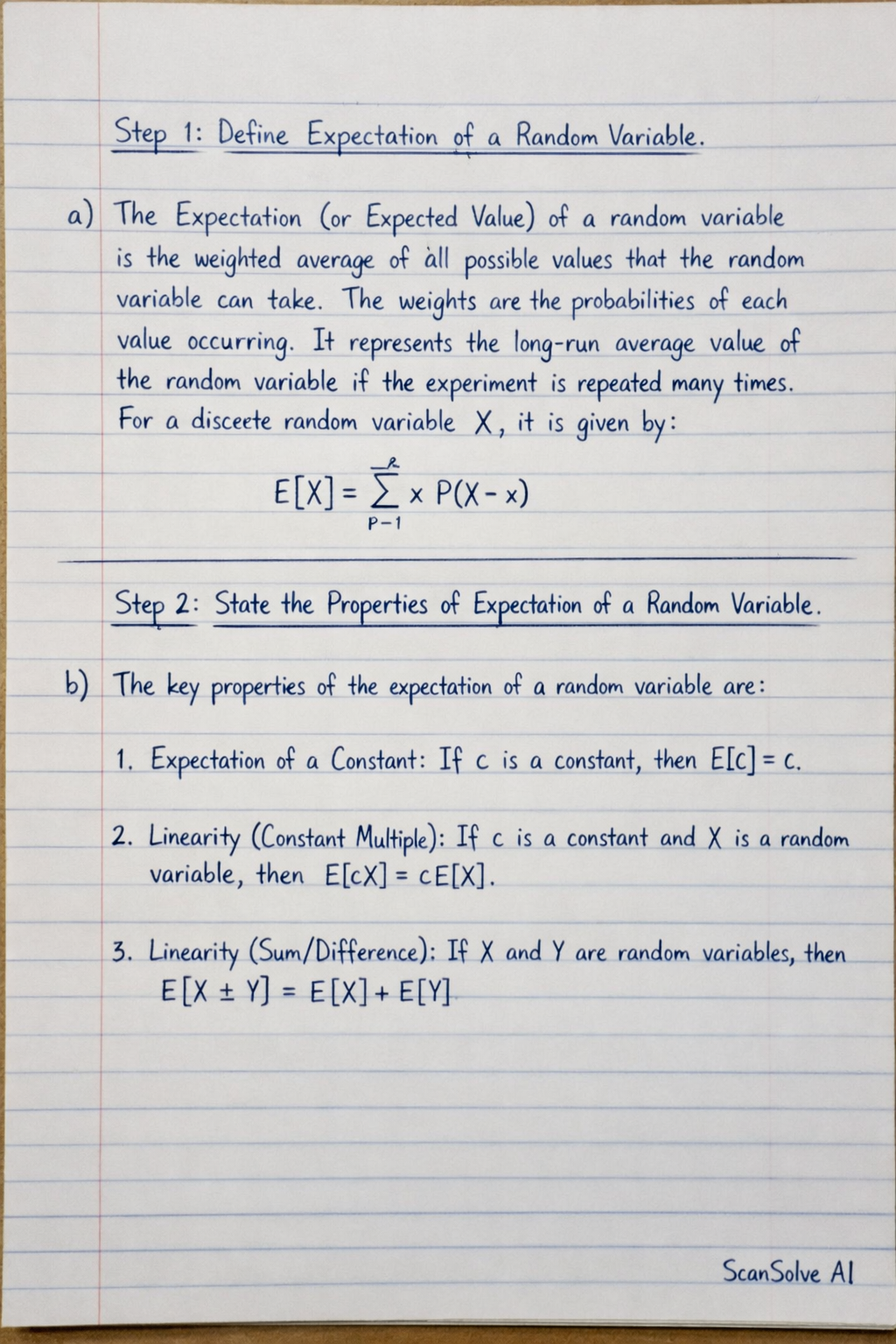
Define Expectation of a Random Variable.
Computer Science
ScanSolve AI Answer
Step-by-step solution
3 stepsDefine Expectation of a Random Variable.
- a) The Expectation (or Expected Value) of a random variable is the weighted average of all possible values that the random variable can take. The weights are the probabilities of each value occurring. It represents the long-run average value of the random variable if the experiment is repeated many times. For a discrete random variable , it is given by .
State the Properties of Expectation of a Random Variable.
- b) The key properties of the expectation of a random variable are:
- Expectation of a Constant: If is a constant, then .
- Linearity (Constant Multiple): If is a constant and is a random variable, then .
- Linearity (Sum/Difference): If and are random variables, then .
- Expectation of a Sum of Independent Random Variables: If are random variables, then . This property holds even if the random variables are not independent.
- Expectation of a Product of Independent Random Variables: If and are independent random variables, then .
- b) The key properties of the expectation of a random variable are:
Construct the Probability Distribution Table and find the Expected Value of X.
-
c) Let be the sample space for tossing a fair coin twice. The possible outcomes are:
Each outcome has a probability of since the coin is fair. The random variable is defined such that if is T (tail) and if is H (head). This means counts the number of heads in the two tosses. Let's map the outcomes to the values of :
The possible values for are .
Now, we find the probability for each value of :- : Occurs for outcome . So, .
- : Occurs for outcomes and . So, .
- : Occurs for outcome . So, .
The Probability Distribution Table for is:
Now, we calculate the Expected Value of , :
The Expected Value of is .
-
Was this helpful?
Still stuck on this one?
Ask a follow-up, and the answer starts from this question.
Got a different question?Ask your own question
More Computer Science Questions
QCalculate the expectation of a discrete random variable, using the example of tossing four coins.QGiven a random variable X with E[X] = 0 and Var(X) = 1, find the expected value and variance of Z…QA discrete random variable X has the following probability distribution: P(X=0)=a, P(X=1)=a…QA random variable X is a Bernoulli random variable if and only if it satisfies the conditions of a…QA decret random variable X is such that X~B(8, 1/4). Find a) P(X=2) b) P(X greater Dan or equal to…
Handwritten Step-by-Step Solution
Get this as a handwritten image on WhatsApp — like a tutor wrote it for you.
Try on WhatsApp