
We read your photo as:
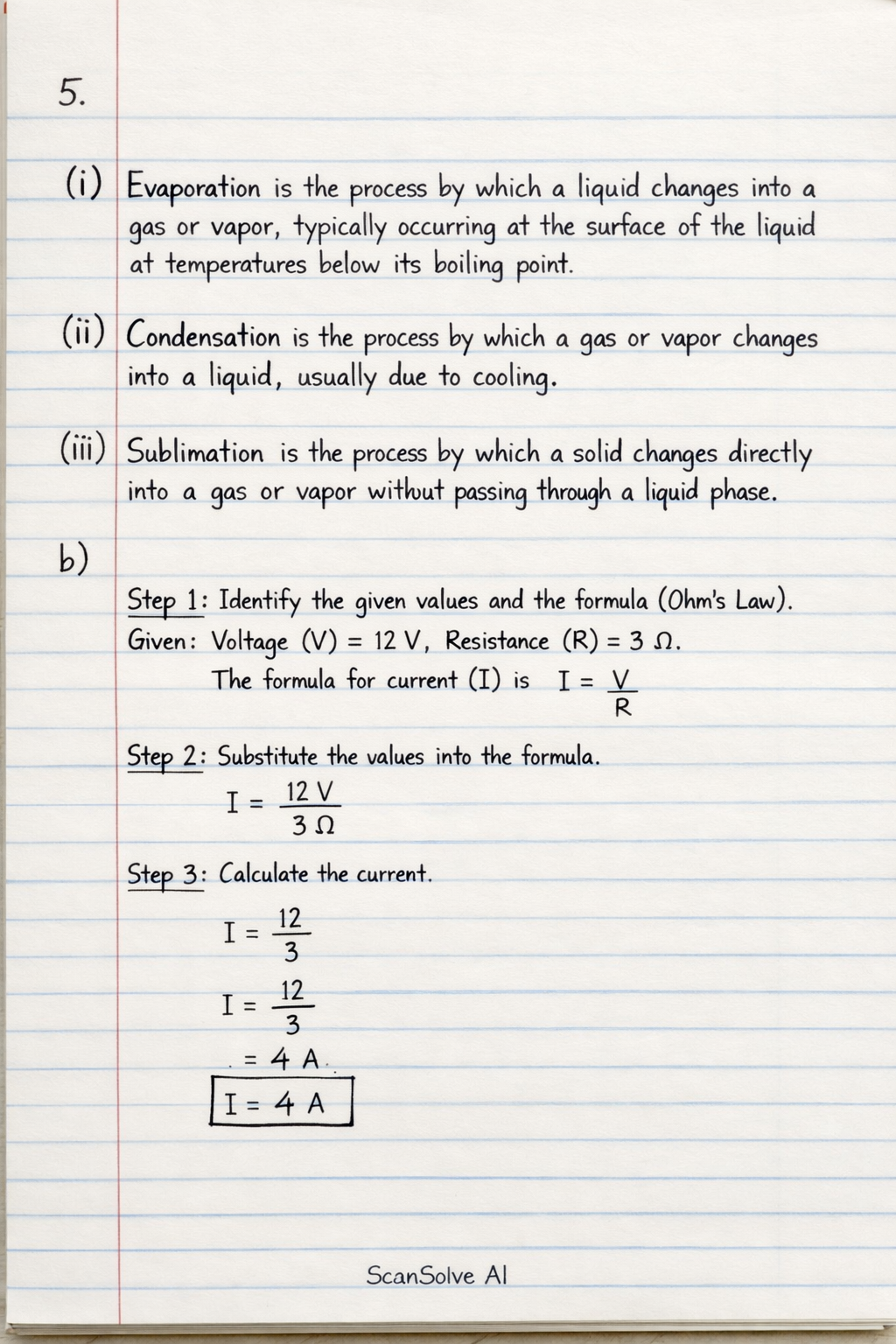
I) Evaporation is the process by which a liquid changes into a gas or vapor, typically occurring at the surface of the liquid at temperatures below its boiling point.
ScanSolve AI Answer
Step-by-step solution
6 stepsa)
i) Evaporation is the process by which a liquid changes into a gas or vapor, typically occurring at the surface of the liquid at temperatures below its boiling point.
ii) Condensation is the process by which a gas or vapor changes into a liquid, usually due to cooling.
iii) Sublimation is the process by which a solid changes directly into a gas or vapor without passing through a liquid phase.
b)
Identify the given values and the formula (Ohm's Law).
Given: Voltage () = , Resistance () = .
The formula for current () is .Substitute the values into the formula.
Calculate the current.
c)
i) Three differences between a porcupine and a hedgehog:
- Porcupines are generally larger than hedgehogs.
- Porcupine quills are longer and can detach easily, while hedgehog spines are shorter and generally remain attached.
- Porcupines are rodents, whereas hedgehogs are insectivores.
ii) The difference between a Vertebrate and an Invertebrate:
- Vertebrates are animals that possess a backbone (spinal column) and an internal skeleton.
- Invertebrates are animals that lack a backbone.
d) The Bronsted-Lowry definition for:
i) Acid: A substance that is a proton (H) donor.
ii) Base: A substance that is a proton (H) acceptor.
a)
i) Homeostasis is the maintenance of a stable internal environment in an organism despite changes in external conditions.
ii) Homeostasis occurs throughout the body of an organism, involving various organs and systems.
b) Four desirable and observable physical features used in the selection of farm animals (suitable breed):
- Good body conformation (e.g., well-muscled, strong frame).
- High growth rate.
- High production yield (e.g., milk, meat, eggs).
- Resistance to common diseases.
c)
i) A drought is a prolonged period of abnormally low rainfall, leading to a severe shortage of water.
ii) Three examples of extreme weather events:
- Hurricanes (or typhoons/cyclones)
- Tornadoes
- Severe heatwaves
d)
i) Atomic mass is the mass of an atom, typically expressed in atomic mass units (amu). It is approximately equal to the total number of protons and neutrons in the atom's nucleus.
ii) The atomic mass of the following elements:
a) H (Hydrogen):
b) O (Oxygen):
c) Na (Sodium):
d) Ca (Calcium):
e) Cl (Chlorine):
a)
Identify the given resistances and the formula for total resistance in a series circuit.
Given: , , .
For resistors in series, the total resistance () is the sum of individual resistances: .Substitute the values into the formula.
Calculate the total resistance.
b)
i) Fermentation is a metabolic process that produces chemical changes in organic substrates through the action of enzymes, typically occurring in the absence of oxygen.
ii) Hybridization is the process of interbreeding individuals from genetically distinct populations or species to produce a hybrid offspring.
iii) Domestication is the process of adapting wild plants and animals for human use through selective breeding, leading to genetic changes over generations.
c)
i) Four environmental effects of illegal mining:
- Deforestation and habitat destruction.
- Soil erosion and degradation.
- Water pollution (e.g., contamination by heavy metals like mercury or cyanide).
- Loss of biodiversity.
ii) Two challenges faced by communities near mining areas:
- Health problems due to exposure to pollutants.
- Loss of traditional livelihoods such as farming or fishing.
d) Four advantages of local breeds of farm animals:
- They are well-adapted to local climatic conditions and environments.
- They often possess natural resistance or tolerance to local diseases and parasites.
- They typically have lower input requirements, thriving on local feed resources and needing less specialized care.
- They contribute to genetic diversity, which is valuable for future breeding programs and resilience.
Still stuck on this one?
Ask a follow-up, and the answer starts from this question.
More Computer Science Questions
Handwritten Step-by-Step Solution
Get this as a handwritten image on WhatsApp — like a tutor wrote it for you.
Try on WhatsApp