
We read your photo as:
Explain the four arithmetic systems used in digital circuits or systems and convert binary to decimal.
Computer Science
ScanSolve AI Answer
Answers
6 partsStep-by-step solution
21 stepsHere are the answers for question 1:
Part a
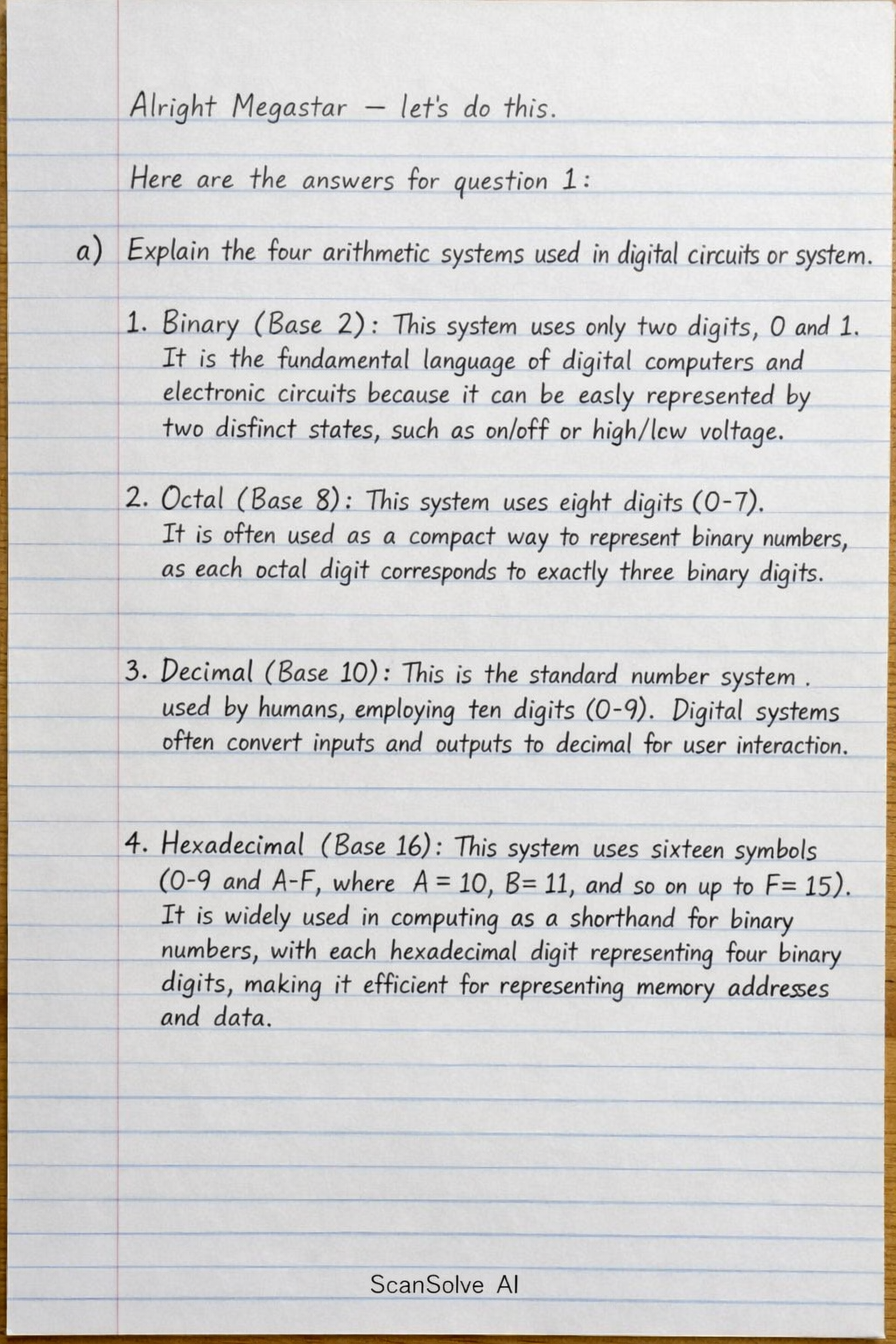
Explain the four arithmetic systems used in digital circuits or system.
- Binary (Base 2): This system uses only two digits, 0 and 1. It is the fundamental language of digital computers and electronic circuits because it can be easily represented by two distinct states, such as on/off or high/low voltage.
- Octal (Base 8): This system uses eight digits (0-7). It is often used as a compact way to represent binary numbers, as each octal digit corresponds to exactly three binary digits.
- Decimal (Base 10): This is the standard number system used by humans, employing ten digits (0-9). Digital systems often convert inputs and outputs to decimal for user interaction.
- Hexadecimal (Base 16): This system uses sixteen symbols (0-9 and A-F, where A represents 10, B is 11, and so on up to F for 15). It is widely used in computing as a shorthand for binary numbers, with each hexadecimal digit representing four binary digits, making it efficient for representing memory addresses and data.
Part b(i)
Convert the following to base 10
Expand the binary number using powers of 2.
Calculate the values.
Sum the results.
Part b(ii)
Expand the binary number using powers of 2.
Calculate the values.
Sum the results.
Part b(iii)
Expand the binary number using powers of 2.
Calculate the values.
Sum the results.
Part c(i)
Convert the following to base 16
Multiply the fractional part by 16 and record the integer part.
Take the new fractional part and repeat the multiplication.
Repeat for desired precision.
Read the integer parts from top to bottom.
Part c(ii)
Divide the integer by 16 and record the remainder.
Divide the quotient by 16 and record the remainder.
Divide the quotient by 16 and record the remainder.
Read the remainders from bottom to top.
Part c(iii)
Divide the integer by 16 and record the remainder.
Divide the quotient by 16 and record the remainder.
Divide the quotient by 16 and record the remainder.
Read the remainders from bottom to top.
Was this helpful?
Try one yourself
A new problem that tests the same skill.
Still stuck on this one?
Ask a follow-up, and the answer starts from this question.
Got a different question?Ask your own question
More Computer Science Questions
QExplain the four arithmetic systems used in digital circuits or system and convert 0.1001 base 2 to…QIdentify the four arithmetic systems.QConvert binary numbers to decimal and perform arithmetic operations.QConvert decimal integers to binary, octal, and hexadecimal.QWhat is a binary number system? Convert the following numbers i. decimal numbers into binary numbers…
Handwritten Step-by-Step Solution
Get this as a handwritten image on WhatsApp — like a tutor wrote it for you.
Try on WhatsApp