

This computer science problem involves algorithmic thinking and programming concepts. The solution below explains the approach, logic, and implementation step by step.
ScanSolve AI Answer
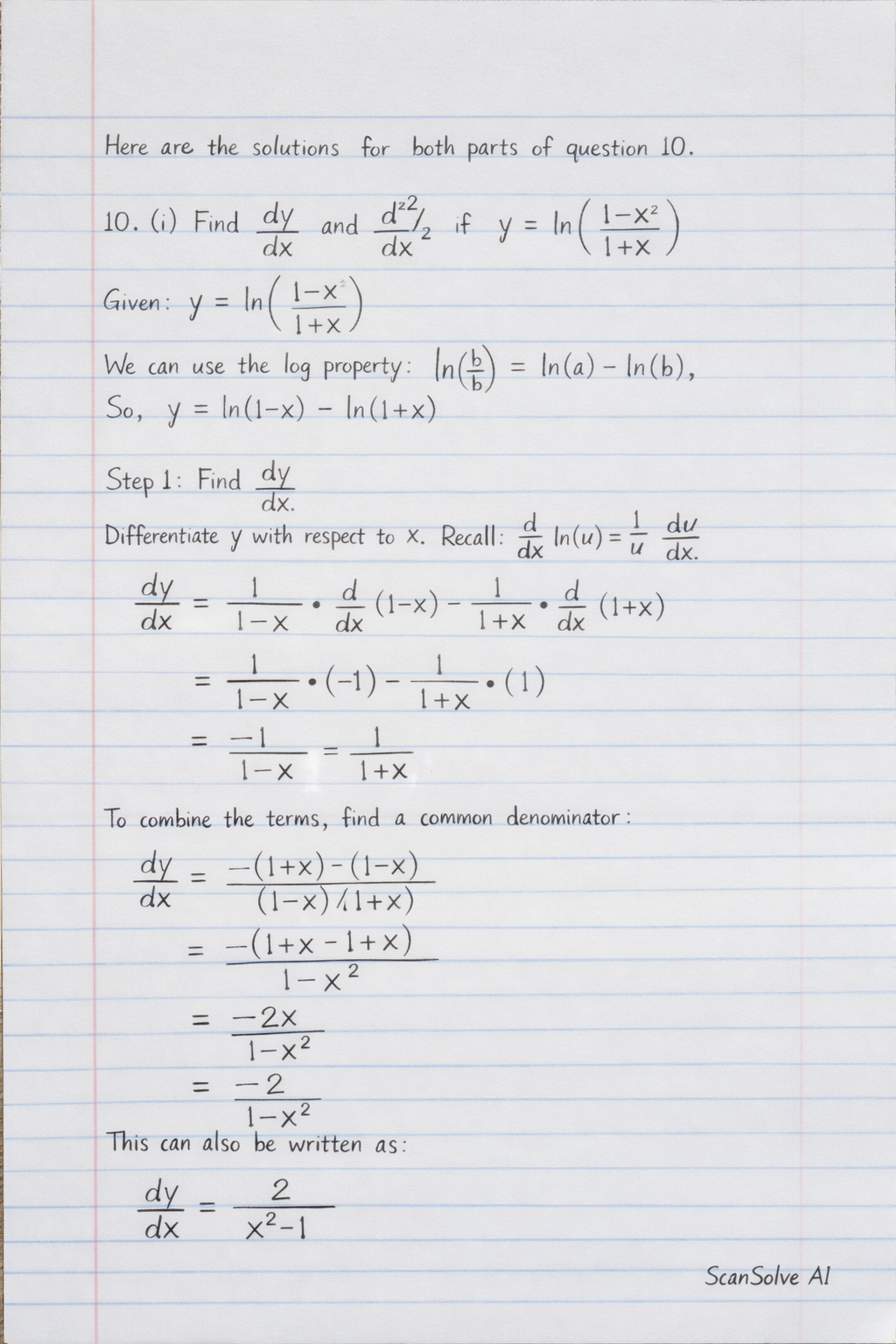
Here are the solutions for both parts of question 10. 10. (i) Find (dy)/(dx) and (d^2y)/(dx^2) if y = ((1-x)/(1+x)) Given the function: y = ((1-x)/(1+x)) We can use the logarithm property ((a)/(b)) = (a) - (b) to simplify the expression: y = (1-x) - (1+x) Step 1: Find (dy)/(dx). Differentiate y with respect to x. Recall that (d)/(dx)((u)) = (1)/(u) (du)/(dx). (dy)/(dx) = (1)/(1-x) · (d)/(dx)(1-x) - (1)/(1+x) · (d)/(dx)(1+x) (dy)/(dx) = (1)/(1-x) · (-1) - (1)/(1+x) · (1) (dy)/(dx) = -(1)/(1-x) - (1)/(1+x) To combine the terms, find a common denominator: (dy)/(dx) = (-(1+x) - (1-x))/((1-x)(1+x)) (dy)/(dx) = (-1-x-1+x)/(1-x^2) (dy)/(dx) = (-2)/(1-x^2) This can also be written as: (dy)/(dx) = (2)/(x^2-1) Step 2: Find (d^2y)/(dx^2). Now, differentiate (dy)/(dx) with respect to x. We can rewrite (dy)/(dx) as 2(x^2-1)^-1. (d^2y)/(dx^2) = (d)/(dx)(2(x^2-1)^-1) Using the chain rule, (d)/(dx)(u^n) = nu^n-1(du)/(dx): (d^2y)/(dx^2) = 2 · (-1)(x^2-1)^-2 · (d)/(dx)(x^2-1) (d^2y)/(dx^2) = -2(x^2-1)^-2 · (2x) (d^2y)/(dx^2) = -(4x)/((x^2-1)^2) Note: The instruction "giving your answer in terms of t" appears to be a typo, as there is no variable 't' in the given function. The answers are provided in terms of x. The derivatives are: (dy)/(dx) = (2)/(x^2-1) (d^2y)/(dx^2) = -(4x)/((x^2-1)^2) 10. (ii) If x^2 - xy + y^2 = 3, show that (2y-x)(d^2y)/(dx^2) + 2((dy)/(dx))^2 - 2(dy)/(dx) + 2 = 0 Given the implicit equation: x^2 - xy + y^2 = 3 Step 1: Find (dy)/(dx) by implicitly differentiating the equation with respect to x. Differentiate each term: (d)/(dx)(x^2) - (d)/(dx)(xy) + (d)/(dx)(y^2) = (d)/(dx)(3) 2x - (1 · y + x · (dy)/(dx)) + 2y (dy)/(dx) = 0 2x - y - x(dy)/(dx) + 2y(dy)/(dx) = 0 Group terms containing (dy)/(dx): (2y-x)(dy)/(dx) = y - 2x Step 2: Find (d^2y)/(dx^2) by implicitly differentiating the equation from Step 1 with respect to x. We will differentiate (2y-x)(dy)/(dx) = y - 2x. Apply the product rule to the left side and differentiate the right side: (d)/(dx)(2y-x) · (dy)/(dx) + (2y-x) · (d)/(dx)((dy)/(dx)) = (d)/(dx)(y - 2x) (2(dy)/(dx) - 1)(dy)/(dx) + (2y-x)(d^2y)/(dx^2) = (dy)/(dx) - 2 Expand the left side: 2((dy)/(dx))^2 - (dy)/(dx) + (2y-x)(d^2y)/(dx^2) = (dy)/(dx) - 2 Rearrange the terms to match the target equation: (2y-x)(d^2y)/(dx^2) + 2((dy)/(dx))^2 - (dy)/(dx) - (dy)/(dx) + 2 = 0 (2y-x)(d^2y)/(dx^2) + 2((dy)/(dx))^2 - 2(dy)/(dx) + 2 = 0 This matches the equation we needed to show.