This computer science problem involves algorithmic thinking and programming concepts. The solution below explains the approach, logic, and implementation step by step.
ScanSolve AI Answer
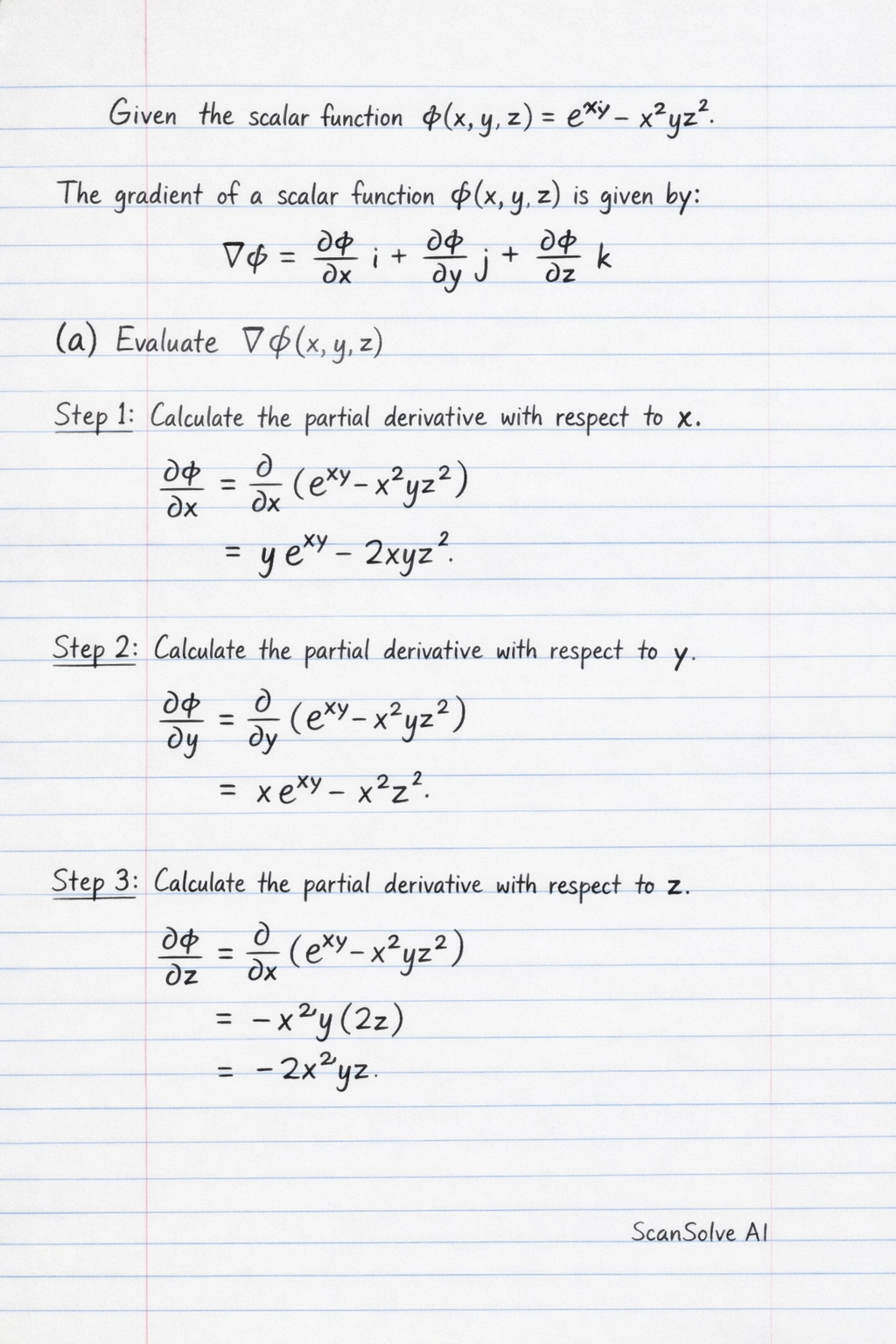
Given the scalar function $\phi(x, y, z) = e^{xy} - x^2yz^2$.
The gradient of a scalar function $\phi(x, y, z)$ is given by:
$$\nabla \phi = \frac{\partial \phi}{\partial x} \mathbf{i} + \frac{\partial \phi}{\partial y} \mathbf{j} + \frac{\partial \phi}{\partial z} \mathbf{k}$$
a) Evaluate $\nabla \phi (x, y, z)$
Step 1: Calculate the partial derivative with respect to $x$.
$$\frac{\partial \phi}{\partial x} = \frac{\partial}{\partial x} (e^{xy} - x^2yz^2) = y e^{xy} - 2xyz^2$$
Step 2: Calculate the partial derivative with respect to $y$.
$$\frac{\partial \phi}{\partial y} = \frac{\partial}{\partial y} (e^{xy} - x^2yz^2) = x e^{xy} - x^2z^2$$
Step 3: Calculate the partial derivative with respect to $z$.
$$\frac{\partial \phi}{\partial z} = \frac{\partial}{\partial z} (e^{xy} - x^2yz^2) = -x^2y(2z) = -2x^2yz$$
Step 4: Combine the partial derivatives to form the gradient vector.
$$\nabla \phi (x, y, z) = (y e^{xy} - 2xyz^2) \mathbf{i} + (x e^{xy} - x^2z^2) \mathbf{j} + (-2x^2yz) \mathbf{k}$$
The gradient is:
$$\boxed{\nabla \phi (x, y, z) = (y e^{xy} - 2xyz^2) \mathbf{i} + (x e^{xy} - x^2z^2) \mathbf{j} - 2x^2yz \mathbf{k}}$$
b) Evaluate $\nabla \phi (2, -1, 1)$
Substitute $x=2$, $y=-1$, and $z=1$ into the expression for $\nabla \phi (x, y, z)$ from part (a).
Step 1: Calculate the $\mathbf{i}$ component.
$$y e^{xy} - 2xyz^2 = (-1) e^{(2)(-1)} - 2(2)(-1)(1)^2 = -e^{-2} + 4$$
Step 2: Calculate the $\mathbf{j}$ component.
$$x e^{xy} - x^2z^2 = (2) e^{(2)(-1)} - (2)^2(1)^2 = 2e^{-2} - 4$$
Step 3: Calculate the $\mathbf{k}$ component.
$$-2x^2yz = -2(2)^2(-1)(1) = -2(4)(-1)(1) = 8$$
Step 4: Combine the components.
$$\nabla \phi (2, -1, 1) = (-e^{-2} + 4) \mathbf{i} + (2e^{-2} - 4) \mathbf{j} + 8 \mathbf{k}$$
The gradient at $(2, -1, 1)$ is:
$$\boxed{\nabla \phi (2, -1, 1) = (4 - e^{-2}) \mathbf{i} + (2e^{-2} - 4) \mathbf{j} + 8 \mathbf{k}}$$
c) Evaluate $|\nabla \phi (1, 1, -1)|$
First, evaluate $\nabla \phi (1, 1, -1)$ by substituting $x=1$, $y=1$, and $z=-1$ into the expression for $\nabla \phi (x, y, z)$.
Step 1: Calculate the $\mathbf{i}$ component.
$$y e^{xy} - 2xyz^2 = (1) e^{(1)(1)} - 2(1)(1)(-1)^2 = e - 2(1)(1) = e - 2$$
Step 2: Calculate the $\mathbf{j}$ component.
$$x e^{xy} - x^2z^2 = (1) e^{(1)(1)} - (1)^2(-1)^2 = e - 1(1) = e - 1$$
Step 3: Calculate the $\mathbf{k}$ component.
$$-2x^2yz = -2(1)^2(1)(-1) = -2(1)(-1) = 2$$
Step 4: Form the gradient vector at $(1, 1, -1)$.
$$\nabla \phi (1, 1, -1) = (e - 2) \mathbf{i} + (e - 1) \mathbf{j} + 2 \mathbf{k}$$
Step 5: Calculate the magnitude of the vector. The magnitude of a vector $A\mathbf{i} + B\mathbf{j} + C\mathbf{k}$ is $\sqrt{A^2 + B^2 + C^2}$.
$$|\nabla \phi (1, 1, -1)| = \sqrt{(e-2)^2 + (e-1)^2 + (2)^2}$$
$$|\nabla \phi (1, 1, -1)| = \sqrt{(e^2 - 4e + 4) + (e^2 - 2e + 1) + 4}$$
$$|\nabla \phi (1, 1, -1)| = \sqrt{e^2 - 4e + 4 + e^2 - 2e + 1 + 4}$$
$$|\nabla \phi (1, 1, -1)| = \sqrt{2e^2 - 6e + 9}$$
The magnitude of the gradient at $(1, 1, -1)$ is:
$$\boxed{|\nabla \phi (1, 1, -1)| = \sqrt{2e^2 - 6e + 9}}$$
Given the scalar function (x, y, z) = e^xy - x^2yz^2.
|Computer Science
Given the scalar function (x, y, z) = e^xy - x^2yz^2.
ScanSolve AI Answer
Given the scalar function ϕ(x,y,z)=exy−x2yz2.
The gradient of a scalar function ϕ(x,y,z) is given by:
∇ϕ=∂x∂ϕi+∂y∂ϕj+∂z∂ϕk
a) Evaluate ∇ϕ(x,y,z)
Step 1: Calculate the partial derivative with respect to x.
∂x∂ϕ=∂x∂(exy−x2yz2)=yexy−2xyz2
Step 2: Calculate the partial derivative with respect to y.
∂y∂ϕ=∂y∂(exy−x2yz2)=xexy−x2z2
Step 3: Calculate the partial derivative with respect to z.
∂z∂ϕ=∂z∂(exy−x2yz2)=−x2y(2z)=−2x2yz
Step 4: Combine the partial derivatives to form the gradient vector.
∇ϕ(x,y,z)=(yexy−2xyz2)i+(xexy−x2z2)j+(−2x2yz)k
The gradient is:
∇ϕ(x,y,z)=(yexy−2xyz2)i+(xexy−x2z2)j−2x2yzk
b) Evaluate ∇ϕ(2,−1,1)
Substitute x=2, y=−1, and z=1 into the expression for ∇ϕ(x,y,z) from part (a).
Step 1: Calculate the i component.
yexy−2xyz2=(−1)e(2)(−1)−2(2)(−1)(1)2=−e−2+4
Step 2: Calculate the j component.
xexy−x2z2=(2)e(2)(−1)−(2)2(1)2=2e−2−4
Step 3: Calculate the k component.
−2x2yz=−2(2)2(−1)(1)=−2(4)(−1)(1)=8
Step 4: Combine the components.
∇ϕ(2,−1,1)=(−e−2+4)i+(2e−2−4)j+8k
The gradient at (2,−1,1) is:
∇ϕ(2,−1,1)=(4−e−2)i+(2e−2−4)j+8k
c) Evaluate ∣∇ϕ(1,1,−1)∣
First, evaluate ∇ϕ(1,1,−1) by substituting x=1, y=1, and z=−1 into the expression for ∇ϕ(x,y,z).
Step 1: Calculate the i component.
yexy−2xyz2=(1)e(1)(1)−2(1)(1)(−1)2=e−2(1)(1)=e−2
Step 2: Calculate the j component.
xexy−x2z2=(1)e(1)(1)−(1)2(−1)2=e−1(1)=e−1
Step 3: Calculate the k component.
−2x2yz=−2(1)2(1)(−1)=−2(1)(−1)=2
Step 4: Form the gradient vector at (1,1,−1).
∇ϕ(1,1,−1)=(e−2)i+(e−1)j+2k
Step 5: Calculate the magnitude of the vector. The magnitude of a vector Ai+Bj+Ck is A2+B2+C2.
∣∇ϕ(1,1,−1)∣=(e−2)2+(e−1)2+(2)2∣∇ϕ(1,1,−1)∣=(e2−4e+4)+(e2−2e+1)+4∣∇ϕ(1,1,−1)∣=e2−4e+4+e2−2e+1+4∣∇ϕ(1,1,−1)∣=2e2−6e+9
The magnitude of the gradient at (1,1,−1) is:
∣∇ϕ(1,1,−1)∣=2e2−6e+9
Need help with your own homework?
Get instant step-by-step solutions to any question. Free to start.