
We read your photo as:
Given the unsorted list, sort the list using Range Sort. [151, 110, 171, 119, 181, 131, 111, 141, 201, 121, ]
ScanSolve AI Answer
Answer
[110, 111, 119, 121, 131, 141, 151, 171, 181, 201]
Step-by-step solution
4 stepsTo sort the given list using Range Sort, we will interpret "Range Sort" as Counting Sort, which is an efficient algorithm for sorting integers within a specific range.
The given unsorted list is:
Find the minimum and maximum values in the list.
The minimum value in the list is 110.
The maximum value in the list is 201.Determine the range and initialize the counting array.
The range of values is .
Create a counting array (or frequency array) of size 92, initialized with zeros. Each index in this array will correspond to the value .
For example, index 0 corresponds to 110, index 1 to 111, and so on, up to index 91 corresponding to 201.Populate the counting array.
Iterate through the original list. For each element , increment the count at index in the counting array.
- For 151: increment count at index .
- For 110: increment count at index .
- For 171: increment count at index .
- For 119: increment count at index .
- For 181: increment count at index .
- For 131: increment count at index .
- For 111: increment count at index .
- For 141: increment count at index .
- For 201: increment count at index .
- For 121: increment count at index .
After this step, the counting array will have a 1 at indices , and 0 at all other indices.
Construct the sorted list.
Iterate through the counting array from index 0 to 91. For each index where the count is 1, add the value to the sorted list.
- Index 0 has count
- Index 1 has count
- Index 9 has count
- Index 11 has count
- Index 21 has count
- Index 31 has count
- Index 41 has count
- Index 61 has count
- Index 71 has count
- Index 91 has count
The sorted list is:
Try one yourself
A new problem that tests the same skill.
Still stuck on this one?
Ask a follow-up, and the answer starts from this question.
More Computer Science Questions
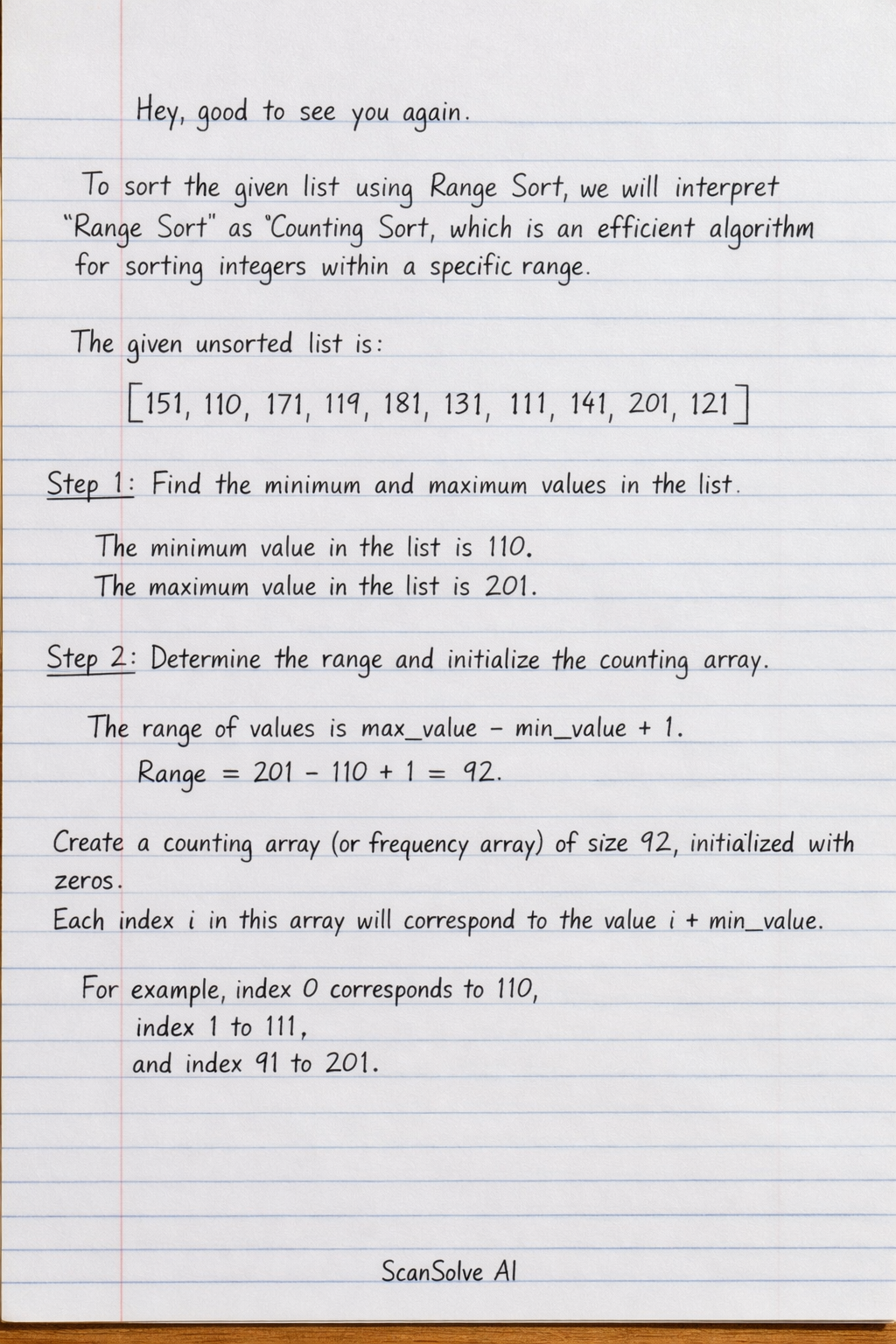
Handwritten Step-by-Step Solution
Get this as a handwritten image on WhatsApp — like a tutor wrote it for you.
Try on WhatsApp