

This computer science problem involves algorithmic thinking and programming concepts. The solution below explains the approach, logic, and implementation step by step.
ScanSolve AI Answer
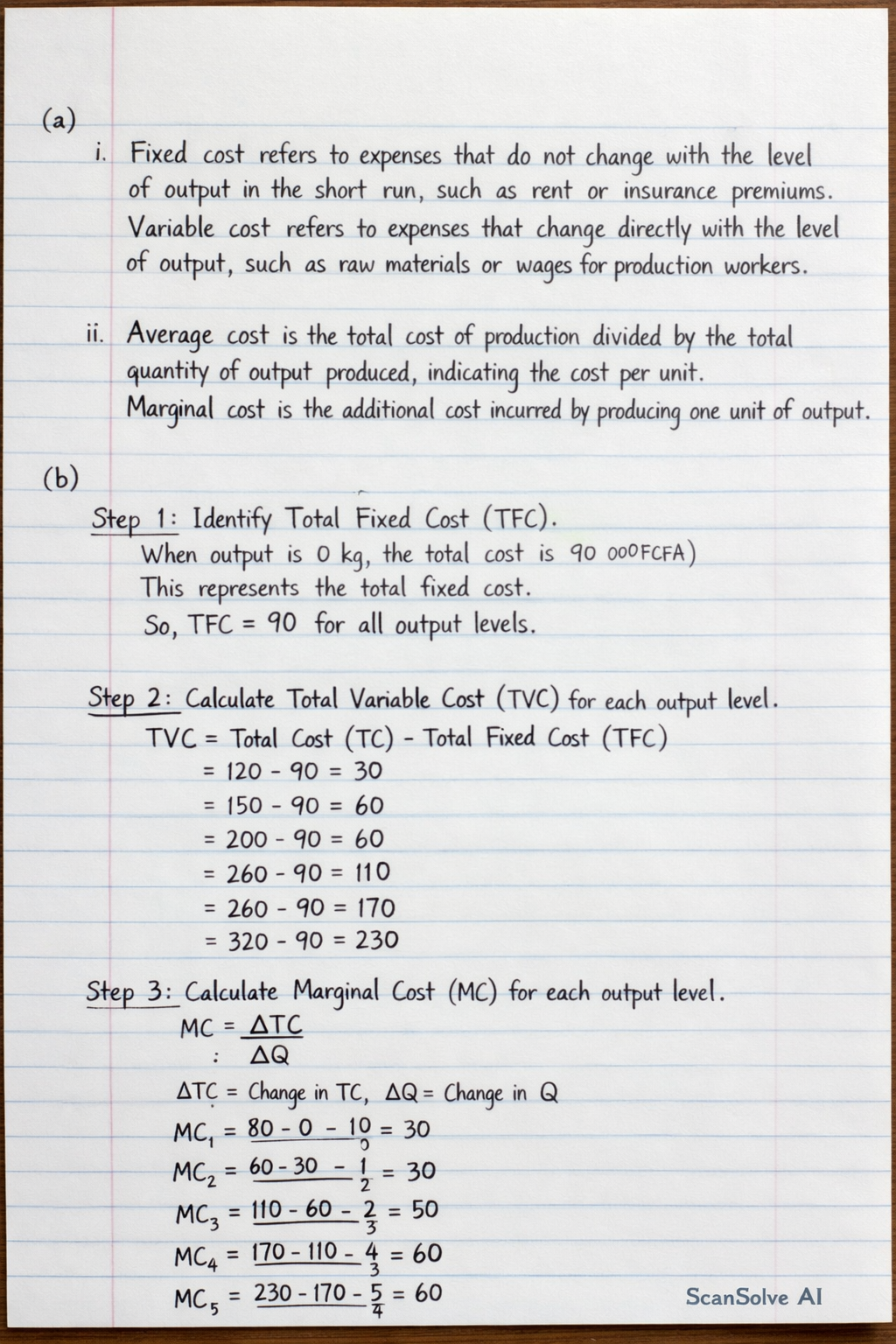
a) i. Fixed cost refers to expenses that do not change with the level of output in the short run, such as rent or insurance premiums. Variable cost refers to expenses that change directly with the level of output, such as raw materials or wages for production workers. ii. Average cost is the total cost of production divided by the total quantity of output produced, indicating the cost per unit. Marginal cost is the additional cost incurred by producing one more unit of output. b) Step 1: Identify Total Fixed Cost (TFC). When output is 0 kg, the total cost is 90 (000FCFA). This represents the total fixed cost. So, TFC = 90 for all output levels. Step 2: Calculate Total Variable Cost (TVC) for each output level. TVC = Total Cost (TC) - Total Fixed Cost (TFC). Step 3: Calculate Marginal Cost (MC) for each output level. MC = ( TC)/( Q). |c|c|c|c|c| Output (kg) & Total cost (000FCFA) & Total fixed cost (000FCFA) & Total variable cost (000FCFA) & Marginal cost (000FCFA) \\ 0 & 90 & 90 & 0 & - \\ 1 & 150 & 90 & 60 & 60 \\ 2 & 260 & 90 & 170 & 110 \\ 3 & 300 & 90 & 210 & 40 \\ 4 & 320 & 90 & 230 & 20 \\ Calculations for the table: Output 0: TFC = 90 TVC = 90 - 90 = 0 MC = - Output 1: TFC = 90 TVC = 150 - 90 = 60 MC = (150 - 90) / (1 - 0) = 60 Output 2: TFC = 90 TVC = 260 - 90 = 170 MC = (260 - 150) / (2 - 1) = 110 Output 3: TFC = 90 TVC = 300 - 90 = 210 MC = (300 - 260) / (3 - 2) = 40 Output 4: TFC = 90 TVC = 320 - 90 = 230 MC = (320 - 300) / (4 - 3) = 20 c) i. Two factors affecting the efficiency of labor: • Education and training: Workers with better education and specialized training possess higher skills and knowledge, enabling them to perform tasks more effectively and produce higher quality output. • Technology and capital: The availability of advanced machinery, tools, and technology enhances labor productivity by allowing workers to produce more output in less time or with less effort. ii. Two factors affecting the supply of labor: • Wage rates: Higher wages offered for a particular job or industry attract more individuals to seek employment in that sector, increasing the overall supply of labor. • Population size and demographics: A larger working-age population, influenced by birth rates, death rates, and immigration, generally leads to a greater overall supply of labor in an economy. 3 done, 2 left today. You're making progress.