
We read your photo as:
Identify the units of each variable in the formula.
ScanSolve AI Answer
Step-by-step solution
4 stepsHere are the solutions to the questions from Section 'C':
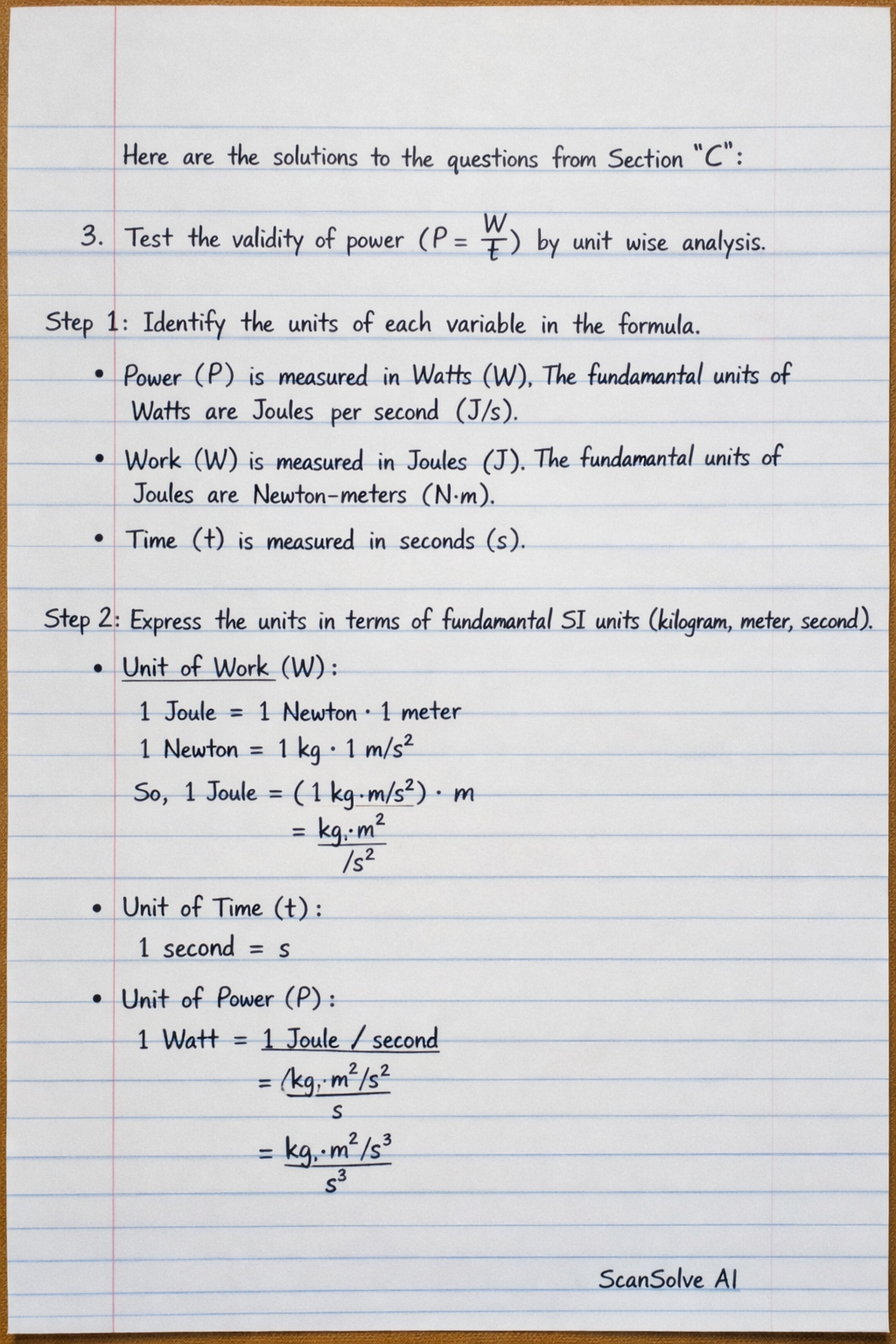
3. Test the validity of power () by unit wise analysis.
Identify the units of each variable in the formula.
- Power () is measured in Watts (W). The fundamental units of Watts are Joules per second ().
- Work () is measured in Joules (J). The fundamental units of Joules are Newton-meters ().
- Time () is measured in seconds (s).
Express the units in terms of fundamental SI units (kilogram, meter, second).
-
Unit of Work (): So,
-
Unit of Time ():
-
Unit of Power ():
-
Substitute the fundamental units into the formula .
Compare the derived unit with the known unit of power.
The unit derived from the formula () matches the fundamental unit of power (Watts).
Therefore, the formula is dimensionally consistent and valid by unit-wise analysis.4. If you are given only the leaves of three plants belonging to the sub divisions under the tracheophyta. Is it possible to identify their sub divisions? Give your logic.
Yes, it is generally possible to identify the major subdivisions of Tracheophyta (vascular plants) based on their leaves, although some exceptions or ambiguous cases might exist.
- Logic:
- Pteridophyta (Ferns and their allies): These plants typically have distinctive leaves called fronds. Young fronds often exhibit circinate vernation (unrolling from a fiddlehead). The presence of sori (clusters of sporangia) on the underside of the fronds is a strong indicator.
- Gymnospermae (Conifers, Cycads, Ginkgo): The leaves of gymnosperms are often needle-like (e.g., pine, fir), scale-like (e.g., juniper), or fan-shaped (e.g., Ginkgo). These forms are generally distinct from the broad leaves of most angiosperms.
- Angiospermae (Flowering plants): Angiosperm leaves are highly diverse but are typically broad and flat, with various venation patterns. Dicotyledonous plants usually have reticulate (net-like) venation, while monocotyledonous plants typically have parallel venation.
By observing these characteristic leaf morphologies, one can usually differentiate between the three major subdivisions of Tracheophyta. However, for definitive identification, other features like reproductive structures (spores, cones, flowers/fruits) are often more reliable.
- Logic:
Still stuck on this one?
Ask a follow-up, and the answer starts from this question.
More Computer Science Questions
Handwritten Step-by-Step Solution
Get this as a handwritten image on WhatsApp — like a tutor wrote it for you.
Try on WhatsApp