
We read your photo as:
In a grammar, if the production S->λ where S is a non-terminal is existed, such production is called ?
Computer Science
ScanSolve AI Answer
In formal grammar, a production rule of the form (or ), where is a non-terminal symbol and (or ) represents the empty string, is known as a null production or epsilon production. This type of production indicates that the non-terminal can derive the empty string.
Let's look at the options:
- A. Null Production: This matches the definition of a production where a non-terminal derives the empty string.
- B. Unit Production: A unit production is of the form , where both and are non-terminals.
- C. Secondary Production: This is not a standard term in formal language theory.
- D. Sigma Production: This is not a standard term in formal language theory. Sigma () typically denotes the set of terminal symbols.
Therefore, the production is a null production.
The final answer is
Was this helpful?
Still stuck on this one?
Ask a follow-up, and the answer starts from this question.
Got a different question?Ask your own question
More Computer Science Questions
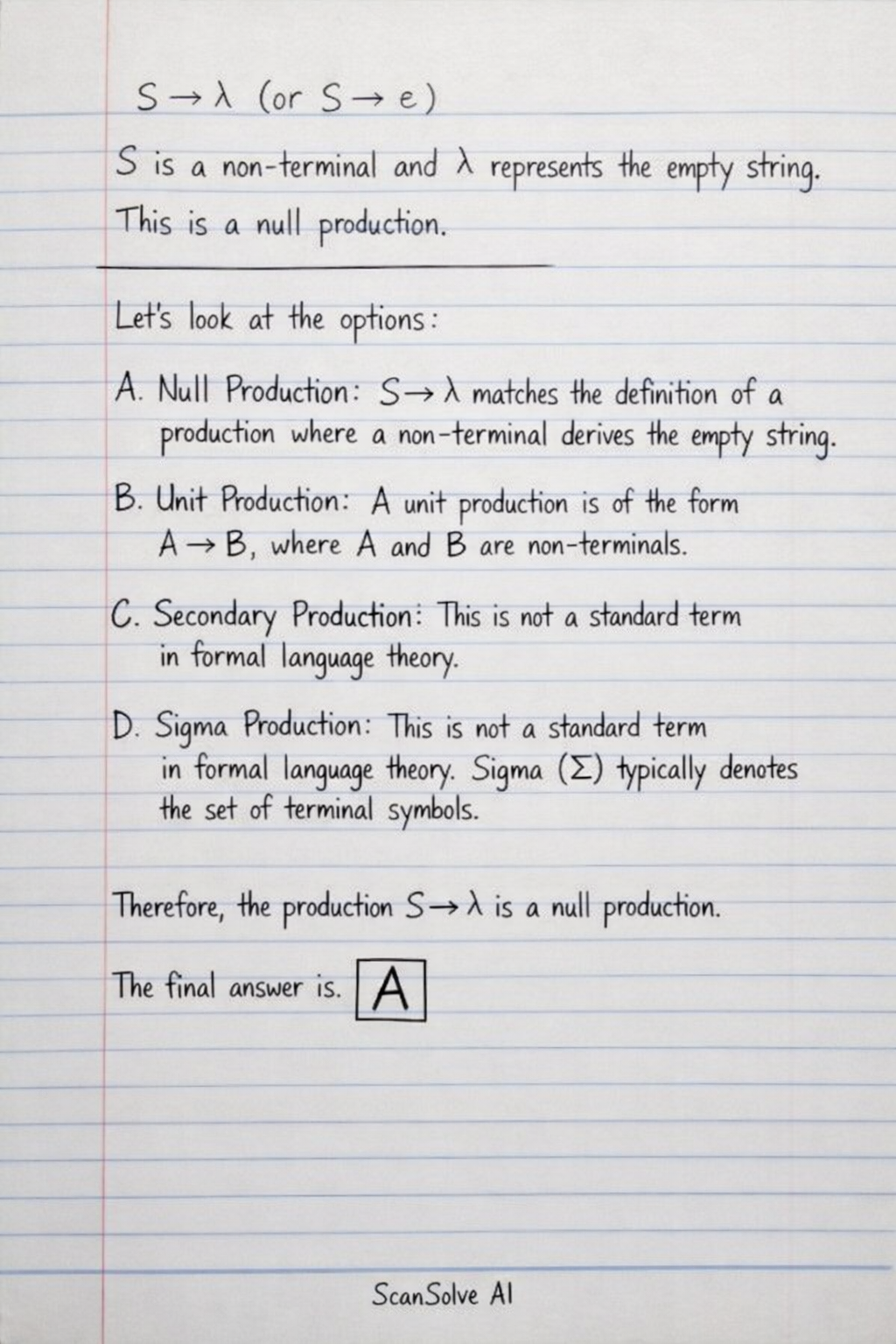
Handwritten Step-by-Step Solution
Get this as a handwritten image on WhatsApp — like a tutor wrote it for you.
Try on WhatsApp