
We read your photo as:
Define Information System (IS) and its typology. Define Hardware, Data, Software, Keyboard, and Touchpad. Explain Network and its types.
ScanSolve AI Answer
-
An Information System (IS) is a set of interrelated components that collect, process, store, and distribute information to support decision-making and control in an organization. Its typology includes systems like Transaction Processing Systems (TPS) for daily operations, Management Information Systems (MIS) for reporting, and Decision Support Systems (DSS) for complex analysis.
-
Define the following terms:
- Hardware: The physical components of a computer system, such as the CPU, memory, and input/output devices.
- Data: Raw, unorganized facts, figures, or symbols that have no inherent meaning until processed.
- Software: A set of instructions, data, or programs used to operate computers and execute specific tasks.
- Keyboard: An input device consisting of an arrangement of buttons or keys, used to enter text, characters, and commands into a computer.
- Touchpad: A flat, rectangular pointing device on a laptop, used to control the cursor on the screen by moving a finger across its surface.
-
A Network is a collection of interconnected devices (like computers, servers, and printers) that can share resources and exchange data. Its types include:
- Local Area Network (LAN): Connects devices in a limited geographical area, like a home or office.
- Wide Area Network (WAN): Connects devices over a large geographical area, such as cities or countries.
- Personal Area Network (PAN): Connects devices within a short range around an individual, like Bluetooth devices.
-
Three (3) major modes of data flow during data transmission:
- Simplex: Data flows in one direction only. For example, a radio broadcast where the receiver cannot send data back to the sender.
- Half-Duplex: Data flows in both directions, but only one direction at a time. For example, a walkie-talkie where users take turns speaking.
- Full-Duplex: Data flows in both directions simultaneously. For example, a telephone conversation where both parties can speak and hear each other at the same time.
-
Explain briefly the following:
- Computer network: A system of interconnected computers and other devices that allows them to share resources and information.
- Network topology: The physical or logical arrangement of nodes and connections within a network, describing how devices are connected.
- Protocol: A set of rules that governs how data is formatted, transmitted, and received between devices in a network.
- Network: A collection of interconnected devices that can communicate and share resources.
-
Identify and explain any three (3) network topology you know:
- Bus Topology: All devices are connected to a single central cable called the bus. Data travels along this bus, and devices pick up data addressed to them. If the bus cable breaks, the entire network can fail.
- Star Topology: All devices are connected to a central hub or switch. Data passes through this central device. A failure in one connection does not affect other devices, but the central device is a single point of failure.
- Ring Topology: Devices are connected in a circular fashion, forming a closed loop. Data travels in one direction around the ring. A break in the ring can disrupt the entire network.
Still stuck on this one?
Ask a follow-up, and the answer starts from this question.
More Computer Science Questions
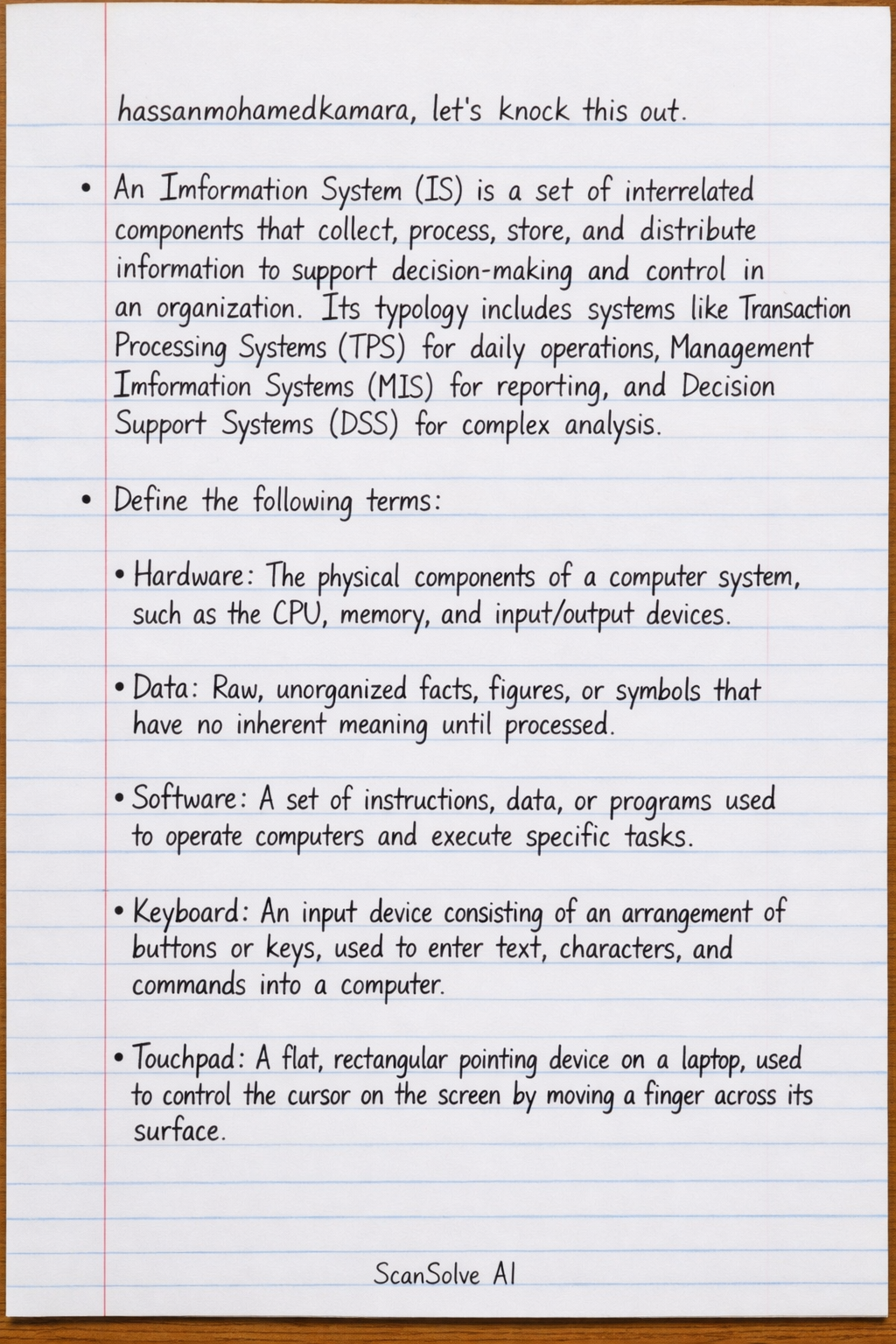
Handwritten Step-by-Step Solution
Get this as a handwritten image on WhatsApp — like a tutor wrote it for you.
Try on WhatsApp