
We read your photo as:
List three instruments used in technical drawing and state their uses. Differentiate between orthographic projection and isometric drawing. Explain why auxiliary view is important in technical drawing
ScanSolve AI Answer
Step-by-step solution
22 stepshere are the answers to Section A and Section B:
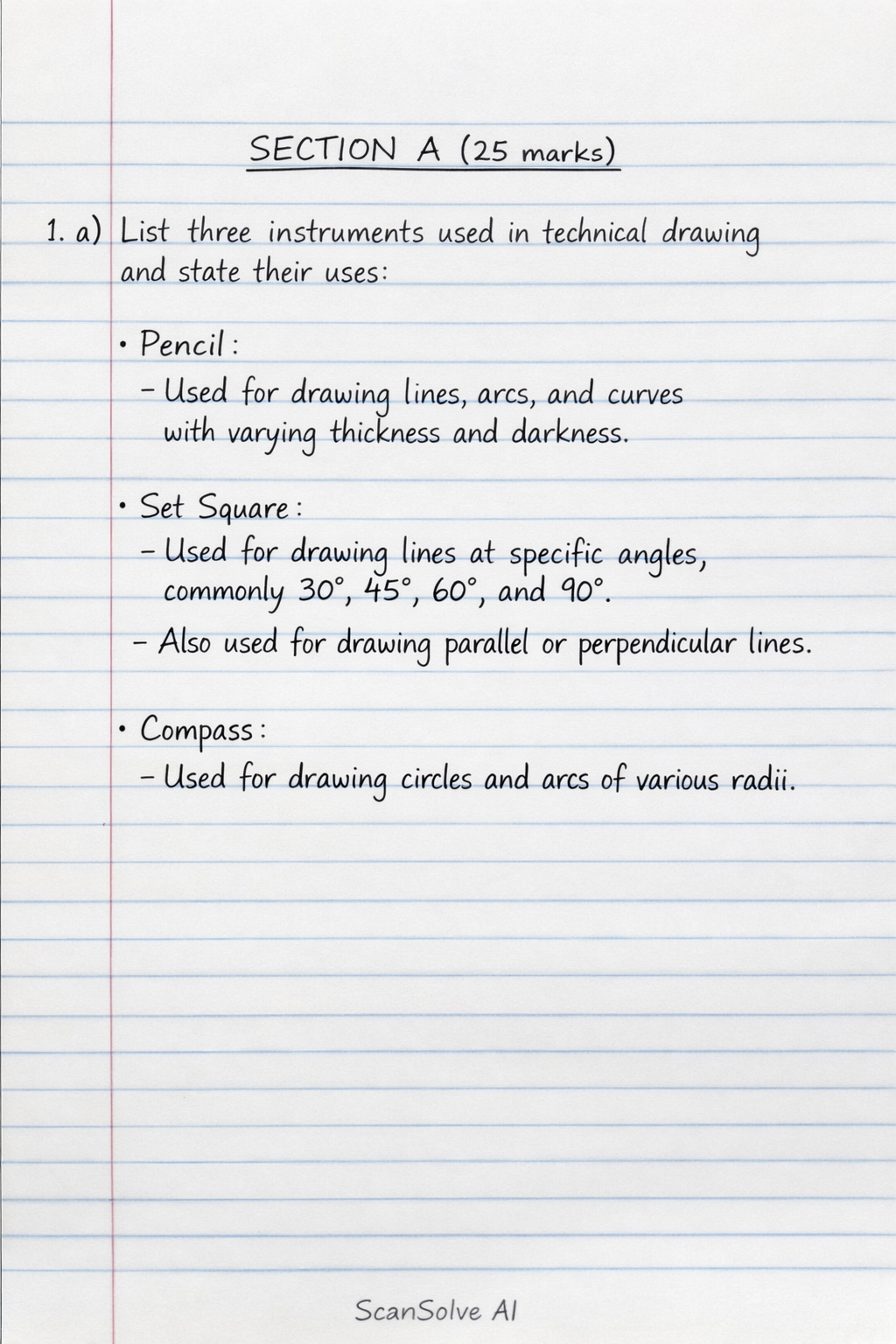
SECTION A (25 marks)
1. a) List three instruments used in technical drawing and state their uses.
- Pencil: Used for drawing lines, arcs, and curves with varying thickness and darkness.
- Set Square: Used for drawing lines at specific angles, commonly 30°, 45°, 60°, and 90°, and for drawing parallel or perpendicular lines.
- Compass: Used for drawing circles and arcs of various radii.
1. b) Differentiate between orthographic projection and isometric drawing.
- Orthographic Projection: This is a 2D representation of a 3D object, showing multiple views (e.g., front, top, side) where lines of sight are perpendicular to the projection plane. It accurately depicts the true shape and size of each face.
- Isometric Drawing: This is a 3D representation of an object in a single view, where all three axes (width, height, depth) are equally foreshortened and drawn at 120° to each other. It provides a pictorial view, showing the object's overall form but not necessarily true shapes of inclined surfaces.
1. c) Explain why auxiliary view is important in technical drawing.
An auxiliary view is important because it allows for the true size and shape of inclined or oblique surfaces to be shown. These surfaces would appear foreshortened in standard orthographic views, making it difficult to dimension or understand their geometry accurately. Auxiliary views project these surfaces onto a plane parallel to them, revealing their true dimensions.
2. a) Divide line AB 60mm in the ratio 1:2:3 using a ruler and a pair of compasses only.
Draw a straight line AB 60mm long.
From point A, draw a ray (a line segment extending from A) at any acute angle to line AB.
Using a compass, mark off equal divisions along the ray.
Label these points .
Join the last mark, , to point B.
From and (representing the cumulative ratios 1 and ), draw lines parallel to to intersect line AB.
Use a set square and ruler to ensure parallelism.
The points where these parallel lines intersect AB will divide line AB into the ratio 1:2:3.
2. b) Inscribe an isosceles triangle where AB= 70mm BC=CA=90mm.
Draw a straight line segment AB 70mm long.
With point A as the center and a radius of 90mm (length of CA), draw an arc.
With point B as the center and a radius of 90mm (length of BC), draw another arc.
The intersection point of these two arcs is point C.
Join point A to C and point B to C to complete the isosceles triangle ABC.
2. c) Construct regular hexagon of sides 50mm using the universal method.
Draw a circle with a radius of 50mm (equal to the side length of the hexagon).
Mark its center O.
Draw a horizontal diameter through the center O, intersecting the circle at two points, say P and Q.
With P as the center and a radius of 50mm, draw an arc that intersects the circle at two points.
With Q as the center and a radius of 50mm, draw another arc that intersects the circle at two other points.
You now have six points on the circumference of the circle.
Connect these six points consecutively with straight lines to form the regular hexagon.
2. d) Using concentric circle method, construct an ellipse if major axis 120mm and minor axis 60mm.
Draw two concentric circles with the same center.
The radius of the larger circle will be half the major axis, which is . The radius of the smaller circle will be half the minor axis, which is .
Divide both circles into a number of equal parts, for example, 12 or 24 parts.
Draw radial lines from the center through these division points on both circles.
From each division point on the larger circle, draw a vertical line downwards or upwards.
From each division point on the smaller circle, draw a horizontal line outwards or inwards.
The intersection points of the vertical lines from the larger circle and the horizontal lines from the smaller circle will give points on the ellipse.
Connect these intersection points with a smooth, continuous curve to form the ellipse.
SECTION B (75 marks)
3. The figure below is drawn in third angle orthographic projection. Draw the isometric view.
The figure showing the orthographic projection is missing from the provided image. Therefore, I cannot draw the isometric view. Please provide the figure for this question.
Still stuck on this one?
Ask a follow-up, and the answer starts from this question.
More Computer Science Questions
Handwritten Step-by-Step Solution
Get this as a handwritten image on WhatsApp — like a tutor wrote it for you.
Try on WhatsApp