
We read your photo as:
Define logic and explain the logical operators conjunction, disjunction, negation, and bi-implication. Prove De Morgan's law for disjunction using a truth table.
ScanSolve AI Answer
Step-by-step solution
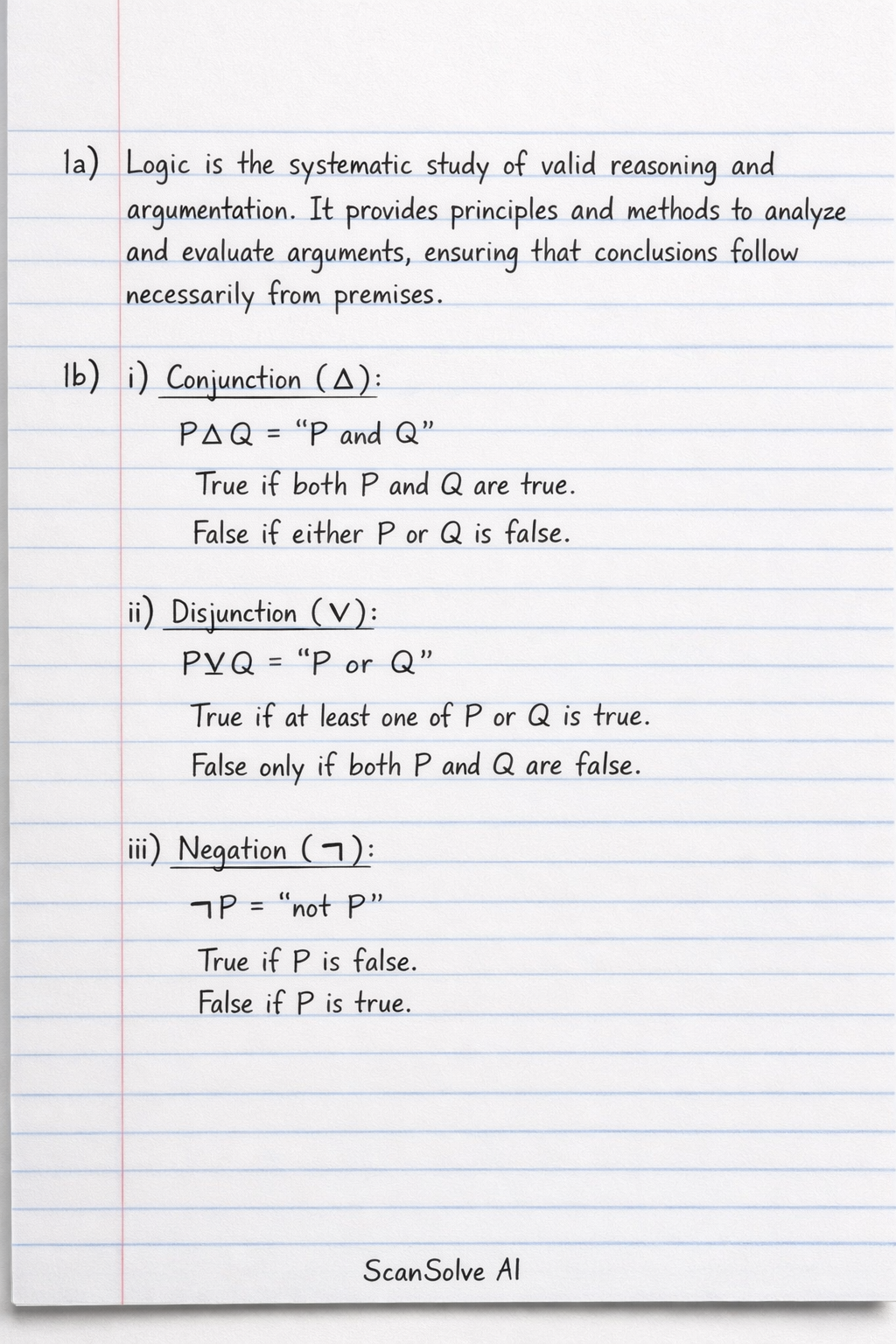
8 steps1a) Logic is the systematic study of valid reasoning and argumentation. It provides principles and methods to analyze and evaluate arguments, ensuring that conclusions follow necessarily from premises.
1b)
- i) Conjunction (): A logical operator that combines two propositions, and , into a new proposition (read as "P and Q"). The conjunction is true if and only if both and are true; otherwise, it is false.
- ii) Disjunction (): A logical operator that combines two propositions, and , into a new proposition (read as "P or Q"). The disjunction is true if at least one of or is true (inclusive or); it is false only if both and are false.
- iii) Negation (): A logical operator that takes a single proposition, , and forms a new proposition (read as "not P"). The negation is true if and only if is false, and false if and only if is true.
- iv) Bi-implication (or Equivalence) (): A logical operator that combines two propositions, and , into a new proposition (read as "P if and only if Q"). The bi-implication is true if and have the same truth value (both true or both false); otherwise, it is false.
1c) To prove , we can use a truth table:
| T | T | T | F | F | F | F |
| T | F | T | F | F | T | F |
| F | T | T | F | T | F | F |
| F | F | F | T | T | T | T |
Since the column for is identical to the column for , the equivalence is proven.
2a) We will prove by mathematical induction that for all positive integers , .
Base Case
For :
LHS: 1
RHS:
Since LHS = RHS, the formula holds for .Inductive Hypothesis
Assume the formula holds for some positive integer .
Inductive Step
We need to show that the formula holds for . That is, we need to show:
Start with the LHS:
Using the inductive hypothesis, substitute the sum up to :
Find a common denominator:
Factor out :
This is the RHS.
Conclusion
By the principle of mathematical induction, the formula holds for all positive integers .
2b) To expand using Pascal's triangle, we first find the coefficients from the 6th row of Pascal's triangle.
Row 0: 1
Row 1: 1 1
Row 2: 1 2 1
Row 3: 1 3 3 1
Row 4: 1 4 6 4 1
Row 5: 1 5 10 10 5 1
Row 6: 1 6 15 20 15 6 1Using these coefficients, the expansion is:
3a)
- Permutation: A permutation is an arrangement of objects in a specific order. The order of selection or arrangement matters. For example, if we select two letters from A, B, C, the permutations are AB, BA, AC, CA, BC, CB.
- Combination: A combination is a selection of objects where the order of selection does not matter. It is simply a group or subset of items. For example, if we select two letters from A, B, C, the combinations are {A, B}, {A, C}, {B, C}.
3b) To find the number of permutations from the letters of the word STATISTICS, we first count the total number of letters and the frequency of each repeated letter.
The word is STATISTICS.
Total number of letters, .Frequencies of repeated letters:
- S appears 3 times ()
- T appears 3 times ()
- A appears 1 time
- I appears 2 times ()
- C appears 1 time
The formula for permutations with repetitions is .
Identify and the frequencies of repeated letters.
Apply the permutation formula.
Calculate the factorials.
Substitute and simplify.
The number of permutations that can be made from the letters of the word STATISTICS is .
Still stuck on this one?
Ask a follow-up, and the answer starts from this question.
More Computer Science Questions
Handwritten Step-by-Step Solution
Get this as a handwritten image on WhatsApp — like a tutor wrote it for you.
Try on WhatsApp