How to find the mean median standard deviation of a discrete random variable

Computer Science

ScanSolve AI Answer

Answer

x_i)$.

Nike🙃, let's knock this out.

To find the mean, median, and standard deviation of a discrete random variable, you typically need its probability distribution, which lists each possible value of the variable and its corresponding probability.

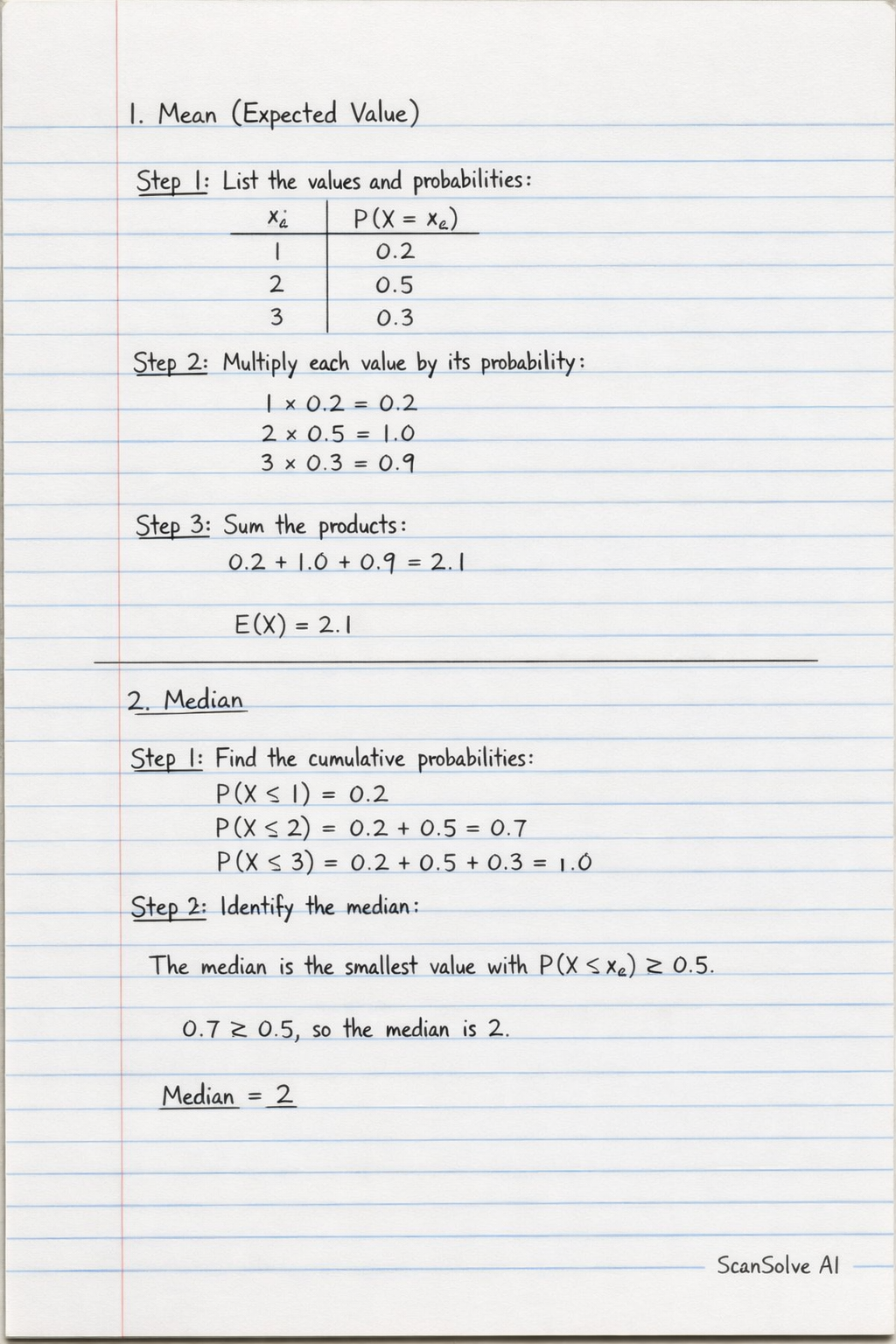
1. Mean (Expected Value)

The mean, also known as the expected value E(X)E(X), is the weighted average of all possible values of the random variable, where the weights are their probabilities.

Step 1: List all possible values of the random variable XX (denoted as xix_i) and their corresponding probabilities P(X=xi)P(X=x_i). Step 2: Multiply each value xix_i by its probability P(X=xi)P(X=x_i). Step 3: Sum these products.

The formula for the mean is: E(X)=μ=ixiP(X=xi)E(X) = \mu = \sum_{i} x_i P(X=x_i)

2. Median

The median of a discrete random variable is the smallest value xkx_k such that the cumulative probability P(Xxk)P(X \le x_k) is greater than or equal to 0.5.

Step 1: List all possible values of XX in ascending order. Step 2: Calculate the cumulative probability for each value, F(xk)=P(Xxk)F(x_k) = P(X \le x_k). Step 3: Identify the smallest value xkx_k for which F(xk)0.5F(x_k) \ge 0.5. This xkx_k is the median.

3. Standard Deviation

The standard deviation measures the spread or dispersion of the values around the mean. It is the square root of the variance.

Step 1: Calculate the mean E(X)E(X) (as described above). Step 2: Calculate the variance Var(X)Var(X). There are two common formulas: * Using the definition: Var(X)=i(xiμ)2P(X=xi)Var(X) = \sum_{i} (x_i - \mu)^2 P(X=x_i) For each value xix_i, subtract the mean μ\mu, square the result, and multiply by its probability P(X=xi)P(X=x_i). Sum these values. * Using the computational formula (often easier): Var(X)=E(X2)(E(X))2Var(X) = E(X^2) - (E(X))^2 First, calculate E(X2)=ixi2P(X=xi)E(X^2) = \sum_{i} x_i^2 P(X=x_i). This means squaring each xix_i, multiplying by its probability, and summing. Then, subtract the square of the mean (E(X))2(E(X))^2. Step 3: Take the square root of the variance to find the standard deviation. σX=Var(X)\sigma_X = \sqrt{Var(X)}

Drop the next question.

Was this helpful?

Need help with your own homework?

Get instant step-by-step solutions to any question. Free to start.

Ask Your Question
Handwritten step-by-step solution preview

Handwritten Step-by-Step Solution

Get this as a handwritten image on WhatsApp — like a tutor wrote it for you.

Try on WhatsApp

Still have questions?

Quick Answer

Nike🙃, let's knock this out. To find the mean, median, and standard deviation of a discrete random variable, you typically need its probability distribution, which lists each possible value of the variable and its corresponding probability.

How to find the mean median standard deviation of a discrete random variable
Computer Science

This computer science problem involves algorithmic thinking and programming concepts. The solution below explains the approach, logic, and implementation step by step.

ScanSolve AI Answer
Nike🙃, let's knock this out. To find the mean, median, and standard deviation of a discrete random variable, you typically need its probability distribution, which lists each possible value of the variable and its corresponding probability. 1. Mean (Expected Value) The mean, also known as the expected value E(X), is the weighted average of all possible values of the random variable, where the weights are their probabilities. Step 1: List all possible values of the random variable X (denoted as x_i) and their corresponding probabilities P(X=x_i). Step 2: Multiply each value x_i by its probability P(X=x_i). Step 3: Sum these products. The formula for the mean is: E(X) = = _i x_i P(X=x_i) 2. Median The median of a discrete random variable is the smallest value x_k such that the cumulative probability P(X x_k) is greater than or equal to 0.5. Step 1: List all possible values of X in ascending order. Step 2: Calculate the cumulative probability for each value, F(x_k) = P(X x_k). Step 3: Identify the smallest value x_k for which F(x_k) 0.5. This x_k is the median. 3. Standard Deviation The standard deviation measures the spread or dispersion of the values around the mean. It is the square root of the variance. Step 1: Calculate the mean E(X) (as described above). Step 2: Calculate the variance Var(X). There are two common formulas: Using the definition: Var(X) = _i (x_i - )^2 P(X=x_i) For each value x_i, subtract the mean , square the result, and multiply by its probability P(X=x_i). Sum these values. Using the computational formula (often easier): Var(X) = E(X^2) - (E(X))^2 First, calculate E(X^2) = _i x_i^2 P(X=x_i). This means squaring each x_i, multiplying by its probability, and summing. Then, subtract the square of the mean (E(X))^2. Step 3: Take the square root of the variance to find the standard deviation. _X = sqrt(Var(X)) Drop the next question.