
We read your photo as:
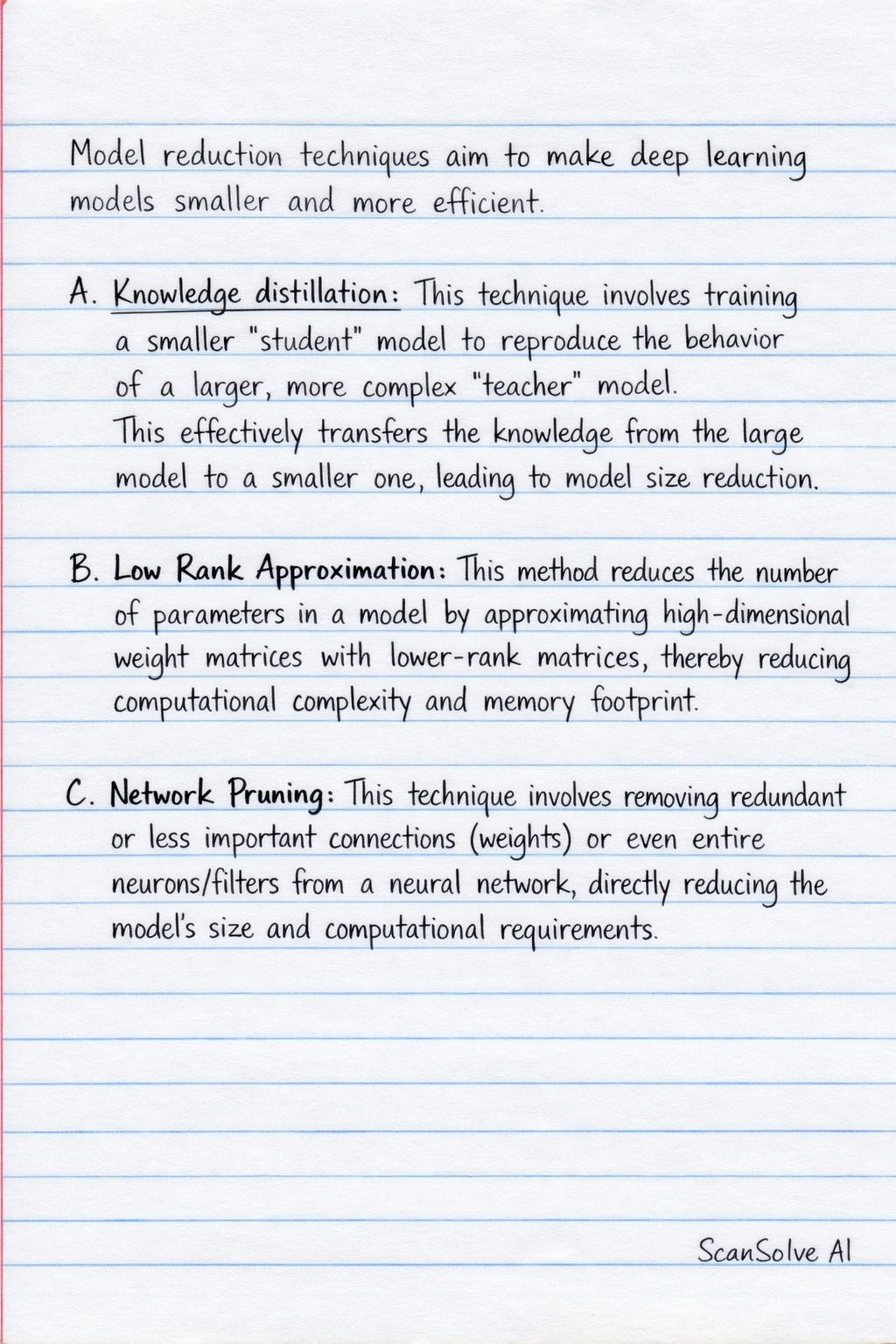
Model reduction techniques aim to make deep learning models smaller and more efficient.
Computer Science
ScanSolve AI Answer
Model reduction techniques aim to make deep learning models smaller and more efficient.
- A. Knowledge distillation: This technique involves training a smaller "student" model to reproduce the behavior of a larger, more complex "teacher" model. This effectively transfers the knowledge from the large model to a smaller one, leading to model size reduction.
- B. Low rank approximation: This method reduces the number of parameters in a model by approximating high-dimensional weight matrices with lower-rank matrices, thereby reducing computational complexity and memory footprint.
- C. Network pruning: This technique involves removing redundant or less important connections (weights) or even entire neurons/filters from a neural network, directly reducing the model's size and computational requirements.
- D. Federated data allocation: This refers to the distribution and management of data in a federated learning system, where models are trained on decentralized data. It is related to distributed learning paradigms, not a technique for reducing the size of a single model itself.
The correct options are:
- A. Knowledge distillation
- B. Low rank approximation
- C. Network pruning
Was this helpful?
Still stuck on this one?
Ask a follow-up, and the answer starts from this question.
Got a different question?Ask your own question
More Computer Science Questions
QWhy are machine learning pipelines important?QWhat is bagging in machine learning?QAn enterprise client wants to accelerate the elimination of tech debt using AI. Which transformation…QDescribe shortly what shrinking work isQTo identify the best description of machine learning within the context of AI.
Browse by topic:Machine Learning
Handwritten Step-by-Step Solution
Get this as a handwritten image on WhatsApp — like a tutor wrote it for you.
Try on WhatsApp