
We read your photo as:
Multiple Choice Questions (Computer)
ScanSolve AI Answer
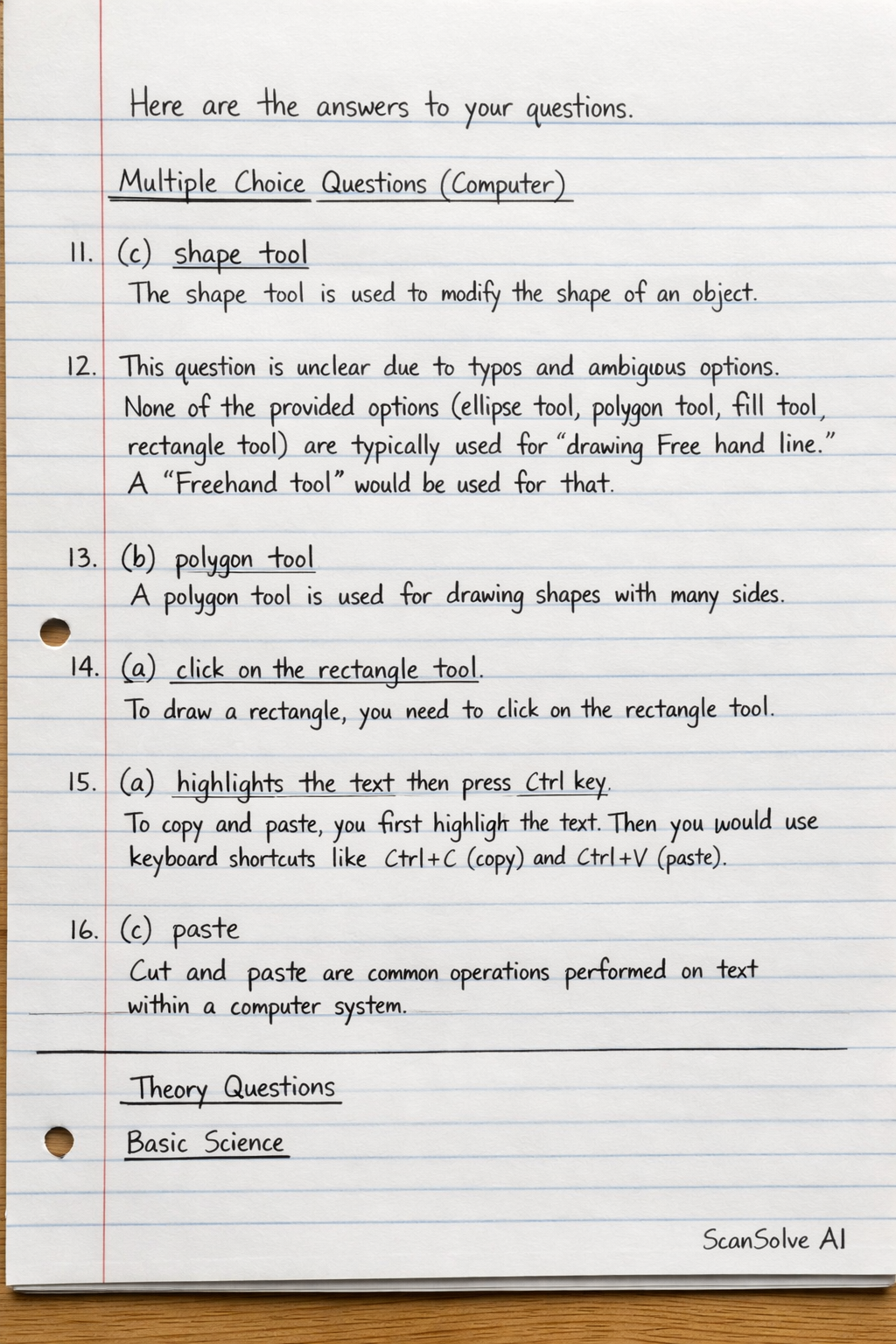
Here are the answers to your questions.
Multiple Choice Questions (Computer)
-
c) shape tool The shape tool is used to modify the shape of an object.
-
This question is unclear due to typos and ambiguous options. None of the provided options (ellipse tool, polygon tool, fill tool, rectangle tool) are typically used for "drawing Free hand line." A "Freehand tool" would be used for that.
-
b) polygon tool A polygon tool is used for drawing shapes with many sides.
-
a) click on the rectangle tool To draw a rectangle, you need to click on the rectangle tool.
-
a) highlights the text then press Ctrl key To copy and paste, you first highlight the text. Then you would use keyboard shortcuts like Ctrl+C (copy) and Ctrl+V (paste).
-
c) paste Cut and paste are common operations performed on text within a computer system.
Theory Questions
Basic Science
-
The human reproductive system is a system of organs within an organism that work together for the purpose of sexual reproduction.
- Male reproductive system: Includes the testes, epididymis, vas deferens, seminal vesicles, prostate gland, urethra, and penis.
- Female reproductive system: Includes the ovaries, fallopian tubes, uterus, cervix, vagina, and vulva.
-
Force is an influence that can change the motion of an object. It is a vector quantity, having both magnitude and direction.
- Gravitational force: The attractive force between any two objects with mass. It pulls objects towards each other, like the Earth pulling objects downwards.
- Frictional force: A force that opposes motion between two surfaces in contact. For example, friction between tires and the road allows a car to stop.
- Normal force: The support force exerted upon an object that is in contact with another stable object. For instance, a table exerts a normal force upwards on a book resting on it.
-
Air is the invisible mixture of gases that surrounds the Earth, primarily nitrogen (about 78%), oxygen (about 21%), and small amounts of other gases.
- Pressure is defined as the force applied perpendicular to the surface of an object per unit area over which that force is distributed.
- Three uses of air and pressure:
- Breathing: Air (specifically oxygen) is essential for respiration in living organisms.
- Tires and balloons: Air pressure is used to inflate tires and balloons, providing support and cushioning.
- Flight: Air pressure differences (aerodynamics) are crucial for aircraft to generate lift and fly.
-
Mineral resources are naturally occurring substances found in the Earth's crust that can be extracted and processed for economic value.
- Types of mineral resources:
- Metallic minerals: Contain metals (e.g., iron, copper, gold, aluminum).
- Non-metallic minerals: Do not contain metals (e.g., limestone, gypsum, sand, clay, salt).
- Energy minerals: Used to produce energy (e.g., coal, petroleum, natural gas, uranium).
- Types of mineral resources:
Basic Technology
-
Maintenance refers to the actions taken to keep equipment, machinery, or infrastructure in good working order, or to restore it to a functional state.
- Types of maintenance:
- Preventive maintenance: Scheduled maintenance to prevent failures before they occur (e.g., regular oil changes in a car).
- Corrective maintenance: Performed to restore equipment to an operational state after a failure has occurred (e.g., repairing a broken machine part).
- Predictive maintenance: Uses data and monitoring to predict when equipment might fail, allowing maintenance to be performed just before a breakdown (e.g., using sensors to detect unusual vibrations).
- Types of maintenance:
-
Safety is the state of being protected from harm or danger. It involves measures taken to prevent accidents, injuries, or losses.
- Three causes of accidents:
- Human error: Mistakes, carelessness, lack of training, or fatigue (e.g., not following safety procedures).
- Unsafe conditions: Hazardous environments or faulty equipment (e.g., slippery floors, poor lighting, unguarded machinery).
- Equipment failure: Malfunctions or breakdowns of tools, machinery, or vehicles due to wear and tear or defects.
- Three causes of accidents:
-
Five ways to prevent accidents in a workshop:
- Always wear appropriate Personal Protective Equipment (PPE) like safety glasses, gloves, and ear protection.
- Keep the workspace clean, organized, and free of clutter to prevent trips and falls.
- Ensure all machinery and tools are in good working condition and properly maintained.
- Follow all operating instructions and safety procedures for tools and equipment.
- Never work alone on dangerous tasks, and ensure proper supervision for new or complex operations.
Five ways to prevent accidents on the road:
- Always obey traffic laws, including speed limits and traffic signals.
- Avoid distractions such as mobile phones, eating, or adjusting the radio while driving.
- Never drive under the influence of alcohol or drugs.
- Maintain a safe following distance from other vehicles.
- Ensure your vehicle is in good working condition, with functional brakes, lights, and tires.
-
A simple machine is a mechanical device that changes the direction or magnitude of a force. They are the basic building blocks of more complex machines.
- The three classes of levers:
- Class 1 lever: The fulcrum is located between the effort and the load (e.g., seesaw, crowbar).
- Class 2 lever: The load is located between the fulcrum and the effort (e.g., wheelbarrow, nutcracker).
- Class 3 lever: The effort is located between the fulcrum and the load (e.g., fishing rod, tweezers).
- The three classes of levers:
PHE (Physical and Health Education)
-
Hockey is a sport in which two teams play against each other by trying to maneuver a ball or a puck into the opponent's goal using a hockey stick. (Assuming field hockey).
- Seven facilities and equipment for hockey:
- Hockey stick
- Hockey ball
- Goal posts and net
- Hockey field (pitch)
- Shin guards
- Mouthguard
- Goalkeeper's protective gear (pads, helmet, gloves)
- Seven facilities and equipment for hockey:
-
Physical fitness is a state of health and well-being and, more specifically, the ability to perform aspects of sports, occupations, and daily activities. It is generally achieved through proper nutrition, moderate-vigorous physical exercise, and sufficient rest.
- Five activities for maintaining physical fitness:
- Running or jogging
- Swimming
- Cycling
- Weightlifting or strength training
- Yoga or Pilates
- Five activities for maintaining physical fitness:
-
Air pollution is the contamination of the atmosphere by harmful substances, including gases, particulate matter, and biological molecules.
- Seven causes of air pollution:
- Vehicle emissions (cars, trucks, buses)
- Industrial emissions (factories, power plants)
- Burning of fossil fuels (coal, oil, natural gas)
- Wildfires and forest fires
- Dust from construction sites and agricultural activities
- Volcanic eruptions
- Household combustion of biomass and coal
- Seven causes of air pollution:
-
An indigenous game is a traditional game or sport that originated within a particular culture or community and has been passed down through generations.
- Some indigenous games:
- Ayo (Mancala variant)
- Ludo (board game)
- Traditional wrestling
- Dambe (traditional boxing from Nigeria)
- Abula (Nigerian volleyball-like game)
- Some indigenous games:
Computer
-
A graphical package (or graphics software) is a type of application software that allows users to create, edit, and manipulate images, drawings, and other visual content.
- Examples: Adobe Photoshop, CorelDRAW, GIMP (GNU Image Manipulation Program).
-
A standard toolbar's contents can vary greatly depending on the software. However, here are 13 common tools found on toolbars, with explanations for 7:
- 13 Common Toolbar Tools: New, Open, Save, Print, Cut, Copy, Paste, Undo, Redo, Bold, Italic, Underline, Zoom.
- Explanation of 7 tools:
- New: Creates a new, blank document or file.
- Open: Allows you to browse and open an existing document or file.
- Save: Stores the current changes made to a document or file.
- Cut: Removes selected text or objects from their current location and places them on the clipboard.
- Copy: Duplicates selected text or objects and places them on the clipboard, leaving the original intact.
- Paste: Inserts the content from the clipboard into the current document at the cursor's position.
- Bold: Applies a bold font style to selected text, making it thicker and darker.
-
To copy and paste text or objects
Still stuck on this one?
Ask a follow-up, and the answer starts from this question.
More Computer Science Questions
Handwritten Step-by-Step Solution
Get this as a handwritten image on WhatsApp — like a tutor wrote it for you.
Try on WhatsApp