We read your photo as:

Rewrite the function.

Computer Science

ScanSolve AI Answer

Answer

Y′=4sec⁡2(2x)tan⁡(2x)Y' = 4\sec^2(2x)\tan(2x)

Step-by-step solution

4 steps

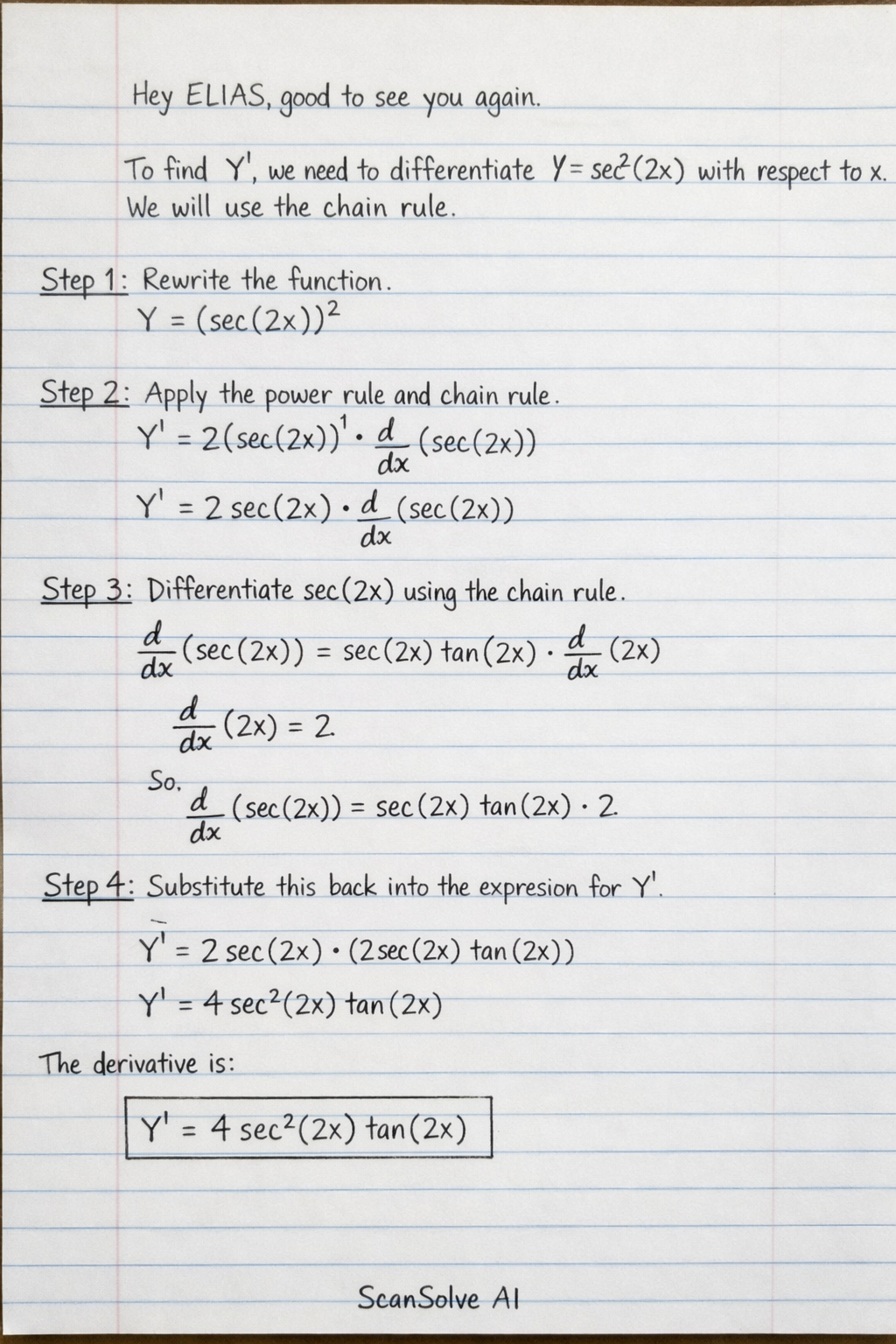
To find Y′Y', we need to differentiate Y=sec⁡2(2x)Y = \sec^2(2x) with respect to xx. We will use the chain rule.

  1. Rewrite the function.

    Y=(sec⁡(2x))2Y = (\sec(2x))^2
  2. Apply the power rule and the chain rule.

    The derivative of f(u)nf(u)^n is nf(u)n−1f′(u)n f(u)^{n-1} f'(u). Here, f(u)=sec⁡(2x)f(u) = \sec(2x) and n=2n=2.

    Y′=2(sec⁡(2x))2−1⋅ddx(sec⁡(2x))Y' = 2(\sec(2x))^{2-1} \cdot \frac{d}{dx}(\sec(2x)) Y′=2sec⁡(2x)⋅ddx(sec⁡(2x))Y' = 2\sec(2x) \cdot \frac{d}{dx}(\sec(2x))
  3. Differentiate sec⁡(2x)\sec(2x) using the chain rule.

    The derivative of sec⁡(u)\sec(u) is sec⁡(u)tan⁡(u)⋅u′\sec(u)\tan(u) \cdot u'. Here, u=2xu = 2x.

    ddx(sec⁡(2x))=sec⁡(2x)tan⁡(2x)⋅ddx(2x)\frac{d}{dx}(\sec(2x)) = \sec(2x)\tan(2x) \cdot \frac{d}{dx}(2x) ddx(2x)=2\frac{d}{dx}(2x) = 2

    So,

    ddx(sec⁡(2x))=sec⁡(2x)tan⁡(2x)⋅2\frac{d}{dx}(\sec(2x)) = \sec(2x)\tan(2x) \cdot 2
  4. Substitute this back into the expression for Y′Y'.

    Y′=2sec⁡(2x)⋅(2sec⁡(2x)tan⁡(2x))Y' = 2\sec(2x) \cdot (2\sec(2x)\tan(2x)) Y′=4sec⁡2(2x)tan⁡(2x)Y' = 4\sec^2(2x)\tan(2x)
Was this helpful?

Try one yourself

A new problem that tests the same skill.

Still stuck on this one?

Ask a follow-up, and the answer starts from this question.

Got a different question?Ask your own question
Handwritten step-by-step solution preview

Handwritten Step-by-Step Solution

Get this as a handwritten image on WhatsApp — like a tutor wrote it for you.

Try on WhatsApp