
We read your photo as:
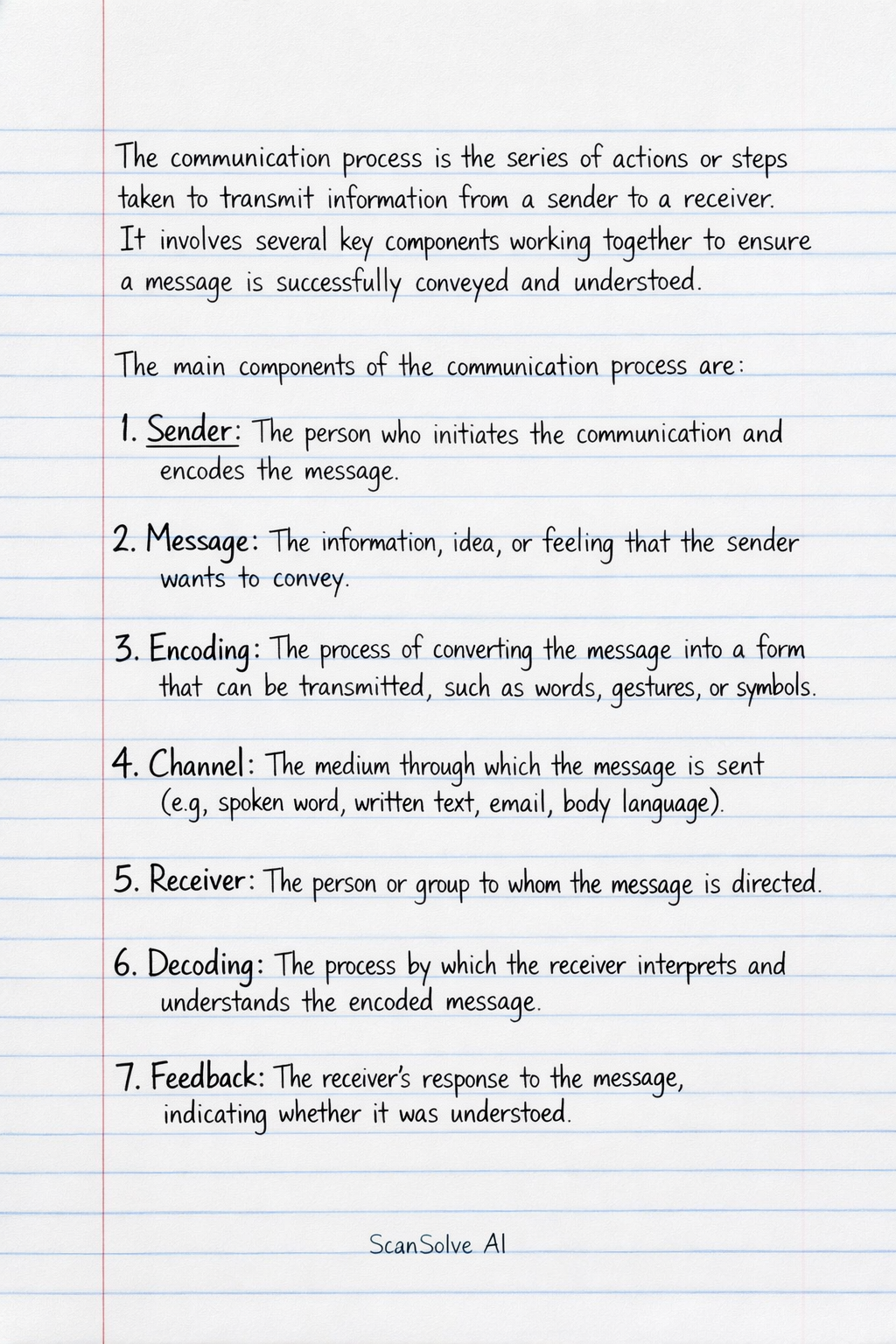
The communication process is the series of actions or steps taken to transmit information from a sender to a receiver. It involves several key components working together to ensure a message is succ
Computer Science
ScanSolve AI Answer
Answer
The communication process is the series of actions or steps taken to transmit information from a sender to a receiver. It involves several key components working together to ensure a message is successfully conveyed and understood.
The main components of the communication process are:
- Sender: The person who initiates the communication and encodes the message.
- Message: The information, idea, or feeling that the sender wants to convey.
- Encoding: The process of converting the message into a form that can be transmitted, such as words, gestures, or symbols.
- Channel: The medium through which the message is sent (e.g., spoken word, written text, email, body language).
- Receiver: The person or group to whom the message is directed.
- Decoding: The process by which the receiver interprets and understands the encoded message.
- Feedback: The receiver's response to the message, indicating whether it was understood.
- Noise: Any interference that distorts or hinders the transmission or reception of the message (e.g., distractions, language barriers, emotional states).
Was this helpful?
Still stuck on this one?
Ask a follow-up, and the answer starts from this question.
Got a different question?Ask your own question
More Computer Science Questions
QExplain decision-making and communication, detailing the steps involved in decision-making.QExplain the process of sending an email and identify the 5 components of data communication in this…QDescribe the components and process of a communication system in a procurement context.QInterpersonal communication is the process of exchanging information, ideas, and feelings between…QExplain the components of the communication mix and provide a brief description of each.
Handwritten Step-by-Step Solution
Get this as a handwritten image on WhatsApp — like a tutor wrote it for you.
Try on WhatsApp