The problem implies Xn is a binomial random variable, Xn Bin(n, p_n), as this is the context for such limit theorems. We are given two conditions:
|Computer Science
The problem implies Xn is a binomial random variable, Xn Bin(n, p_n), as this is the context for such limit theorems. We are given two conditions:
ScanSolve AI Answer
2 steps
Answer
\text{D
You're on a roll —
Step 1: Analyze the given conditions for the random variable Xn.
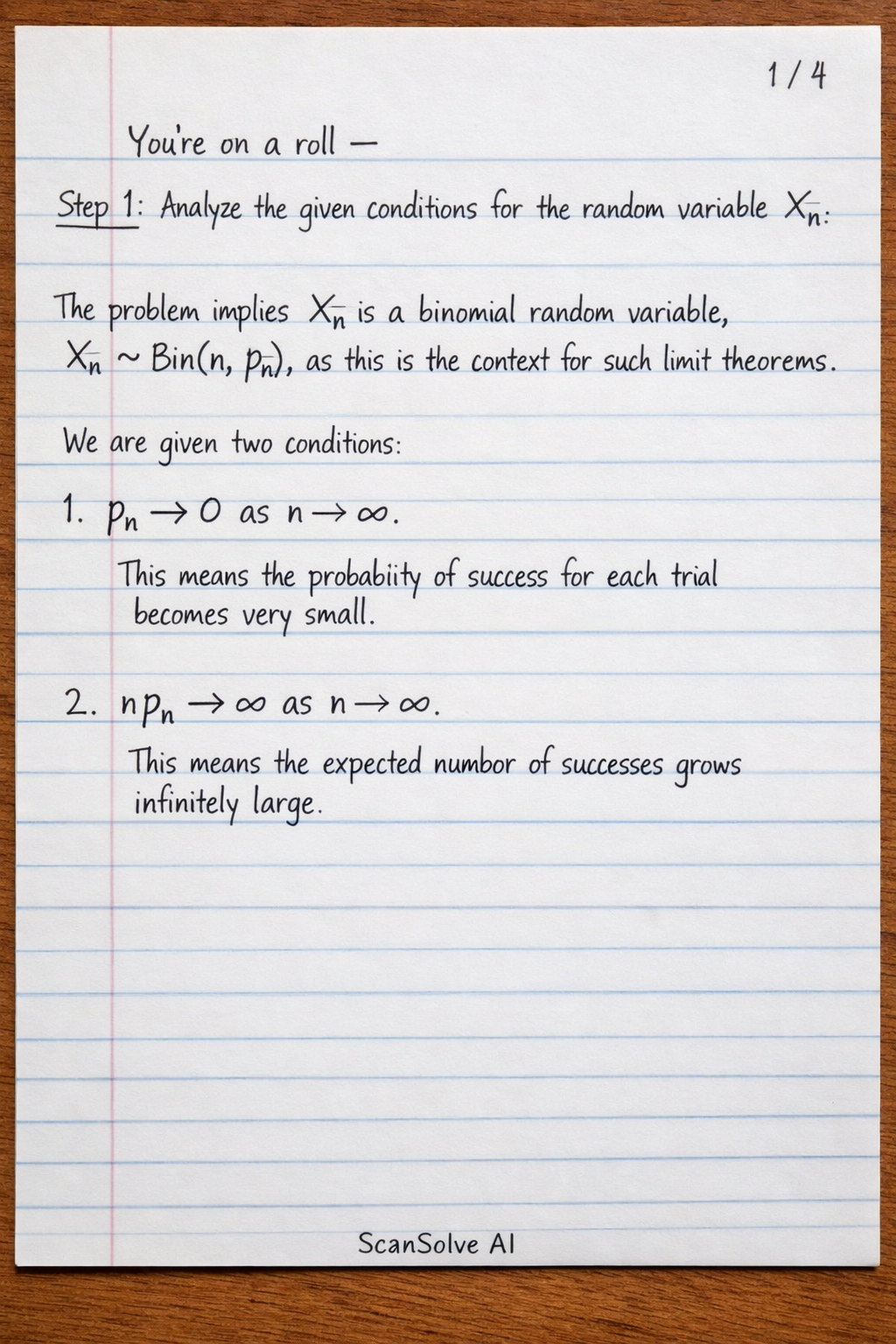
The problem implies Xn is a binomial random variable, Xn∼Bin(n,pn), as this is the context for such limit theorems. We are given two conditions:
pn→0 as n→∞. This means the probability of success for each trial becomes very small.
npn→∞ as n→∞. This means the expected number of successes grows infinitely large.
Step 2: Evaluate the applicability of different asymptotic approximations.
A. Binomial:Xn is already a binomial random variable. The question asks for an approximation, implying a different distribution that Xn converges to under these conditions, not its original form.
B. Poisson: The Poisson approximation to the binomial distribution is valid when n→∞, pn→0, and npn→λ, where λ is a finite positive constant. In this problem, npn→∞, so the Poisson approximation is not appropriate.
C. Bernoulli: A Bernoulli distribution describes a single trial (n=1). It is not an asymptotic approximation for a sequence of n trials as n→∞.
D. Normal: The Normal approximation to the binomial distribution (also known as the De Moivre-Laplace theorem, a special case of the Central Limit Theorem) states that if Xn∼Bin(n,pn), then for large n, Xn can be approximated by a normal distribution N(μ,σ2) where μ=npn and σ2=npn(1−pn). The conditions for this approximation to be good are typically that both npn and n(1−pn) are sufficiently large (e.g., ≥5 or 10).
Given npn→∞, the mean is growing large.
Given pn→0, it implies 1−pn→1. Since npn→∞ and pn→0, n must also tend to infinity. Therefore, n(1−pn)≈n→∞.
Since both npn→∞ and n(1−pn)→∞, the conditions for the normal approximation are met. The standardized variable npn(1−pn)Xn−npn converges in distribution to a standard normal distribution.
Step 3: Conclude the best approximation.
Based on the conditions pn→0 and npn→∞, the binomial distribution Xn is best approximated by a Normal distribution.
The final answer is D
Got more? Send 'em.
Was this helpful?
Need help with your own homework?
Get instant step-by-step solutions to any question. Free to start.
This computer science problem involves algorithmic thinking and programming concepts. The solution below explains the approach, logic, and implementation step by step.
ScanSolve AI Answer
You're on a roll — Step 1: Analyze the given conditions for the random variable X_n. The problem implies X_n is a binomial random variable, X_n Bin(n, p_n), as this is the context for such limit theorems. We are given two conditions: 1. p_n 0 as n . This means the probability of success for each trial becomes very small. 2. np_n as n . This means the expected number of successes grows infinitely large. Step 2: Evaluate the applicability of different asymptotic approximations. A. Binomial: X_n is already a binomial random variable. The question asks for an approximation*, implying a different distribution that X_n converges to under these conditions, not its original form. B. Poisson: The Poisson approximation to the binomial distribution is valid when n , p_n 0, and np_n , where is a finite positive constant*. In this problem, np_n , so the Poisson approximation is not appropriate. C. Bernoulli: A Bernoulli distribution describes a single trial (n=1). It is not an asymptotic approximation for a sequence of n trials as n . D. Normal: The Normal approximation to the binomial distribution (also known as the De Moivre-Laplace theorem, a special case of the Central Limit Theorem) states that if X_n Bin(n, p_n), then for large n, X_n can be approximated by a normal distribution N(, ^2) where = np_n and ^2 = np_n(1-p_n). The conditions for this approximation to be good are typically that both np_n and n(1-p_n) are sufficiently large (e.g., 5 or 10). Given np_n , the mean is growing large. Given p_n 0, it implies 1-p_n 1. Since np_n and p_n 0, n must also tend to infinity. Therefore, n(1-p_n) ≈ n . Since both np_n and n(1-p_n) , the conditions for the normal approximation are met. The standardized variable (X_n - np_n)/(sqrt(np_n(1-p_n))) converges in distribution to a standard normal distribution. Step 3: Conclude the best approximation. Based on the conditions p_n 0 and np_n , the binomial distribution X_n is best approximated by a Normal distribution. The final answer is D Got more? Send 'em.