

This computer science problem involves algorithmic thinking and programming concepts. The solution below explains the approach, logic, and implementation step by step.
ScanSolve AI Answer
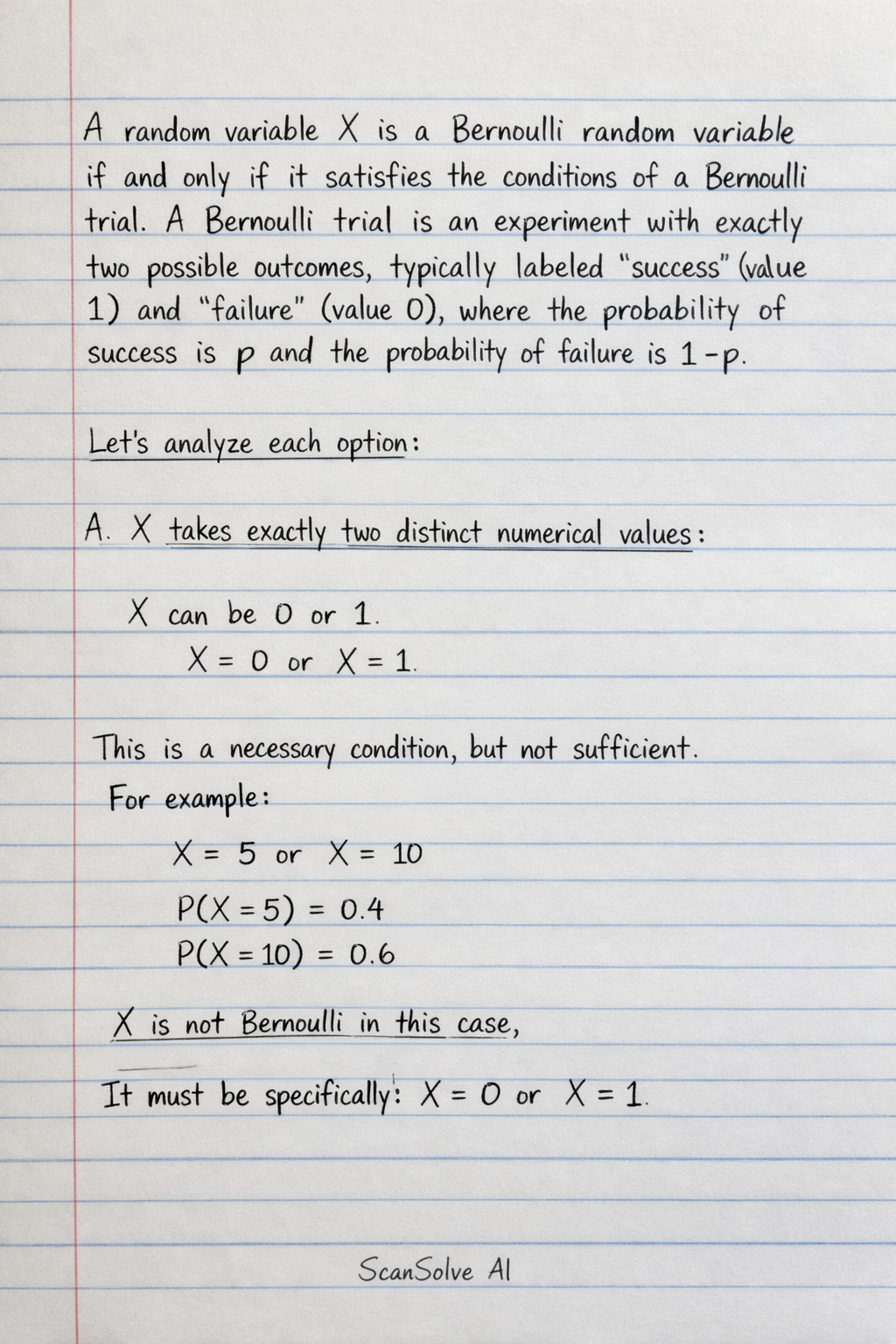
A random variable X is a Bernoulli random variable if and only if it satisfies the conditions of a Bernoulli trial. A Bernoulli trial is an experiment with exactly two possible outcomes, typically labeled "success" (value 1) and "failure" (value 0), where the probability of success is p and the probability of failure is 1-p. Let's analyze each option: A. X takes exactly two distinct numerical values: This is a necessary condition, but not sufficient. For example, a random variable could take values 5 and 10 with certain probabilities, but it wouldn't be a Bernoulli variable unless those values were specifically 0 and 1. B. X \0, 1\ almost surely: This means that the random variable X can only take on the values 0 or 1. If X can only take values 0 and 1, then we can define P(X=1) = p. Since X must take one of these values, P(X=0) = 1 - P(X=1) = 1-p. This precisely matches the definition of a Bernoulli random variable. The term "almost surely" is a technical term in probability theory that means the probability of X taking a value outside \0,1\ is zero. C. P(X=1) = p for some p (0,1): This specifies the probability of one outcome, but it doesn't restrict the other possible outcomes of X. For example, a random variable could have P(X=1) = 0.5, but also P(X=2) = 0.3 and P(X=3) = 0.2. This variable is not Bernoulli. Therefore, this condition alone is not sufficient. D. X has variance p(1-p): This is a property of a Bernoulli random variable, not its defining characteristic. While a Bernoulli random variable does* have this variance, other types of random variables might also have this variance (or could be constructed to have it) without being Bernoulli. Option B is the most accurate and complete definition among the choices because it specifies the exact set of values the random variable can take, which is fundamental to the definition of a Bernoulli random variable. The final answer is B