
We read your photo as:
Explain three strategies educators can implement to support technology in the classroom. How can blended learning improve student engagement in STEM? Describe the application of Vygotsky's scaffolding in programming.
ScanSolve AI Answer
Step-by-step solution
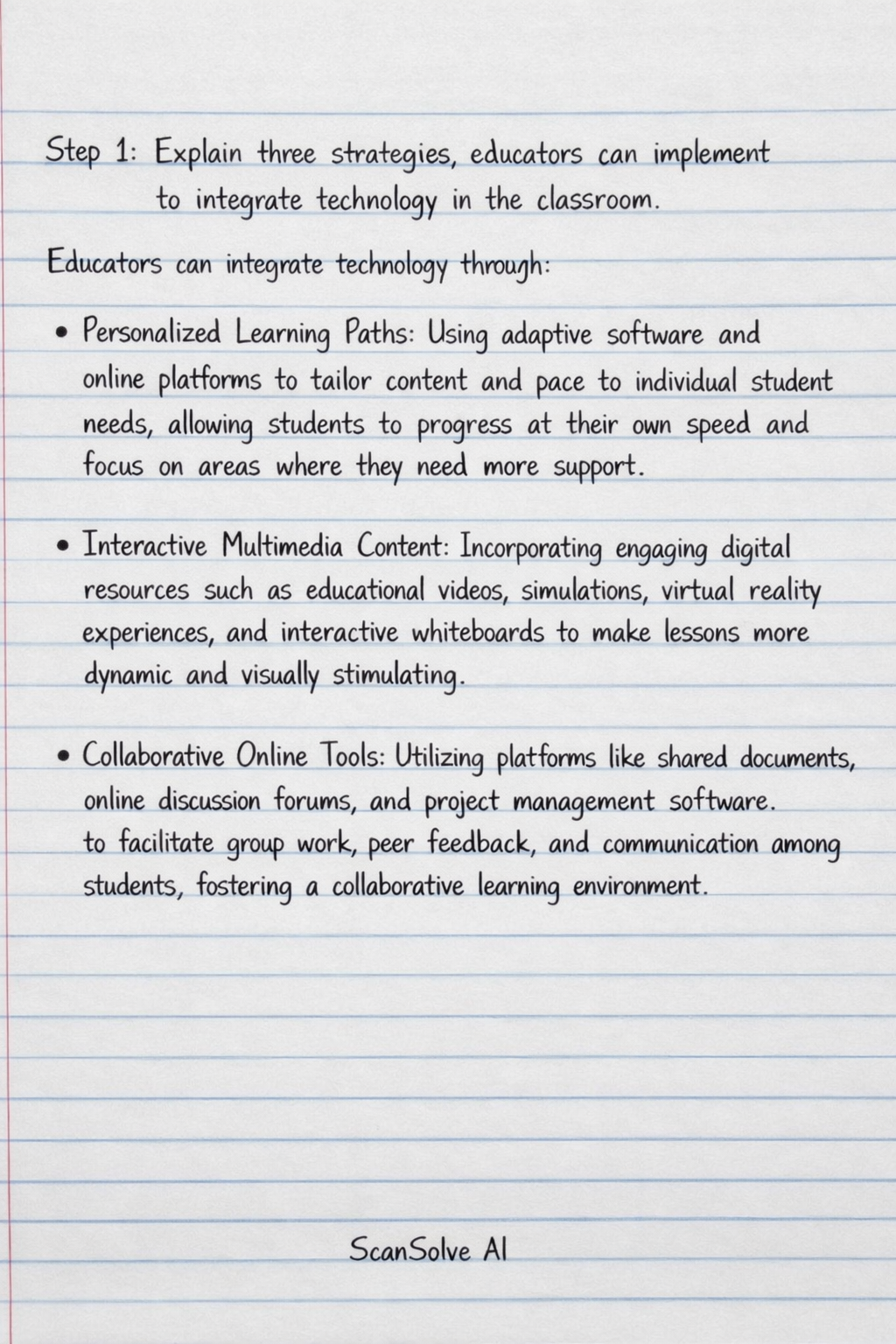
3 stepsExplain three strategies educators can implement to integrate technology in the classroom.
Educators can integrate technology through:
- Personalized Learning Paths: Using adaptive software and online platforms to tailor content and pace to individual student needs, allowing students to progress at their own speed and focus on areas where they need more support.
- Interactive Multimedia Content: Incorporating engaging digital resources such as educational videos, simulations, virtual reality experiences, and interactive whiteboards to make lessons more dynamic and visually stimulating.
- Collaborative Online Tools: Utilizing platforms like shared documents, online discussion forums, and project management software to facilitate group work, peer feedback, and communication among students, fostering a collaborative learning environment.
How can blended learning improve student engagement in STEM?
Blended learning improves student engagement in STEM by offering a flexible and dynamic learning experience. It allows students to access online resources and lectures at their own pace, freeing up classroom time for hands-on experiments, problem-solving activities, and collaborative projects. This approach caters to diverse learning styles, provides immediate feedback through digital tools, and makes complex STEM concepts more accessible and relevant through interactive simulations and real-world data analysis, thus increasing student ownership and motivation.
Describe the application of Vygotsky's scaffolding in programming.
Vygotsky's scaffolding in programming involves a more knowledgeable individual (teacher or peer) providing temporary support to a learner to help them master a programming task within their Zone of Proximal Development (ZPD). This can be applied by:
- Gradual Release of Responsibility: Starting with fully functional code examples, then providing partially completed code for students to finish, and eventually guiding them to write code independently.
- Pair Programming: An experienced programmer works alongside a novice, explaining concepts, suggesting solutions, and helping debug code, gradually reducing direct intervention as the learner gains confidence.
- Structured Problem-Solving: Offering templates, pseudocode, or step-by-step algorithms for complex problems, which are then slowly withdrawn as the student internalizes the problem-solving process.
Still stuck on this one?
Ask a follow-up, and the answer starts from this question.
More Computer Science Questions
Handwritten Step-by-Step Solution
Get this as a handwritten image on WhatsApp — like a tutor wrote it for you.
Try on WhatsApp