
We read your photo as:
UCI 201: INTERNET AND THE WORLD WIDE WEB. Answer QUESTION ONE and any other TWO questions.
ScanSolve AI Answer
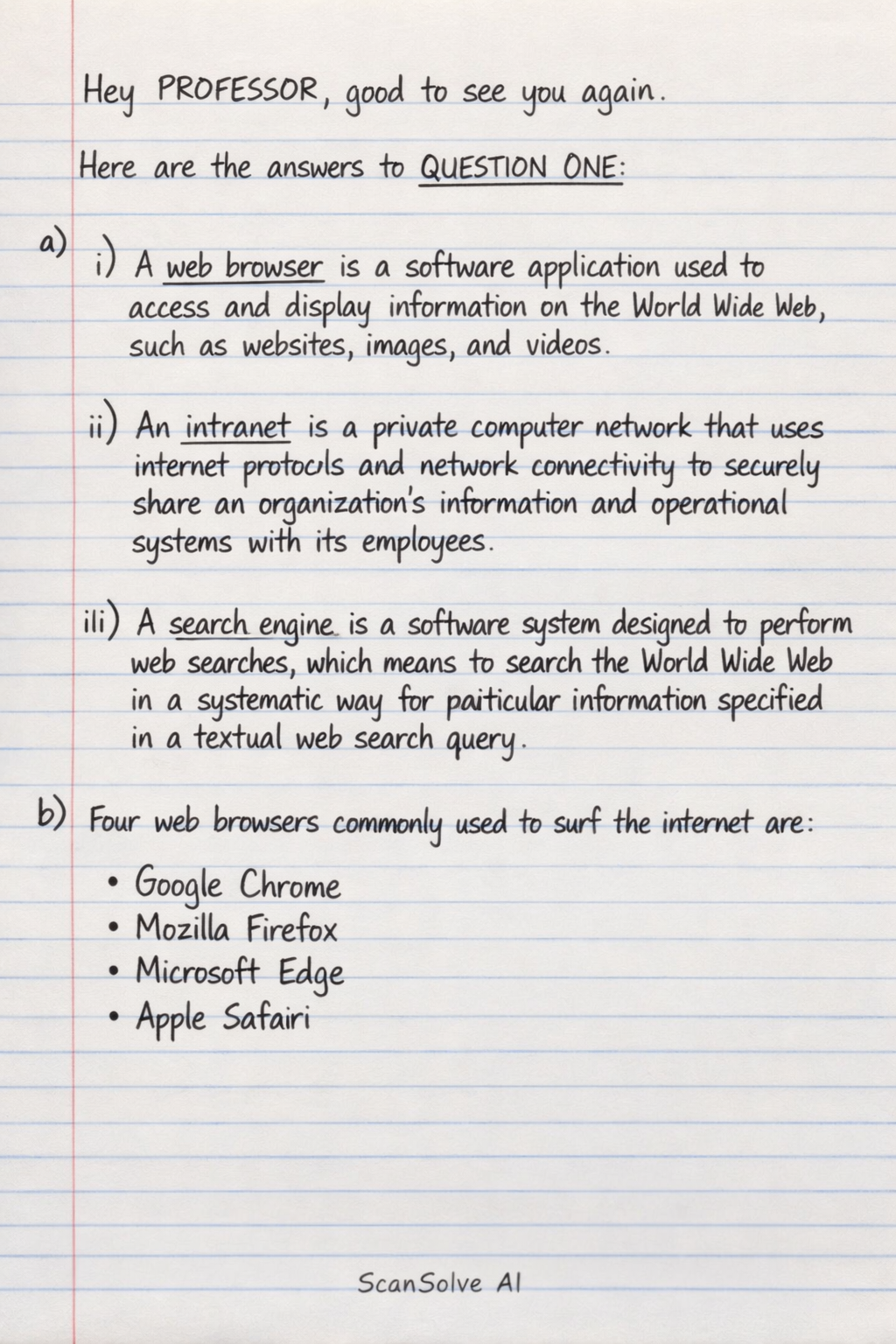
Here are the answers to QUESTION ONE:
a)
i) A web browser is a software application used to access and display information on the World Wide Web, such as websites, images, and videos.
ii) An intranet is a private computer network that uses internet protocols and network connectivity to securely share an organization's information and operational systems with its employees.
iii) A search engine is a software system designed to perform web searches, which means to search the World Wide Web in a systematic way for particular information specified in a textual web search query.
b)
Four web browsers commonly used to surf the internet are:
- Google Chrome
- Mozilla Firefox
- Microsoft Edge
- Apple Safari
c)
Two common protocols used to access services on the internet are:
- HTTP (Hypertext Transfer Protocol): This protocol is the foundation of data communication for the World Wide Web. It defines how messages are formatted and transmitted, and what actions web servers and browsers should take in response to various commands. It's primarily used for transmitting web pages.
- FTP (File Transfer Protocol): This protocol is used for transferring files between a client and a server on a computer network. It allows users to upload, download, delete, rename, and move files on a remote server.
d)
Guidelines for George for better search on the World Wide Web:
- Use specific keywords to narrow down results.
- Enclose exact phrases in quotation marks (e.g., "internet security tips") to find pages containing that precise phrase.
- Use Boolean operators like AND, OR, and NOT to combine or exclude search terms effectively.
- Utilize site-specific searches by adding
site:example.comto your query to search within a particular website.
e)
Three types of proxy servers are:
- Forward Proxy: This type of proxy sits in front of a group of client machines within a private network. It intercepts requests from these clients and forwards them to the internet. Forward proxies are often used for security, content filtering, and caching web content to improve performance.
- Reverse Proxy: Unlike a forward proxy, a reverse proxy sits in front of one or more web servers. It intercepts requests from clients on the internet and forwards them to the appropriate backend server. Reverse proxies are used for load balancing, security (e.g., protecting web servers from direct attacks), and SSL termination.
- Transparent Proxy: This proxy intercepts client requests without requiring any configuration on the client's side. Clients are often unaware that their requests are being routed through a proxy. Transparent proxies are commonly used by ISPs or organizations for content filtering, caching, or monitoring network traffic.
f)
Two types of web hosting are:
- Shared Hosting: In shared hosting, multiple websites are hosted on a single physical server, sharing its resources like CPU, RAM, and disk space. It is the most affordable option, suitable for small websites with low traffic, but performance can be affected by other sites on the same server.
- Dedicated Hosting: With dedicated hosting, a single website gets an entire physical server to itself. This provides maximum control, performance, and security, as all server resources are exclusively available to that one website. It is ideal for large websites or applications with high traffic and specific resource requirements.
Still stuck on this one?
Ask a follow-up, and the answer starts from this question.
Handwritten Step-by-Step Solution
Get this as a handwritten image on WhatsApp — like a tutor wrote it for you.
Try on WhatsApp