
We read your photo as:
Variable Oxidation States:
Computer Science
ScanSolve AI Answer
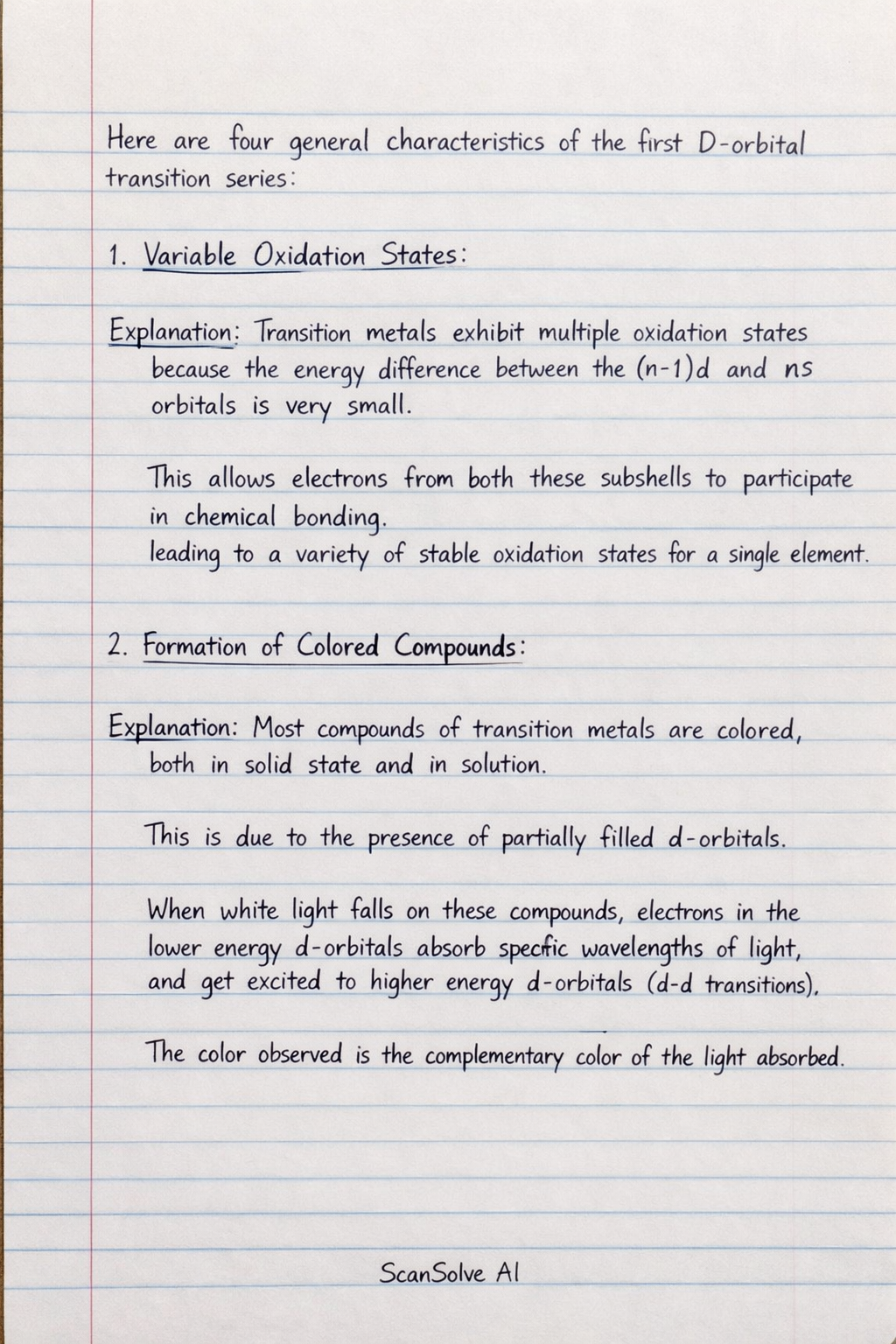
Here are four general characteristics of the first D-orbital transition series:
-
Variable Oxidation States:
- Explanation: Transition metals exhibit multiple oxidation states because the energy difference between the and orbitals is very small. This allows electrons from both these subshells to participate in chemical bonding, leading to a variety of stable oxidation states for a single element.
-
Formation of Colored Compounds:
- Explanation: Most compounds of transition metals are colored, both in solid state and in solution. This is due to the presence of partially filled -orbitals. When white light falls on these compounds, electrons in the lower energy -orbitals absorb specific wavelengths of light and get excited to higher energy -orbitals (d-d transitions). The color observed is the complementary color of the light absorbed.
-
Paramagnetism:
- Explanation: Many transition metal ions and their compounds are paramagnetic, meaning they are weakly attracted to a magnetic field. This property arises from the presence of unpaired electrons in their -orbitals. Each unpaired electron has a magnetic moment, and these moments align in an external magnetic field.
-
Catalytic Properties:
- Explanation: Transition metals and their compounds often act as excellent catalysts in various chemical reactions. This is attributed to their ability to exhibit multiple oxidation states and to form intermediate compounds with reactants. They also provide a suitable surface for adsorption of reactants, facilitating the reaction by lowering the activation energy.
Was this helpful?
Still stuck on this one?
Ask a follow-up, and the answer starts from this question.
Got a different question?Ask your own question
More Computer Science Questions
Handwritten Step-by-Step Solution
Get this as a handwritten image on WhatsApp — like a tutor wrote it for you.
Try on WhatsApp