
We read your photo as:
At this price determine and interpret the price elasticity of demand.
ScanSolve AI Answer
Answer
Step-by-step solution
4 stepsIdentify the initial and final price and quantity demanded.
The initial price is .
The final price is .
The initial quantity demanded is .
The final quantity demanded is .Calculate the change in quantity demanded () and the change in price ().
Apply the point price elasticity of demand formula.
The formula for point price elasticity of demand (PED) is:
Substitute the values:
The absolute value of the price elasticity of demand is .
Interpret the price elasticity of demand.
Since the absolute value of the price elasticity of demand is 0.67, which is less than 1 (), the demand is inelastic. This means that the percentage change in quantity demanded is less than the percentage change in price. For example, a 1% increase in price leads to a 0.67% decrease in quantity demanded.
The price elasticity of demand is .
The demand is inelastic.
Try one yourself
A new problem that tests the same skill.
Still stuck on this one?
Ask a follow-up, and the answer starts from this question.
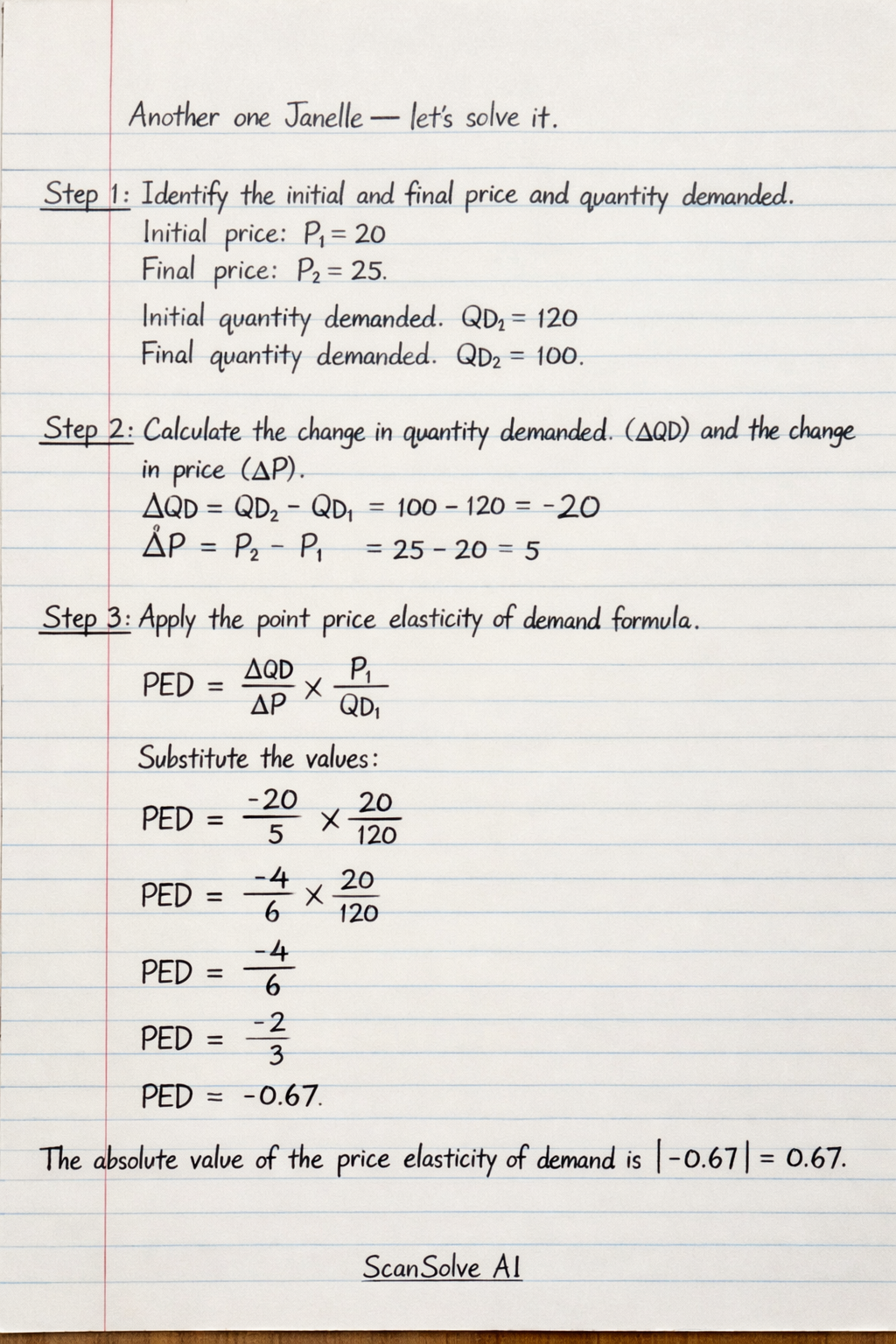
Handwritten Step-by-Step Solution
Get this as a handwritten image on WhatsApp — like a tutor wrote it for you.
Try on WhatsApp